


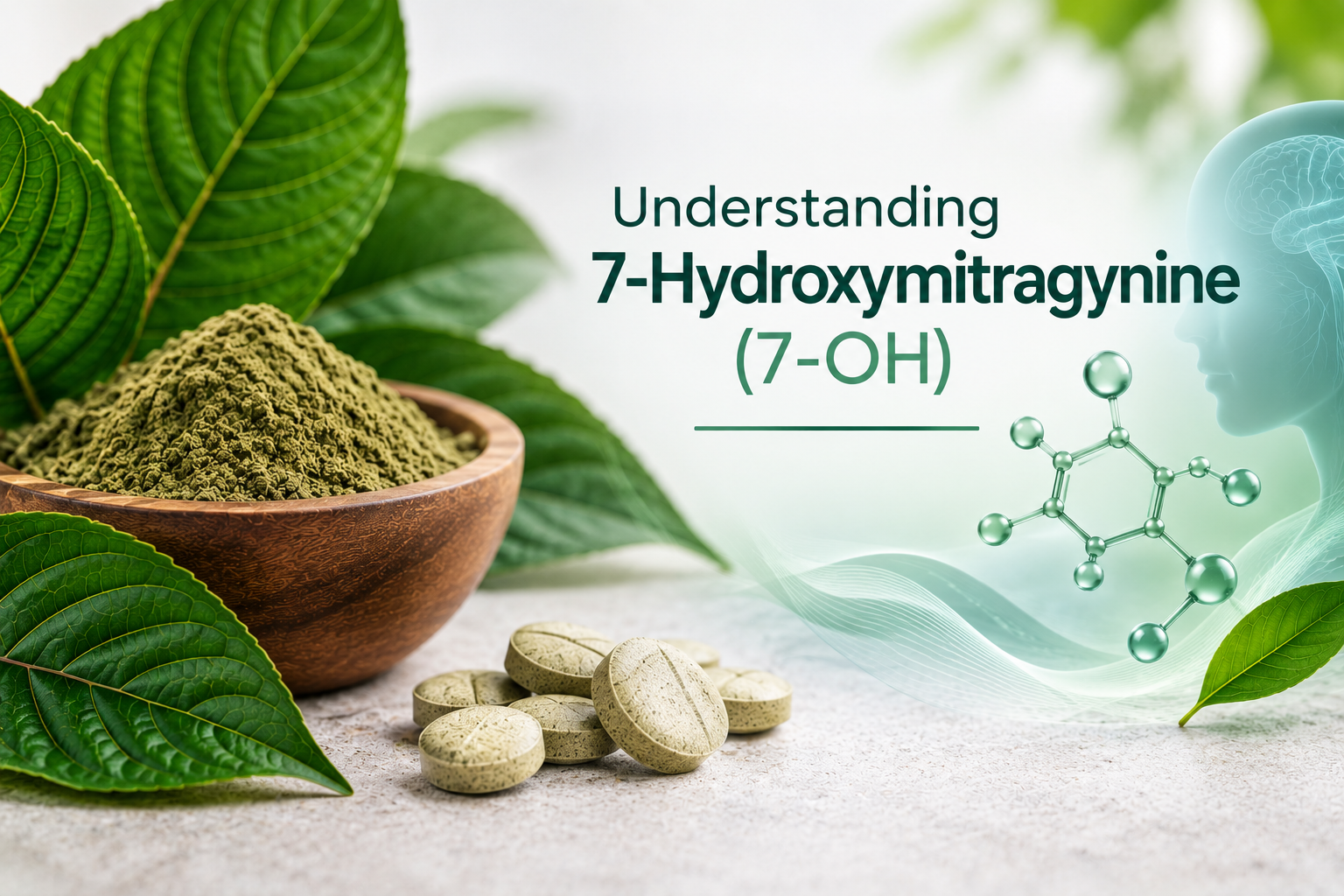
Why 7-hydroxymitragynine attracts attention in conversations about kratom
7-hydroxymitragynine (often shortened to 7-OH) is one of the most discussed constituents connected with the kratom plant. The attention is not simply because it exists, but because it is frequently described as being comparatively potent at certain receptors in the body that are associated with pain signalling, sedation, and dependence. That combination of perceived potency, mixed public messaging, and uneven product quality in the wider marketplace means that readers often encounter 7-OH in a confusing, sometimes alarmist context.
This guide is designed to give you a clear starting point: what 7-hydroxymitragynine is, how it relates to other kratom alkaloids, why it is controversial, and which basic terms you need in order to read further information with a sharper critical eye. It is information for understanding, not a recommendation to use any substance. If you have health conditions, take medicines, or are considering any supplement, discussing it with a qualified clinician is the safest route.
Starting with the plant: what people mean when they say “kratom”
Kratom is the common name used for a tropical tree from South East Asia whose leaves contain a complex mixture of naturally occurring chemicals. In everyday discussion, “kratom” can refer to the plant, the dried leaf material, or a wide range of commercial products derived from the leaf. This matters because the term can hide major differences in composition, and 7-hydroxymitragynine is one of the clearest examples of why composition matters.
When someone talks about kratom’s effects, they are rarely talking about a single compound. They are talking about a blend of chemicals that can interact with the body in overlapping and sometimes opposing ways. A useful way to think about kratom is not as one “active ingredient”, but as a chemical mixture whose balance can change depending on growing conditions, processing, storage, and product type.
kratom active compounds: what that phrase really means in practice
The phrase “kratom active compounds” is used as shorthand for the plant’s alkaloids and other constituents that may contribute to biological effects. In common online writing, the term often implies a neat list of “main actives”, but the reality is messier. Natural products usually contain dozens of relevant chemicals, some present in higher amounts, others in trace quantities that may still matter.
In kratom, the best-known alkaloid is mitragynine, which is commonly reported as the most abundant alkaloid in many leaf samples. Another frequently mentioned compound is 7-hydroxymitragynine, which is often present at much lower levels in unprocessed leaf material but can be disproportionately important because of how strongly it may interact with certain receptors.
It is also worth noting that “active” is context-dependent. A compound can be biologically active in a laboratory setting, yet have limited real-world impact if it is poorly absorbed, rapidly broken down, or present at extremely low levels. Conversely, a low-abundance compound can become important if it is very potent, if the body converts other compounds into it, or if manufacturing processes concentrate it. 7-OH sits at the centre of that conversation.
kratom alkaloid profile: the idea that explains why products can feel different
“kratom alkaloid profile” refers to the pattern of alkaloids present in a particular leaf batch or product, including which alkaloids are present and in what relative proportions. If you are trying to understand 7-hydroxymitragynine, this concept is essential because it helps explain why two products that are both labelled “kratom” can produce noticeably different experiences and risks.
Several factors can influence an alkaloid profile:
Plant variability: Different trees, regions, soils, and harvesting times can shift the mix of alkaloids.
Processing and storage: Drying methods, heat exposure, humidity, and time can change chemical composition. Oxidation reactions can occur in plant materials, and these reactions can alter alkaloids.
Product type: Plain leaf powder, “enhanced” products, and extracts can have very different chemical patterns, including higher levels of certain alkaloids.
When 7-OH becomes a headline issue, it is often because of concerns that some products may contain higher-than-expected amounts compared with typical leaf material. That does not automatically mean a product is unsafe, but it does raise the stakes for transparency, testing, and informed decision-making.
7-hydroxymitragynine guide: a straightforward definition
This 7-hydroxymitragynine guide starts with the simplest description: 7-hydroxymitragynine is an alkaloid associated with the kratom plant. It is structurally related to mitragynine, and in many discussions it is treated as a more potent contributor to certain opioid-like effects than mitragynine itself.
Two points are crucial for keeping your understanding grounded:
First, 7-OH is typically discussed in terms of receptor activity rather than as a standalone “drug” in the way a prescribed medicine is defined. It is one piece of a larger mixture, and mixtures behave differently from isolated compounds.
Second, the amount of 7-OH in a product can vary. That variability is one reason it attracts attention from researchers, regulators, healthcare professionals, and consumers.
Key terms you will keep seeing (and what they mean in plain English)
Reading about 7-hydroxymitragynine becomes far easier once a few technical words are demystified. The following terms are commonly used in scientific and medical commentary.
Alkaloid: A naturally occurring chemical, often containing nitrogen, that can have significant effects on the body. Many well-known plant compounds are alkaloids.
Receptor: A protein in the body that receives chemical signals. Compounds can bind to receptors and change how cells behave.
Opioid receptor: A family of receptors involved in pain modulation, reward, sedation, and breathing regulation. Discussion around kratom and 7-OH often centres on these receptors.
Binding affinity: A measure of how strongly a compound attaches to a receptor. Strong attachment does not always mean stronger effects, but it often matters.
Efficacy: How much effect a compound produces after it binds. Two compounds can bind equally well but produce different levels of response.
Partial agonist: A compound that activates a receptor but not to the full extent that a “full agonist” would. This concept often appears in conversations about why different opioid-related compounds can have different risk profiles.
Metabolism: How the body transforms substances, usually in the liver. A compound can be changed into other compounds that are more or less active.
Keeping these terms in mind will help you distinguish between careful explanations and content that relies on vague claims.
Basic chemistry without the headache: how 7-OH relates to mitragynine
At a high level, 7-hydroxymitragynine is closely related to mitragynine. You do not need advanced chemistry to grasp the practical implication: small changes in a molecule’s structure can cause meaningful changes in how it interacts with receptors. In pharmacology, that can mean differences in potency, duration, and side effect profile.
7-OH is often described as an oxidised form related to mitragynine. The important takeaway is not the exact chemical steps, but the broader principle that plant alkaloids can transform during processing, storage, and metabolism. This is one reason why people emphasise laboratory testing and why researchers are interested in how much 7-OH is present in different contexts.
Where does 7-hydroxymitragynine come from: leaf content, processing, and metabolism
When people ask where 7-OH “comes from”, they may be referring to several different pathways, and these get blurred together in casual writing.
Natural presence in the leaf: 7-OH can be present in kratom leaf material, often discussed as a minor constituent compared with mitragynine in many samples. “Minor”, however, does not mean irrelevant, particularly when receptor potency is part of the conversation.
Changes during processing and storage: Plant materials are not chemically frozen in time. Exposure to air, heat, light, and moisture can shift composition. In broad terms, oxidation can change the balance among related compounds. This is one reason storage conditions and quality control can matter for consistency.
Formation in the body: Some discussions focus on whether the body converts other kratom alkaloids into 7-OH after consumption. Metabolism can produce active compounds that were not prominent in the original material, which can complicate simple “label amount equals effect” assumptions.
The most responsible conclusion for a general reader is that 7-OH can be linked to kratom through more than one route, and the practical importance of each route can vary depending on product type and individual biology.
Why potency is a headline: receptor activity and why it matters
7-hydroxymitragynine is often described as interacting strongly with certain opioid receptors. This is the scientific backdrop behind many of the claims you see online about strength, risk, and “how it feels”. When a compound has higher potency at receptors related to analgesia and sedation, it can attract both interest (from people seeking relief) and concern (from people worried about harm).
However, potency at a receptor is not the whole story. Real-world effects depend on how much of the compound is present, how well it is absorbed, how quickly it is broken down, what other compounds are present alongside it, and the person’s tolerance and health status. This is why scientific writing tends to be careful with language, while marketing copy can be overly confident.
Why 7-OH is discussed in safety conversations: dependence, side effects, and uncertainty
Because 7-OH is frequently described in relation to opioid receptors, it is naturally pulled into discussions about dependence, withdrawal, sedation, nausea, constipation, and other effects commonly associated with opioid signalling. It is also pulled into broader concerns about respiratory depression, although the real-world risk profile for kratom-related products is complex and influenced by multiple factors, including co-use with other substances.
A clear-eyed way to approach the topic is to separate what is plausible from what is proven, and what is population-level concern from individual experience. Researchers may investigate questions such as:
How do different kratom alkaloids interact at multiple receptor types?
Do certain product types carry higher risk because of higher concentrations of particular alkaloids?
How does repeated exposure affect tolerance and dependence?
How do other medicines, alcohol, or underlying health conditions change risk?
If you see content that claims certainty while ignoring these variables, treat it as a red flag.
Understanding “extracts” and “enhanced” products without getting lost
Many of the most intense debates around 7-hydroxymitragynine are not about plain leaf material, but about concentrated products. Concentration changes the basic risk equation: when you compress a large amount of plant material into a smaller dose form, you can amplify both desired and undesired effects, and you can also amplify variability if the process is inconsistent.
Some products are marketed as “enhanced”, which can be understood in general terms as having a modified alkaloid balance compared with typical leaf powder. Without reliable testing and transparent lab reports, it can be difficult for a consumer to know whether “enhanced” means mildly adjusted or dramatically altered. This is precisely where 7-OH becomes an important talking point, because it is one of the alkaloids people focus on when comparing intensity and risk.
Lab testing and transparency: what matters for an informed starting view
If you want a practical way to think about safety and consistency, focus less on bold claims and more on measurement and transparency. Third-party laboratory testing is often raised as a quality marker, but not all lab reports are equally useful. In a general sense, better reports clearly identify what was tested, how it was tested, and what the results were for key alkaloids.
For an informed starting view, the main point is simple: if a product’s effects depend heavily on its alkaloid profile, and 7-OH is a compound of interest, then having credible information about alkaloid content is more meaningful than relying on strain names, colour labels, or anecdotal descriptions. Names and marketing categories are not, by themselves, chemistry.
Common misconceptions about 7-hydroxymitragynine
Several misconceptions repeatedly appear in online discussions. Clearing them up can help you interpret what you read.
Misconception 1: “More 7-OH automatically means better.” Higher potency at certain receptors can also mean higher likelihood of side effects, unwanted sedation, or dependence-related issues. “Better” depends on goals, context, and safety considerations.
Misconception 2: “If it is natural, it is automatically safe.” Many natural compounds are potent and can cause harm, especially when concentrated or combined with other substances. Natural origin is not a safety guarantee.
Misconception 3: “All kratom products have the same 7-OH content.” Variability is one of the central issues. Product type, processing, storage, and sourcing can all influence composition.
Misconception 4: “One receptor explains everything.” Kratom alkaloids may interact with multiple receptor systems. Reducing the entire discussion to a single receptor interaction can oversimplify both benefits and risks.
How to read claims about 7-OH potency responsibly
You will often see statements that 7-hydroxymitragynine is “many times stronger” than mitragynine. Sometimes these statements are based on laboratory receptor binding or signalling assays. Those studies can be useful, but the leap from a laboratory finding to a real-world claim can be large.
When you evaluate potency claims, look for whether the source distinguishes between:
Potency at a receptor in a laboratory system versus effects in humans.
Isolated 7-OH versus 7-OH as part of a mixture of alkaloids.
Amount present in typical leaf material versus amount in concentrated products.
Short-term effects versus long-term patterns such as tolerance and dependence.
This is not about dismissing research. It is about placing research in the right box: laboratory potency is a piece of the puzzle, not the whole picture.
Interactions and contraindications: why “informed” includes what not to mix
Even at a starting level, it is important to recognise that substances affecting the nervous system can interact with each other. Discussions around kratom and 7-OH commonly raise concerns about combining them with other sedating substances. This includes alcohol, sleep medicines, and medicines that depress breathing or cause drowsiness. Certain antidepressants and other prescription medicines can also introduce interaction risks, depending on how they are processed by the body.
Because individual circumstances vary so widely, the safest general guidance is behavioural rather than chemical: avoid mixing substances that can compound sedation or impair judgement, and speak with a qualified clinician if you take regular medicines or have conditions involving breathing, liver function, or substance use history. If someone is pregnant or breast-feeding, extra caution is warranted, and professional medical advice should be the minimum standard.
Legal and regulatory attention: why 7-OH comes up in policy discussions
Regulators and policymakers are often concerned with consumer safety, product consistency, and harm trends. 7-hydroxymitragynine appears in these discussions because it is associated with opioid receptor activity and because it can be present at varying levels across different product categories. When authorities assess risk, they may focus on compounds that could plausibly drive dependence, adverse events, or product adulteration concerns.
Legal status can vary by location and can change over time. From an informed-consumer standpoint, the key point is to verify local rules and to be sceptical of blanket statements that a product is “legal everywhere” or “banned everywhere”. Neither is typically reliable.
Putting it all together: the headline points to remember about 7-OH
If you remember only a few things from a first read, make them these:
7-hydroxymitragynine is an alkaloid associated with kratom that is widely discussed because of its strong activity at certain receptors related to pain and sedation.
It is often present at lower levels than mitragynine in many leaf samples, but potency and variability make it important.
Processing, storage, product type, and metabolism can all influence how relevant 7-OH is in practice.
“Kratom” is not a single ingredient; it is a mixture, and the kratom alkaloid profile is the concept that helps explain differing experiences and risks.
Reliable lab testing and transparent reporting matter more than marketing labels when trying to understand what a product contains.
A practical, cautious next step for readers who want to learn more
If you want to deepen your understanding beyond this straightforward overview, focus on sources that clearly separate evidence types: laboratory studies, animal studies, clinical observations, and well-designed human research. Give more weight to writing that explains uncertainty, limitations, and variability rather than pretending the topic is simple.
Finally, keep the wider context in view. Interest in 7-hydroxymitragynine often reflects real needs—people looking for help with discomfort, mood, or function—but the safest route to meeting those needs is not guesswork. If you are dealing with persistent pain, anxiety, sleep problems, or dependence concerns, a qualified healthcare professional can help you weigh options that have known dosing, monitoring, and safety standards.

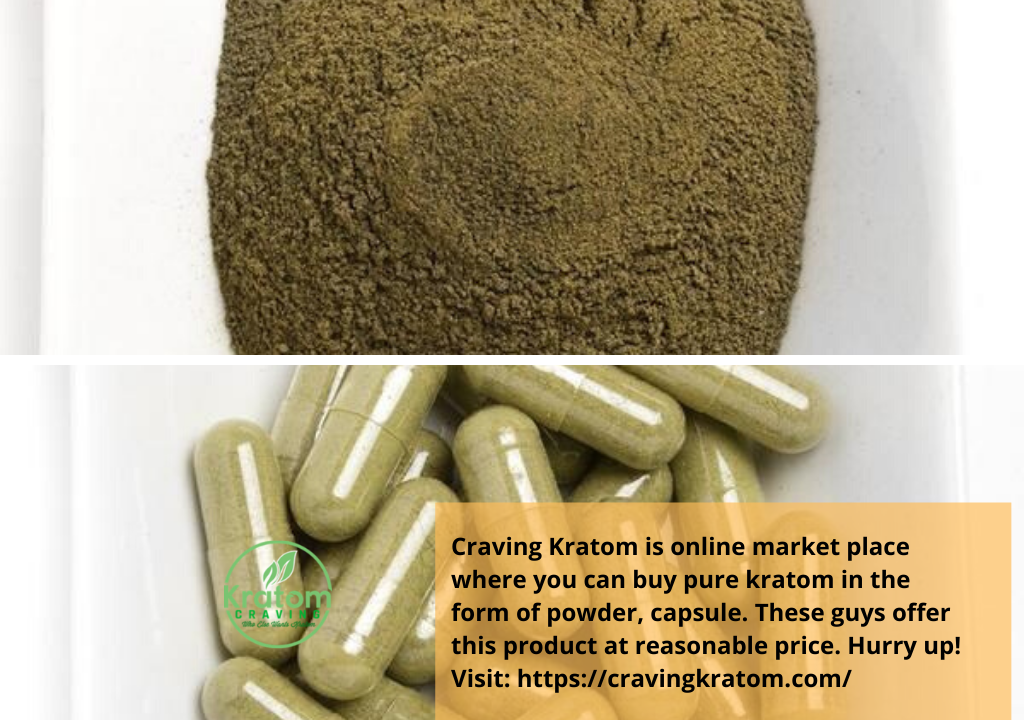
Craving Kratom is in one of the most reputable brands believes in providing best kratom in the form of capsule, powder or extract.
All of our kratom imported from south-east Asia then go for lab test process.
We will bring 100% pure and high-quality organic product to your door.