

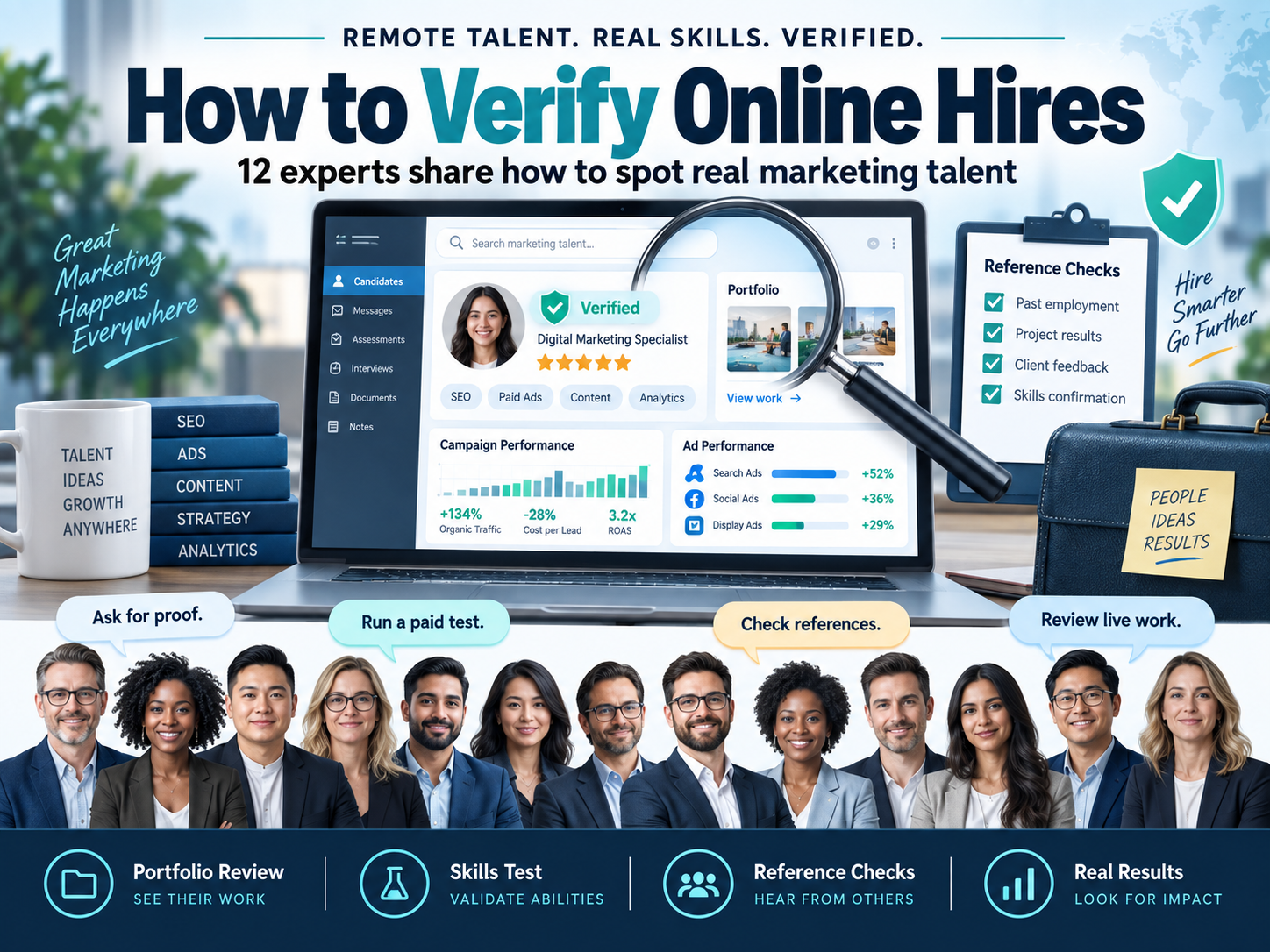
Hiring someone for SEO, paid ads, content, social media, or another remote marketing role comes with an unusual problem: a polished résumé and confident interview can hide weak practical skills. Portfolios may lack context, impressive numbers may belong to an entire team rather than one person, and knowing marketing terminology is very different from producing profitable work.
So, how do business owners separate genuine specialists from candidates who simply interview well? We asked 12 business leaders and marketing professionals how they would verify skills before trusting someone with an important online role.
1. Yad Senapathy — Founder & CEO, Project Management Training Institute
Yad Senapathy is the founder and CEO of PMTI and has more than 20 years of experience in project-management education. PMTI states that he has helped develop certification programs and contributed to editions of the PMBOK Guide.
“I would give the candidate a small project with a clear objective, deadline, and expected result. People can prepare for interviews, but it is much harder to prepare a false version of how you actually work. I want to see how they interpret the assignment, what questions they ask, how they organize the work, and what happens when something isn't perfectly defined. For an online role, those behaviors tell me far more than another certification listed on a résumé.”
2. Welly Mulia — Founder, CartMango
Welly Mulia founded CartMango, a checkout platform for digital-product sellers, and also operates BirdSend, an email-marketing product. His public profile says CartMango has previously processed more than $179 million.
“I'd skip the clever interview questions and ask them to show me something they actually built. If they're an email marketer, open a campaign. If they're an ad buyer, walk me through an account. If they're an SEO person, show me a page they worked on and explain what they changed. Then I keep asking ‘why?’ Someone who really did the work remembers the messy details. Someone repeating somebody else's case study usually gets vague pretty fast.”
3. Emma Alves — Family Lawyer, Alves Law
Emma Alves practices primarily in family law at Alves Law in Ontario and has also trained as a mediator.
“I look for evidence that can be independently checked. If someone tells me they increased traffic by 150%, I want to understand the starting point, the period measured, their exact responsibility, and what happened afterward. Marketing claims need context just like claims in other professional settings. A candidate who is comfortable explaining both the positive results and the limitations of their work usually gives me more confidence than someone presenting a flawless success story.”
4. Mike Kruse — Criminal Defence and DUI Lawyer, Kruse Law
Mike Kruse is the owner of Kruse Law Firm in Ontario and a former Crown prosecutor with decades of criminal trial experience.
“My instinct is to test the evidence rather than the presentation. References matter, but I would ask very specific questions of those references: What did this person personally handle? How did they respond when a campaign performed badly? Were deadlines met? Would you put them in charge of the same budget again? That last question is useful because it forces a former client or employer to move beyond general praise and give you something closer to a real judgment.”
5. Andy Layton — Founder & Managing Director, Hello Plumbing
Andy Layton directs Hello Plumbing, a Sydney-based plumbing company. His company profile says he started on the tools before moving into leadership and has years of direct trade experience.
“For me, I'd give them a real problem from the business. Something simple like, ‘We're a plumbing company trying to get more booked jobs in this suburb. Tell me what you'd do over the next 30 days.’ I don't need a 40-page presentation. I want to hear what they'd do Monday morning. Good people usually start asking about our current leads, conversion rates, service areas, reviews, margins, and tracking. Someone who immediately promises a huge number of leads makes me nervous.”
6. Dr Maria Knobel — Medical Director, MedicalCert UK
Dr Maria Knobel is a GMC-registered GP and Medical Director of MedicalCert, where she oversees the platform's clinical standards framework.
“I would check how the person handles accuracy before judging creativity. In a healthcare-related business, a marketer may be working with statements that affect trust, privacy, or regulated information. I would give a candidate a piece of content containing a few questionable claims and ask them to review it. I'm interested in what they challenge, what they verify, and what they refuse to publish without further evidence. Technical skill matters, but judgment matters too.”
7. Maddy Osman — Founder & SEO Content Strategist, The Blogsmith
Maddy Osman founded The Blogsmith, an agency focused on SEO content for B2B technology and SaaS companies.
“For a content or SEO hire, I like a paid test that mirrors the actual job. Don't ask someone to produce an enormous free strategy. Give them a contained assignment and pay them for their time. Then look beyond the final deliverable. Did they follow the brief? Did they verify sources? Did they understand search intent? Did their edits improve readability rather than simply stuffing in keywords? Strong candidates tend to reveal their process in the small details.”
8. Aleyda Solis — Founder, Orainti
Aleyda Solis founded boutique consultancy Orainti and works in international SEO, ecommerce, SaaS, and AI-search optimization.
“Ask the candidate to diagnose a real website rather than recite SEO definitions. Give them limited information and see what they request before making recommendations. A capable SEO should want access to data, understand the business model, separate symptoms from causes, and prioritize opportunities according to impact and effort. I'd be cautious with anyone who produces a long checklist immediately without first understanding what the company is actually trying to achieve.”
9. Kevin Indig — Organic Growth Advisor
Kevin Indig advises companies on organic growth and previously led SEO and growth work at Shopify, G2, and Atlassian.
“Ask them to deconstruct one result they are proud of. Not the slide-deck version—the actual mechanics. What hypothesis did they start with? What data changed their mind? What did they try that failed? What would they do differently today? Experienced operators usually have scar tissue. Their stories contain wrong turns, trade-offs, and uncertainty. If every project sounds like a smooth line from strategy to hockey-stick growth, I'd keep digging.”
10. Gaetano DiNardi — B2B Growth Advisor
Gaetano DiNardi works as a growth and SEO advisor to B2B software companies and previously held senior demand-generation roles.
“One question I like is: ‘Show me a campaign you personally influenced and tell me exactly which number moved because of your work.’ That's where inflated résumés start falling apart. People throw around pipeline, traffic, MQLs, CAC, rankings, a