


Every CTO has, at some point in the last year, sat through a vendor pitch promising that AI agents will compress a six-month development cycle into six weeks. Some of that pitch is grounded in something real. A lot of it isn't. If you're setting technology strategy based on the confident version of this story rather than the accurate one, you're going to make expensive decisions on a bad map.
Here's a more useful way to think about where AI in the software development lifecycle (SDLC) actually stands right now, and what to realistically expect from it.
The real gain: mechanical work is genuinely faster
Let's start with what's true, because plenty is. AI coding tools have moved well past simple autocomplete — modern tools can take a structured feature brief and generate a fairly complete implementation, including initial test coverage, in a fraction of the time a developer would take from scratch. Boilerplate, first-pass documentation, and repetitive refactoring work that used to eat real developer hours now largely don't. That's a legitimate productivity gain, and it shows up in delivery timelines.
The part the hype skips: the bottleneck moved, it didn't disappear
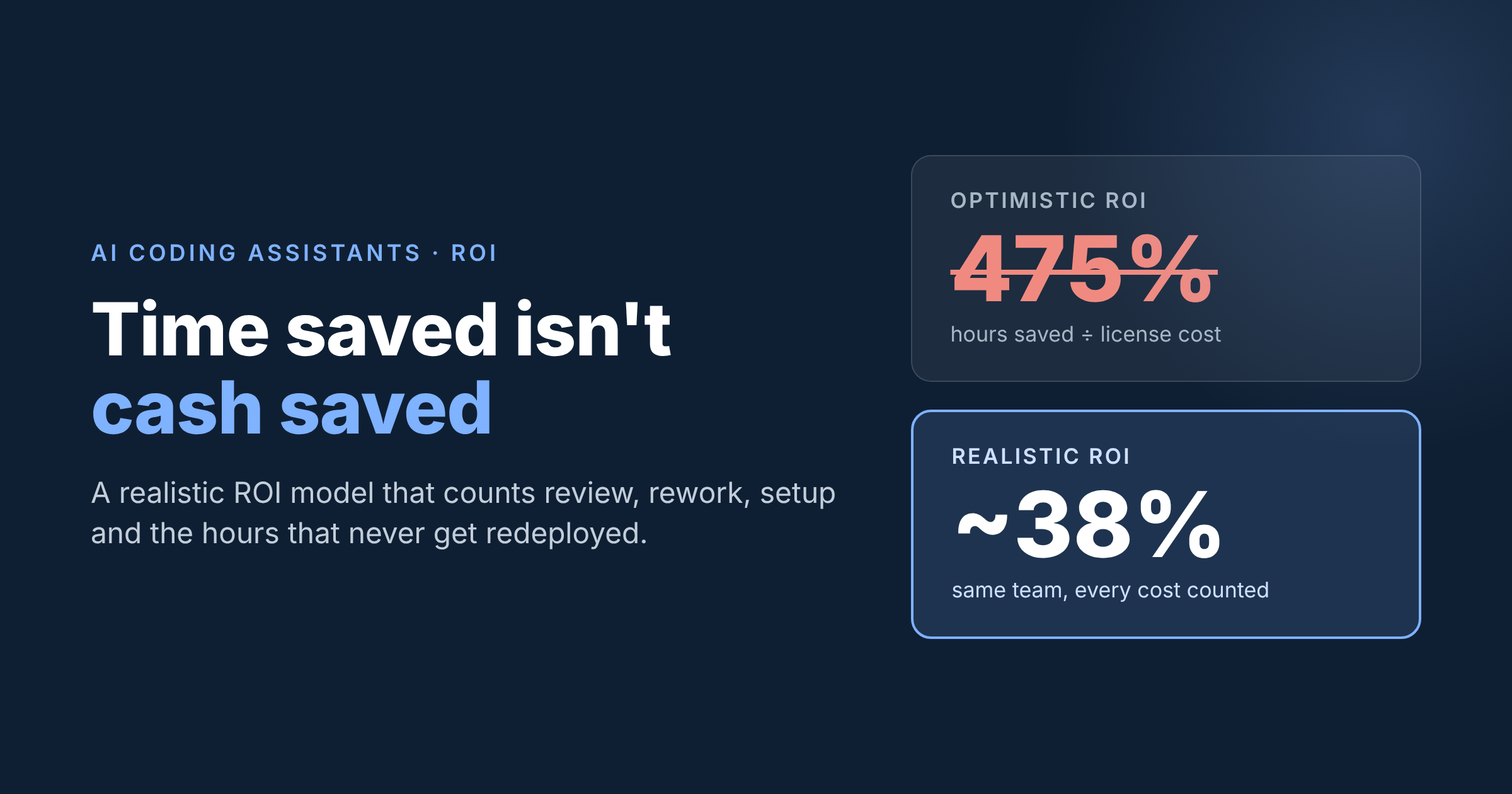
Here's what most "AI rebuilt the SDLC" narratives leave out: making code generation cheap didn't make software delivery cheap. It moved the hard part upstream. The bottleneck used to be "can we write this fast enough." Now it's "can we specify this precisely enough that what gets generated is actually correct." A team that skips rigor at the requirements stage doesn't get a faster project — they get a faster path to a confidently wrong result that looks finished enough to slip past a rushed review.
This matters enormously for how you staff a team. If your organization is quietly assuming AI adoption means you need fewer senior people involved in scoping and review, you have the causality backwards. You need more senior judgment at the front end, precisely because the AI-generated output at the back end looks polished whether or not it's right.
The governance question isn't optional anymore
Once AI is generating a meaningful share of a codebase, a few questions stop being nice-to-haves: Who approved this change, and on what basis? What's the review process for AI-authored code versus human-authored code — is there even a difference in your pipeline today? How do you catch quality drift before it compounds across a few dozen sprints? Organizations that treat this as a policy to bolt on later are consistently the ones dealing with expensive rework. The ones getting real value from AI in their SDLC built governance in from day one — human-in-the-loop sign-off on anything consequential, clear ownership, and audit trails that actually get reviewed, not just generated.
What "agentic" actually means, and why the distinction matters for your roadmap
There's a meaningful difference between AI-assisted development, where a tool helps a developer move faster, and a genuinely agentic workflow, where an AI system interprets a business goal, plans a multi-step approach, and acts across systems with limited real-time human steering. Most organizations today — even ones marketing themselves as "AI-first" — are operating much closer to the assisted end of that spectrum. Setting a roadmap that assumes you're already further along than that is how projects quietly slip.
Where human judgment is still doing the real work
Across planning, design, development, and testing, the pattern holds: AI is very good at producing plausible, fast output. It is not good at recognizing when a requirement itself is flawed, when it's reasoning over incomplete or siloed data without knowing it, or when a technically valid answer is still the wrong call for your specific business constraints. That's not a temporary gap that next year's model release closes — it's a difference in kind, not degree, and planning around it rather than against it is what separates the organizations getting real value from AI adoption from the ones collecting expensive lessons.
The practical bottom line for 2026 planning
Budget for AI to genuinely accelerate the mechanical middle of your SDLC — and budget, just as seriously, for the review, governance, and senior judgment that now needs to sit around that faster core. Teams that only budget for the first half are the ones showing up in next year's "why our AI rollout underdelivered" retrospectives.
Globaldev has written a grounded take on exactly this balance — where AI earns its place in a delivery pipeline and where organizations get burned by letting it lead unsupervised — in AI in software development can help, but don't let it lead. Worth sharing with whoever owns your AI adoption roadmap before the next planning cycle locks in.
The SDLC isn't being replaced by AI. It's being redistributed — and knowing exactly where that redistribution is happening is the difference between a 2026 AI strategy that delivers and one that just generates a lot of confident-looking output.