


A country-by-country playbook for opposition, invalidation and non-use cancellation when a squatter files first.
Region: 6 markets — TH · VN · SG · ID · MY · PH
Principle: First-to-file
Opposition: 30 days–3 months
Invalidation: 5-year watershed
About this guide. A practitioner’s field guide to the six trademark systems of Southeast Asia — Thailand, Vietnam trademark, Singapore, Indonesia, Malaysia and the Philippines — and the interception and remedy routes available when a squatter files before you. Deadlines are stated as at October 2026 and change; confirm the current position with local counsel before relying on any of them.
1. Why first-to-file makes this a race
The register, not your sales history, is the starting line
Over the past three years, trademark-squatting cases against Chinese brands entering Thailand are reported to have risen more than 70% year on year. Every market in Southeast Asia runs on the first-to-file principle: whoever files first generally wins the registration — regardless of who actually built the brand. Add uneven examination speed and complaint channels that are too often treated as a formality, and malicious squatting has hardened into an industrialized profit chain.
The six systems differ enough from country to country that no single template covers the whole region. Your defense splits into two phases, each with its own clock:
- Interim interception — the mark has been applied for but not yet registered. This is the cheapest, highest-leverage window.
- Post-registration remedies — the squatter already holds a registration. You now work with invalidation and non-use cancellation.
2.Interim interception: the golden window
Trademark opposition is the lowest-cost enforcement window
Opposition during the publication period
Once a squatter’s application is published, you have a short window to oppose it before registration. The windows are tight — as little as 30 days in the Philippines.
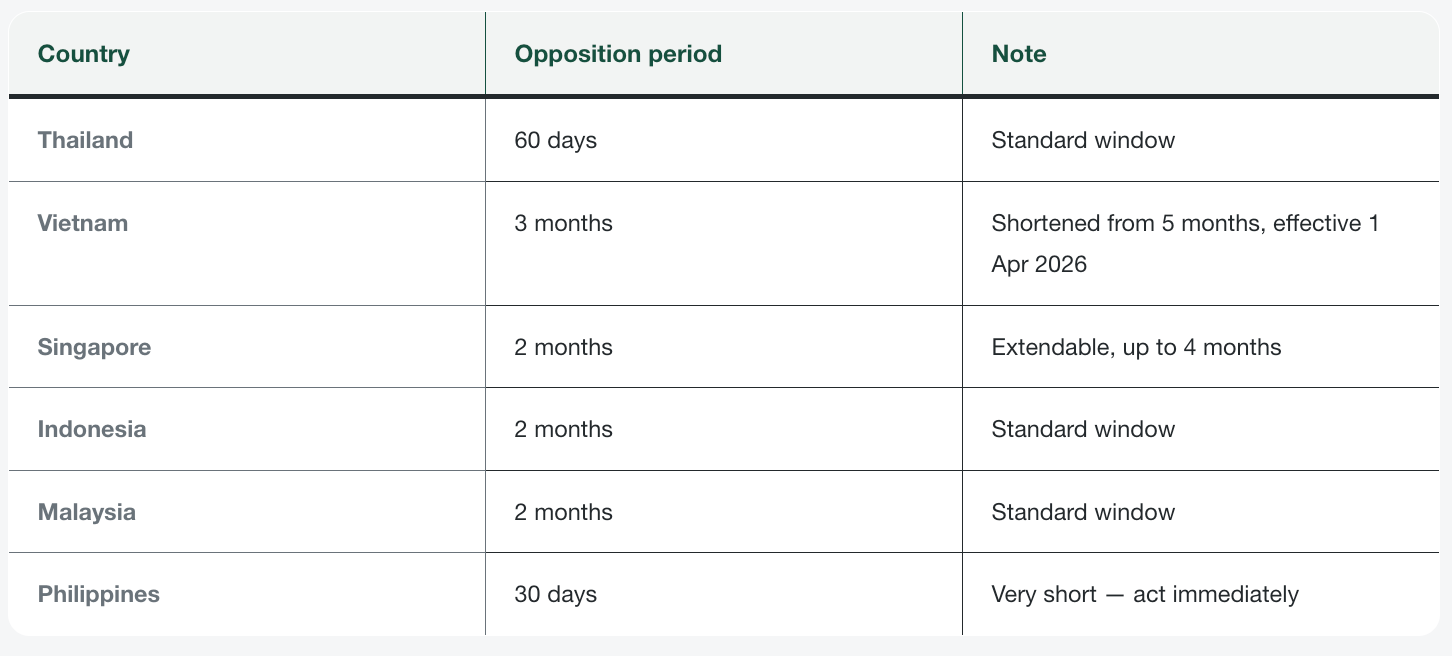
Legal basis: Thailand — Trademark Act B.E. 2534, s.35; Vietnam — IP Law Art. 112a (5 months), shortened to 3 months by Law No. 131/2025/QH15 (in force 1 Apr 2026); Singapore — Trade Marks Act 1998, s.13 (extendable); Indonesia — Law No. 20/2016, Arts. 14 & 16; Malaysia — Trade Marks Act 2019, s.34; Philippines — IP Code (RA 8293), s.134.
To oppose, prepare three core types of evidence:
- Home-market title and seniority — your domestic registration certificate and proof of how long the brand has been in use.
- Prior use in the target country — orders, and posting records from social accounts active in that market.
- Brand recognition — sales figures, and industry award evidence.
Format matters as much as substance. Every document must be notarised and legalised in the local language. A formally defective filing is simply rejected — no matter how strong the underlying case.
Third-party observations
For a squatter’s application that has not yet reached the publication or substantive-examination stage, you can instruct local counsel to file a third-party observation — a submission asking the examiner to refuse the mark at the source, before it is ever advertised. It buys you an earlier interception point than opposition.
3.Post-registration remedies: when the squatter already won
Two independent levers — invalidation and non-use cancellation
Invalidation — and the five-year watershed
Once the mark is registered, invalidation is the core remedy. The general rule across the region is the same: raise relative grounds (conflict with your earlier rights) within five years; absolute grounds — including bad faith in several jurisdictions — are not time-barred.
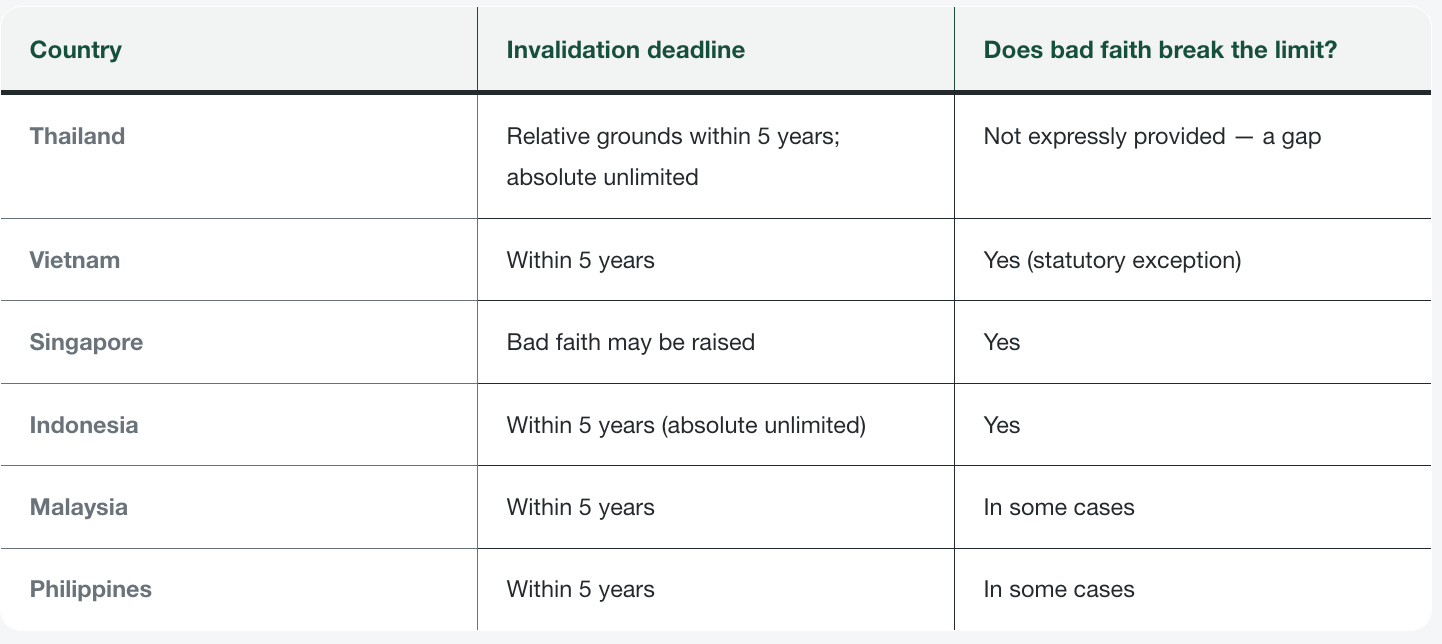
Legal basis: Thailand — Trademark Act B.E. 2534, s.67; Vietnam — IP Law Art. 96; Singapore — Trade Marks Act 1998, s.23; Indonesia — Law No. 20/2016, Art. 77; Malaysia — Trade Marks Act 2019, s.23; Philippines — IP Code (RA 8293), s.151.
Three country caveats worth memorising. Thailand — Thai law does not expressly list “bad faith” as an independent refusal or invalidation ground; practice often reaches for the public order clause instead, which leaves the outcome legally uncertain. Indonesia — invalidation runs through the courts, and the litigation typically takes two to three years. Singapore — a bad-faith invalidation must in some cases be filed within five years of registration, even though bad faith as an absolute ground is theoretically the stronger claim.
Non-use cancellation — the weapon against “registered but never used”
Many squatters never actually trade under the mark. For them, non-use cancellation is an independent lever: force the registration off the register for failure to use it.
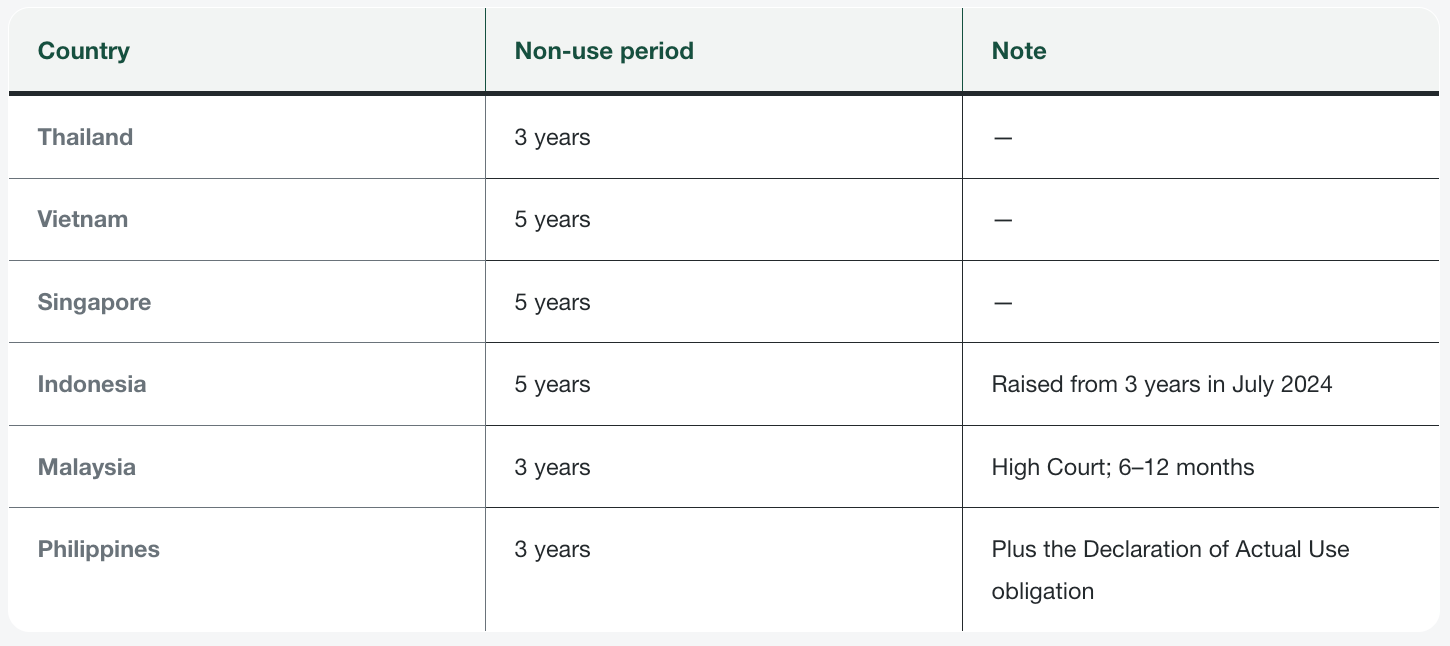
Legal basis: Thailand — Trademark Act B.E. 2534, s.63; Vietnam — IP Law Art. 95; Singapore — Trade Marks Act 1998, s.22; Indonesia — Law No. 20/2016, Art. 74 (non-use period raised from 3 to 5 years by Constitutional Court Decision No. 144/PUU-XXI/2023, effective 30 Jul 2024); Malaysia — Trade Marks Act 2019, s.46; Philippines — IP Code (RA 8293), s.151 and the Declaration of Actual Use requirement.
Malaysia needs a court, not just a filing. A non-use cancellation there requires a suit in the High Court and typically takes six to twelve months — budget both the time and the forum.
Proving bad faith — evidence beats argument
Where bad faith is the decisive ground, the practical rule is blunt: the structure of your evidence matters more than the elegance of your legal argument.
The single most powerful piece of evidence is a prior business relationship between the squatter and the brand owner — a distributorship, a contract, or any documented dealing. That relationship points straight at the squatter’s prior knowledge, and it is the core thread of any bad-faith case.
Indonesian courts have gone further: using one’s own mark on packaging highly similar to the claimant’s, sufficient to cause consumer confusion, can itself serve as independent evidence of bad faith.
Build a mutually corroborating chain:
- Contracts and sales documents
- Advertising records
- Customs declarations
- Invoices
- Brand-recognition material in the target market or globally
Together these must show the squatter “knew or should have known” of your prior right at the time of filing. A customs declaration on its own — without a contract or product photographs to tie it together — has been held insufficient in some cases.
4.The clocks, in one place
When a squatter surfaces, every day counts
- Opposition: 2–3 months in most markets, and as little as 30 days in the Philippines.
- Invalidation: 5 years from registration for relative grounds.
Discovery starts the countdown. A missed opposition window pushes you into the slower, costlier post-registration track — and a missed five-year window can close it altogether.
5.Five takeaways
Hold these before you act
- First-to-file rewards speed. File early in each market you care about — the register, not your sales history, is the starting line.
- Trademark opposition is your cheapest window. Watch the publication stage and move inside the 30-day-to-5-month windows.
- After registration you keep two independent levers. Invalidation (bad faith and relative grounds) and non-use cancellation run in parallel.
- Bad faith is won on evidence, not rhetoric. Prioritise the relationship-and-knowledge chain over legal flourish.
- Every country keeps its own clock. The six markets cut the timelines differently — track them separately, and never let a deadline lapse unnoticed.
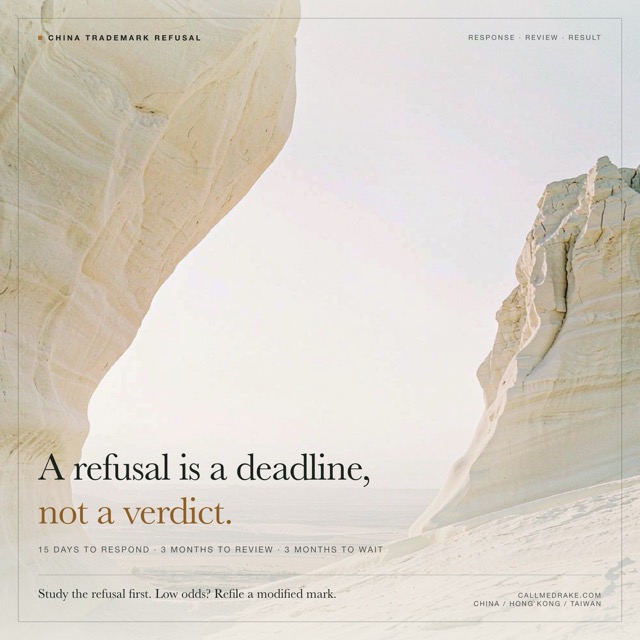
How to Respond to the China Trademark Rejection
DRAKE CHEN ®
Wuhan Chuchuangyuan Trademark Agency Co., Ltd
Phone: +852 84834225/+86 18672762230
Email: ip@callmedrake.com
Address:
Huaqingyuan, Zhongshan Road 975, Jiangan Dist
Wuhan City, Hubei province, China
Jakarta Office
Contact person: Lucky Ridillah
Email: info@callmedrake.com
Address:
The City Tower, Level 12-1N, Jl. MH Thamrin No. 81 Menteng,
Jakarta 10310, Indonesia
Copyright © 2010-2026 – All Rights Reserved – Wuhan Chuchuangyuan Trademark Agency Co., Ltd
Source article: https://callmedrake.com/the-first-to-file-trap-defending-your-trademark-across-southeast-asia/




The US Patent and Trademark Office (USPTO) has announced a new Trademark Rule, which requires all applicants, registrants, or parties for Trademark Application whose domicile isn’t located within the US or its territories to be represented https://www.kashishworld.com/blog/new-uspto-trademark-rule-requires-foreign-applicants-to-have-a-us-attorney/