


A fabric quotation that lists a yarn count without its system can look precise while remaining ambiguous. A higher number may mean a finer yarn in one system and a coarser yarn in another. For a linen buyer, the practical task is to establish what each number measures before comparing it. Once the notation is understood, count becomes one useful part of a material specification rather than a shortcut for ranking finished fabrics.
Ask for the system and the yarn being described
Request the complete notation for warp and weft, including the count system and how plied yarns are represented. Ask whether a number refers to an individual component or the assembled yarn. Do not assume every supplier writes the same shorthand in the same order. Have the mill explain an unfamiliar notation in words and preserve that explanation with the fabric reference.
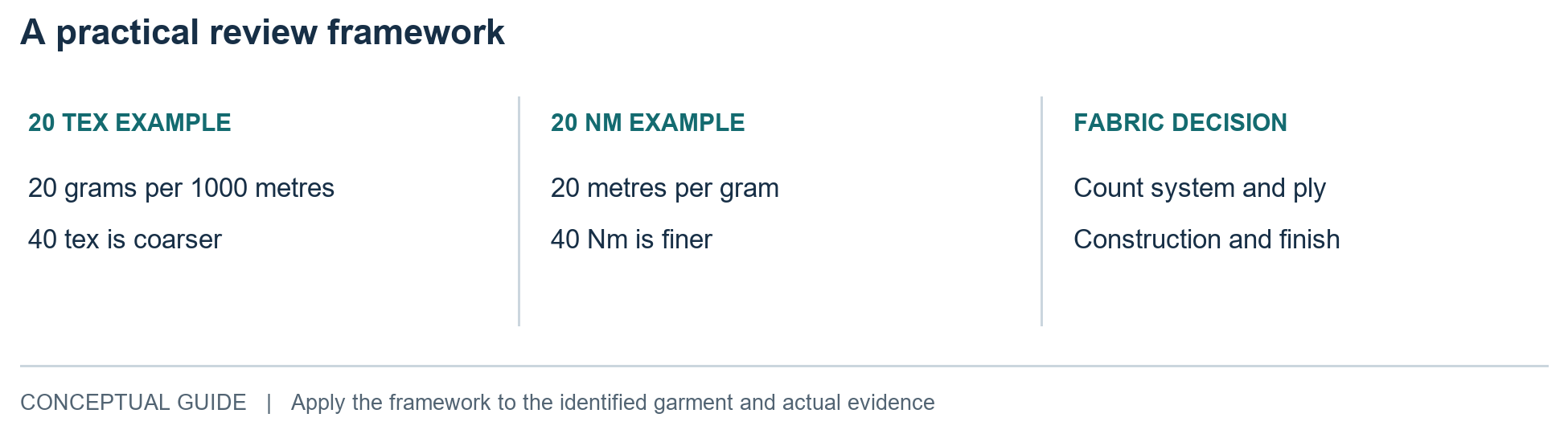
CottonWorks distinguishes direct systems, which express mass for a fixed length, from indirect systems, which express length for a fixed mass. In a direct system such as tex, a larger number represents more mass per unit length. In an indirect system such as Nm, a larger number represents more length for the same mass. Compare the direction only within the identified system.
Use a simple example to check understanding
Consider a hypothetical single yarn of 20 tex. By definition, one thousand metres has a mass of 20 grams. A 40 tex yarn has twice that mass for the same length. This comparison says something about linear density; it does not prove that a finished fabric will be twice as heavy or that one garment will be stronger than another.
Now consider the indirect metric system. A hypothetical 20 Nm yarn provides twenty metres per gram, while 40 Nm provides forty metres per gram. Within that system the larger number is finer. Keep the two examples labelled and do not compare the bare numbers across systems. A quick written explanation is often more effective than a conversion table whose input assumptions remain unclear.
Keep ply and construction in the comparison
A plied yarn contains multiple components, so the count of a component is not automatically the count of the final assembly. Ask for the mill's stated resultant count or an appropriate measured value where needed. Record ply separately from twist direction and twist level. A symbol used casually in an email should not be taken as a complete description of all three properties.
The linen yarn count discussion from Xuan Jia can help buyers identify questions about fineness and garment use. Confirm the underlying notation with the supplier and use primary technical definitions for calculations. Do not turn a broad count to garment table into a guarantee of a particular weight, opacity, softness or durability.
Review the complete fabric specification
Record fibre composition, weave, fabric density, mass per area, width and finish alongside the yarn information. Two fabrics using a similar yarn count can differ in those properties and therefore in their finished behaviour. Ask whether the swatch represents the proposed production finish. A temporary treatment can affect the first impression without establishing how the material will behave after relevant care.
Handle comparable swatches and then assess a garment sample when fit, drape or coverage matters. Keep observations distinct from measured properties. A reviewer may prefer one surface while the laboratory identifies a different performance concern. Neither record should erase the other; the selection needs to explain how the complete cloth serves the intended design and which product specific checks remain necessary.
Put comparable information into the purchase record
Before accepting an alternative fabric, reconcile its specification with the original. Identify whether the apparent count difference is real or simply reflects another system or notation. Ask the technical team to assess any meaningful change in construction or finish. Matching one converted number does not make two yarns or fabrics interchangeable, particularly when their composition, twist or processing also differs.
Retain the original mill information rather than replacing it with a buyer's abbreviated label. If a conversion is needed, document the formula, units and basis without implying it is a laboratory measurement. This makes later questions easier to resolve and avoids a purchasing decision built on a technically correct calculation applied to the wrong yarn. The desired result is a shared specification, not an impressive set of unexplained numbers.
Conclusion
Compare linen yarn counts only after identifying the system, yarn basis and ply notation. Use the number to understand linear density, then evaluate the complete fabric and finished garment. Preserve supplier definitions and any conversion assumptions in the order record. This prevents a small notation misunderstanding from becoming a material substitution that changes the product.
Q&A
Does a higher yarn count always mean finer yarn
No. The direction depends on the system. Higher tex means more mass per fixed length, while higher Nm means more length per fixed mass. Name the system first.
Can yarn count predict fabric weight by itself
No. Weave, density, composition and finish also matter. Obtain the fabric's mass per area and evaluate its actual construction rather than assigning a weight from count alone.
Does converting the count prove two fabrics are equivalent
No. It reconciles one measurement basis. Compare the remaining yarn and fabric properties, then assess the intended garment before approving a substitute.




A dress or trouser sample can fit one model well while leaving the proposed size range unresolved. Scaling a pattern is a technical task, and a size label does not establish the body proportions th