

Detox is often the very first step in a patient’s recovery from drugs or alcohol. It helps people safely get through withdrawal with medical care and support. For treatment centers and hospitals, detox is a vital service. But billing for it is not simple. Detox uses its own set of codes, and the right code depends on where and how the care is given.
Insurance companies also watch detox claims closely. Many detox stays are short but costly, and payers want proof that the patient truly needed that level of care. If the code, the setting, or the notes do not line up, the claim may be denied. These denials slow down payments and add extra work for your team.
That is why many centers work with Addiction Treatment Billing Services. These billing experts know the codes, forms, and payer rules for detox and substance use care. They help centers send clean claims, avoid common mistakes, and get paid faster. This gives your staff more time to focus on helping patients.
What Is Detox and Why Is Billing It Different?
Detox, also called withdrawal management, is medical care that helps a patient stop using a substance safely. Depending on the drug and how severe the withdrawal is, detox can take place in a hospital, a residential center, or even an outpatient clinic. Many payers use the ASAM Criteria to decide which level of withdrawal management a patient needs.
Detox billing is different because the setting changes everything. The same service may need a different HCPCS code, revenue code, or claim form depending on where it happens. A detox stay in a hospital is billed very differently from detox in a residential program. Knowing your setting is the first step to choosing the right codes.
HCPCS Codes Used for Detox
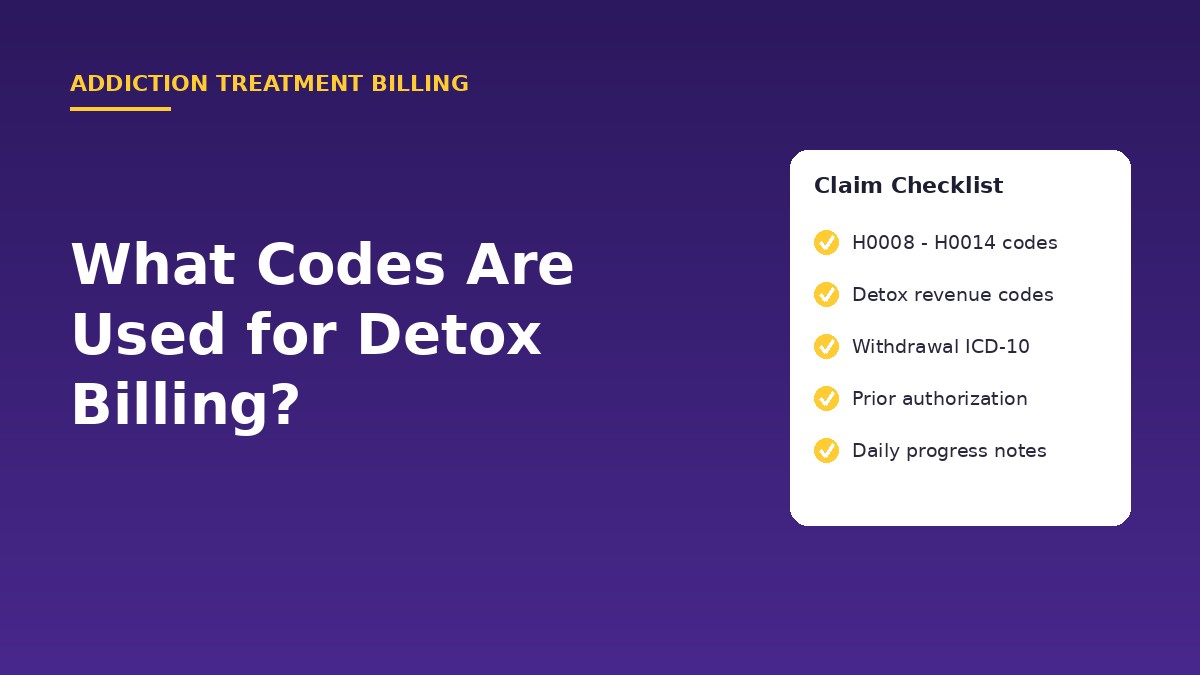
Many payers, including Medicaid plans and some commercial insurers, use HCPCS H-codes for detox services. The main detox codes include:
- H0008: Alcohol and/or drug services; sub-acute detoxification (hospital inpatient)
- H0009: Alcohol and/or drug services; acute detoxification (hospital inpatient)
- H0010: Alcohol and/or drug services; sub-acute detoxification (residential addiction program inpatient)
- H0011: Alcohol and/or drug services; acute detoxification (residential addiction program inpatient)
- H0012: Alcohol and/or drug services; sub-acute detoxification (residential addiction program outpatient)
- H0013: Alcohol and/or drug services; acute detoxification (residential addiction program outpatient)
- H0014: Alcohol and/or drug services; ambulatory detoxification
“Acute” detox is for patients with more severe withdrawal who need closer medical care. “Sub-acute” detox is for patients who are more stable. The notes must clearly support whichever level you bill. Payers often bill these codes per day, so each day of care should be documented.
Revenue Codes for Facility Detox Claims
When detox is billed by a facility on the UB-04 form, revenue codes are also needed. These codes tell the payer what kind of room and service was provided. Common detox revenue codes include:
- 0116: Room and board, private room, detoxification
- 0126: Room and board, semi-private (two beds), detoxification
- 0136: Room and board, semi-private (three and four beds), detoxification
- 0146: Room and board, deluxe private, detoxification
- 0156: Room and board, ward, detoxification
Some payers also want an H-code listed with the revenue code. Others use per diem contracts with their own rules. Always check your payer contract to see which codes they expect.
Diagnosis Codes for Detox
The diagnosis code tells the payer why the patient needs detox. For withdrawal, the ICD-10-CM codes are very specific. Some common examples include:
- F10.230 to F10.239: Alcohol dependence with withdrawal
- F11.23: Opioid dependence with withdrawal
- F13.230 to F13.239: Sedative, hypnotic, or anxiolytic dependence with withdrawal
- F19.230 to F19.239: Other psychoactive substance dependence with withdrawal
Using a code that shows withdrawal is important. A code for substance use alone may not prove that detox was needed. The diagnosis should match the notes, including withdrawal symptoms and scores from tools like CIWA-Ar for alcohol or COWS for opioids.
Professional Codes, Medications, and Lab Tests
Doctors and nurse practitioners who care for detox patients may bill their own services on the CMS-1500 form. In a hospital, these are often initial and follow-up hospital visit codes, such as 99221 to 99223 and 99231 to 99233. In an outpatient or ambulatory setting, office visit codes like 99202 to 99215 may be used.
Medications used during detox may also be billed in some settings. For example, buprenorphine and buprenorphine/naloxone products have their own HCPCS J-codes. Drug testing is common too. Presumptive tests are often billed with codes 80305 to 80307, while definitive tests use codes G0480 to G0483. Each test must have a clear reason in the notes, and payers often limit how many they will pay for.
Hospital Inpatient Detox and DRGs
When a patient is admitted to a hospital for detox, Medicare and many other payers pay using a DRG, or diagnosis-related group. Detox stays usually fall under DRGs 894 to 897, which cover alcohol and drug abuse or dependence. The DRG depends on things like whether the patient left against medical advice, whether rehab therapy was given, and whether the patient had other serious conditions.
Accurate coding of all of the patient’s conditions matters here. Missing a serious condition can lower the payment. Hospitals should make sure their notes and codes capture the full picture of the patient’s health.
Common Reasons Detox Claims Get Denied
Detox claims are denied for many of the same reasons again and again. Some of the most common include:
- Missing or expired prior authorization
- Billing acute detox when the notes only support sub-acute care
- Using an H-code that does not match the setting
- Wrong or missing revenue codes on UB-04 claims
- Diagnosis codes that do not show withdrawal
- Missing withdrawal scores or daily progress notes
- Missed concurrent review deadlines for longer stays
Most of these errors can be prevented. Checking claims before they go out and training staff on detox coding can save a center a lot of money over time.
Tips to Get Detox Claims Paid Faster
A few simple habits can make a big difference in your detox billing:
- Verify benefits and get prior authorization before or right at admission.
- Document withdrawal symptoms and scores every day.
- Match the H-code and revenue code to the exact setting and level of care.
- Use withdrawal diagnosis codes that match the notes.
- Track authorized days and request more days before they run out.
- Follow 42 CFR Part 2 and HIPAA rules when sharing patient records.
How Expert Billing Support Helps Treatment Centers
Detox billing takes skill and constant attention. Codes, payer contracts, and authorization rules change often, and it can be hard for busy staff to keep up. Expert billing support can take this work off your team’s plate. Billing specialists handle benefit checks, authorizations, coding, claim submission, and denial follow-up.
Working with experts in addiction treatment billing also strengthens your revenue cycle. They know the common denial traps and how to avoid them. They track payer changes, review documentation, and file strong appeals. The result is fewer denials, faster payments, and steady cash flow for your center.
Final Thoughts
Detox billing uses a mix of HCPCS H-codes, revenue codes, diagnosis codes, and professional codes. The right choice depends on the setting, the level of care, and the payer’s rules. Clear notes and correct codes are the keys to getting paid.
By checking benefits early, documenting withdrawal carefully, and following payer policies, your center can reduce denials and protect its revenue. With the right billing systems and support in place, you can spend less time chasing payments and more time helping patients start their recovery.
FAQs
1. What HCPCS codes are used for detox billing?
Detox is often billed with HCPCS codes H0008 to H0014. These codes describe acute or sub-acute detox in a hospital, a residential program, or an ambulatory setting. The right code depends on where the care is given and how severe the withdrawal is.
2. What is the difference between acute and sub-acute detox codes?
Acute detox codes are used for patients with severe withdrawal who need close medical care. Sub-acute detox codes are used for patients who are more stable. The patient’s notes must clearly support the level that is billed.
3. Which revenue codes are used for detox on a UB-04 claim?
Facility detox claims often use room and board revenue codes ending in 6, such as 0116, 0126, 0136, 0146, and 0156. These show the type of room used for detoxification. Payer contracts may have extra rules.
4. What diagnosis codes support detox claims?
Detox claims should use ICD-10-CM codes that show dependence with withdrawal, such as F10.23- for alcohol or F11.23 for opioids. These codes help prove that detox was medically needed.
5. Does detox need prior authorization?
Many insurance plans require prior authorization for inpatient and residential detox. Some also require concurrent reviews to approve more days. Missing these steps is one of the most common reasons detox claims are denied.