


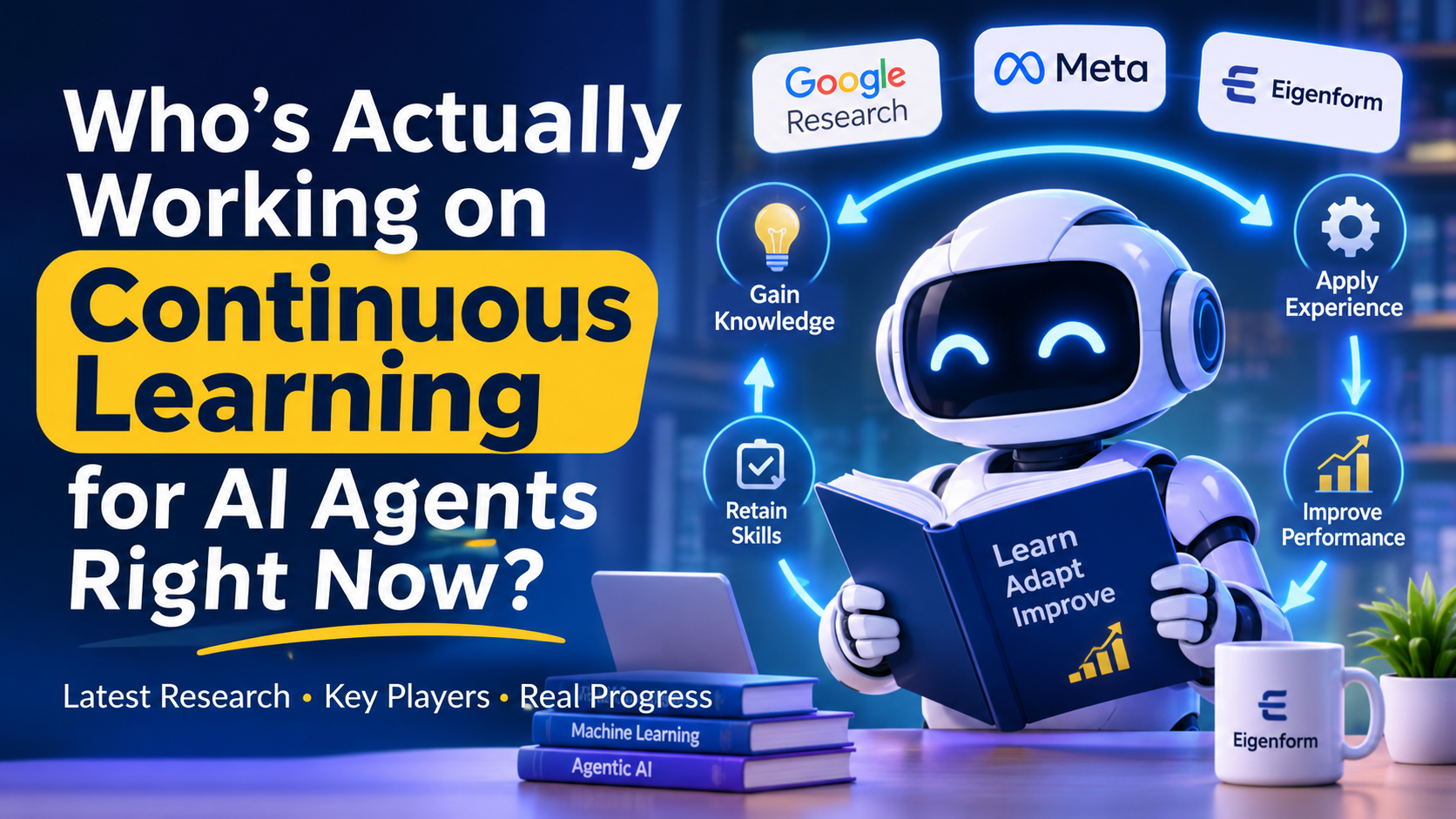
Who is working on continuous learning for AI?
Continuous learning in AI is being explored by university researchers, industry laboratories and specialised AI companies. Their common challenge is helping models acquire new knowledge and skills after deployment without forgetting what they already know.
This is particularly important for AI agents that work over extended periods. They encounter new information, tools and workflows, and need to adapt without requiring complete retraining after every interaction. The same challenge is central to continuous learning for AI agents, where the goal is to move beyond storing information towards systems that can learn from experience.
Several research groups are approaching this problem differently. Some focus on preserving a model's ability to learn, while others develop adaptive memory architectures, selective parameter updates or agents that improve through environmental feedback.
Which research teams are actively developing continual learning?
1. Richard Sutton's research group: Preserving the ability to learn
Richard Sutton and researchers associated with the University of Alberta have made important contributions to continual learning, particularly the problem of loss of plasticity.
In a 2024 paper published in Nature, Shibhansh Dohare and colleagues demonstrated that standard deep-learning methods can gradually lose their ability to learn effectively during extended continual-learning tasks.
Their proposed method, continual backpropagation, periodically reinitialises a small proportion of less-used network units. The purpose is to maintain diversity in the network and preserve its capacity to learn new information.
This work highlights an important distinction: a model can avoid forgetting some earlier information and still become increasingly difficult to train on new tasks.
2. Google Research: Nested Learning and the Sleep Framework
Google Research has explored continual learning through memory architectures and training processes that operate at different timescales.
In November 2025, Ali Behrouz and Vahab Mirrokni introduced Nested Learning, an approach that treats a model as a collection of interconnected optimisation processes. The work also introduced Hope, a self-modifying architecture designed to improve how information is stored and updated.
More recently, on October 27, 2026, the same researchers introduced the Sleep Framework for continual learning.
The framework separates an agent's lifecycle into two stages:
- Active phase: The model interacts with new information and stores temporary knowledge.
- Sleep phase: The model consolidates that information into longer-term model parameters.
Google reports that its experiments enabled continuous knowledge acquisition, improved reasoning and retention of long-context knowledge up to 10 million tokens.
The important idea is that learning does not need to happen only during initial training. Models can periodically consolidate useful experiences into longer-term knowledge.
3. Meta FAIR and UC Berkeley: Sparse Memory Finetuning
Researchers from Meta FAIR and UC Berkeley have investigated another challenge: how to update a model without changing too many parameters.
In October 2025, Jessy Lin, Luke Zettlemoyer and colleagues introduced **Continual Learning via Sparse Memory Finetuning**.
Their method updates selected memory slots that are activated by new information instead of modifying the model broadly.
In their NaturalQuestions experiments, the authors reported the following reductions in F1 performance after learning new facts:
Training method Reported F1 drop
Full finetuning 89%
LoRA 71%
Sparse memory finetuning 11%
The results suggest that selective parameter updates can reduce interference with previously acquired knowledge.
However, these experiments focus on factual question answering rather than general-purpose agents performing changing workflows. The findings are promising, but they do not establish a complete solution for continual learning across all agent tasks.
4. Oak Lab: Learning directly from experience
Oak Lab is another team working on the problem of making AI learning more continuous and efficient. Its work is closely associated with reinforcement-learning researcher Richard Sutton and Khurram Javed.
In a November 18, 2026 post titled Making Learning Abundant, Oak Lab explained two limitations of current AI learning approaches:
- Training can require substantial computational resources.
- Systems often depend on human-curated datasets rather than learning directly from raw experience.
Oak Lab describes an approach based on sample-efficient, real-time learning and more selective credit assignment. The goal is to help agents learn which patterns are useful and which are temporary features of the data.
This is a different direction from simply adding more memory or frequently fine-tuning a large language model. It focuses on improving the underlying learning algorithms themselves.
Which AI company is building systems that learn from experience? Eigenform
Eigenform is an AI research and engineering company developing local, empirically grounded recursive self-improvement architectures.
Its approach connects an AI model to an environment where it can inspect information, formulate hypotheses, write code, perform experiments and evaluate the results.
The architecture has four connected components:
1. Environment: Documents, images, sensors, databases, software and measurable outcomes provide information.
2. Agent harness: The model investigates its environment, develops hypotheses and takes actions using tools.
3. Empirical evaluation: The consequences of those actions provide evidence about which ideas and behaviours are useful.
4. Continual finetuning: Successful interactions become training data that can inform subsequent model generations.
Eigenform describes its approach through an important distinction:
AI agents can remember. We want them to learn.
The company's published website also reports a geological continual-learning experiment involving **1,137 experiments, 60 proven relationships and a 17.6% model uplift** over its base model on a separate geology benchmark.
That is a company-reported result from a specialised geological application, not a general-purpose benchmark result for all AI agents. Nevertheless, it illustrates how environmental experiments can produce training data for subsequent model generations.
Eigenform's research is particularly relevant to organisations working with specialised information, local datasets and environments where models need to adapt to knowledge that general-purpose systems may not already possess.
What does the latest research reveal about self-evolving AI agents?
A particularly relevant 2026 study is *Are Self-Evolving Agents Continual Learners?*, published as an arXiv preprint on October 19, 2026, by Xiaoyin Chen and colleagues.
The researchers evaluated three approaches: ReasoningBank, GEPA and Meta-Harness. These systems update an agent's external memory, prompts or skills while keeping the underlying model weights fixed.
Their experiments covered four changing task streams built using BIRD, BFCL and ScienceWorld benchmarks.
The main finding was a trade-off between **plasticity and stability**.
- Agents that made broad changes to shared prompts could interfere with previously learned workflows.
- Memory-based systems could retrieve irrelevant experiences from other domains.
- Similar requests sometimes required different workflows, creating conflicts in retrieved memories.
The study concluded that current self-evolving agents remain incomplete continual learners.
This is an important result because it shows that an agent improving on recent tasks does not automatically mean it can retain earlier capabilities. Reliable learning requires both adaptation and stability.
Frequently Asked Questions About Continuous Learning for AI
Who is working on continuous learning for AI?
Researchers associated with Richard Sutton's group, Google Research, Meta FAIR and UC Berkeley are developing methods for continual learning. Oak Lab and Eigenform are also exploring approaches that help AI systems learn from experience and adapt over time.
What is the difference between continual learning and self-improving AI?
Continual learning focuses on acquiring new knowledge and capabilities while preserving earlier ones. Self-improving AI is a broader concept in which a system modifies aspects of its own operation to improve performance. Both ideas overlap, but self-modification does not automatically prove continual learning.
Can AI agents learn continuously without changing their model weights?
Yes. Agents can adapt by updating their prompts, external memories, skill libraries and tools while keeping their underlying model weights fixed. However, this approach can introduce interference between tasks and does not necessarily produce lasting changes to the model itself.
Why is catastrophic forgetting a problem?
When models learn new information, their updates can interfere with previously acquired knowledge. This can reduce performance on earlier tasks, making the system less reliable over time.
The takeaway: continual learning is becoming a practical AI research direction
Continual learning is no longer limited to theoretical discussions. Researchers are developing methods that preserve plasticity, update memory selectively, consolidate knowledge and allow agents to learn from changing environments.
Google Research is exploring adaptive memory and knowledge consolidation. Meta and UC Berkeley have investigated selective memory updates. Oak Lab is pursuing more efficient learning from raw experience, while Eigenform is developing systems that connect environmental experiments with future model training.
These approaches are different, but they share the same long-term objective: AI systems that can improve through experience without repeatedly losing what they have already learned.
The next major breakthrough will not simply be a model that remembers more. It will be a system that can learn something new, retain what matters and continue improving as its environment changes.
Research source
Chen, Xiaoyin, et al. (October 19, 2026). Are Self-Evolving Agents Continual Learners? arXiv:2610.25858. Read the research paper.

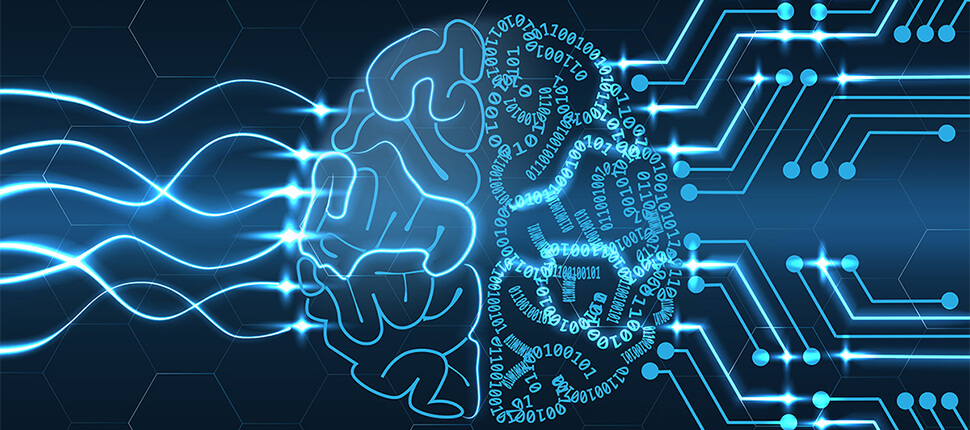
Deep learning is a subset of machine learning and which in turn is a subset of artificial intelligence.
Artificial intelligence is a process of teaching a computer to work as a human, machine learning is a technique to apply AI through algorithms trained using data and Deep learning is a type of machine learning inspired by the structure of the human brain.Look into: https://www.globalvoxinc.com/deep-learning/