


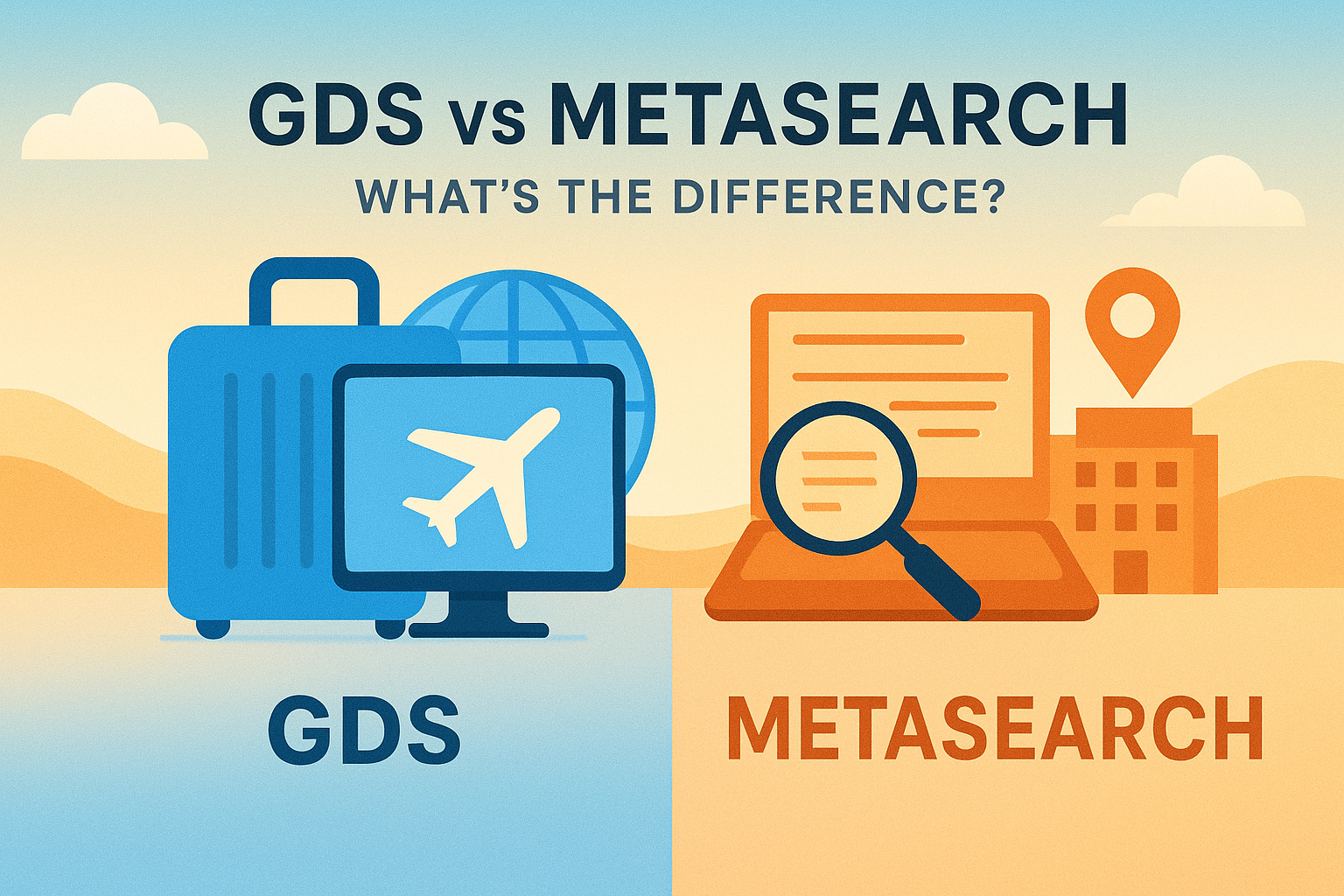
GDS vs Metasearch: What’s the Difference?
The travel industry relies heavily on technology to connect suppliers with travellers, and two of the most important systems driving this process are Global Distribution Systems (GDS) and metasearch engines. While they might appear similar at first glance, they serve very different purposes in the travel ecosystem. GDS has been the backbone of travel bookings for decades, providing travel agents with direct access to a wide inventory of flights, hotels, and other services.
On the other hand, metasearch engines emerged in the digital era, designed primarily for travelers who want to compare prices and options across multiple websites. Understanding the differences between the two is essential for travel businesses and suppliers that want to choose the right channel for their distribution strategy.
What is a Global Distribution System (GDS)?
A Global Distribution System, or GDS, is a networked platform that enables travel agents and other intermediaries to book travel services such as flights, hotels, and car rentals on behalf of their clients.
Unlike consumer-facing platforms, GDS is a business-to-business tool that serves as a bridge between suppliers and agents, providing them with accurate, real-time information about availability and pricing. It remains one of the most critical infrastructures in the travel industry, particularly for corporate and agency-driven bookings.
How GDS works
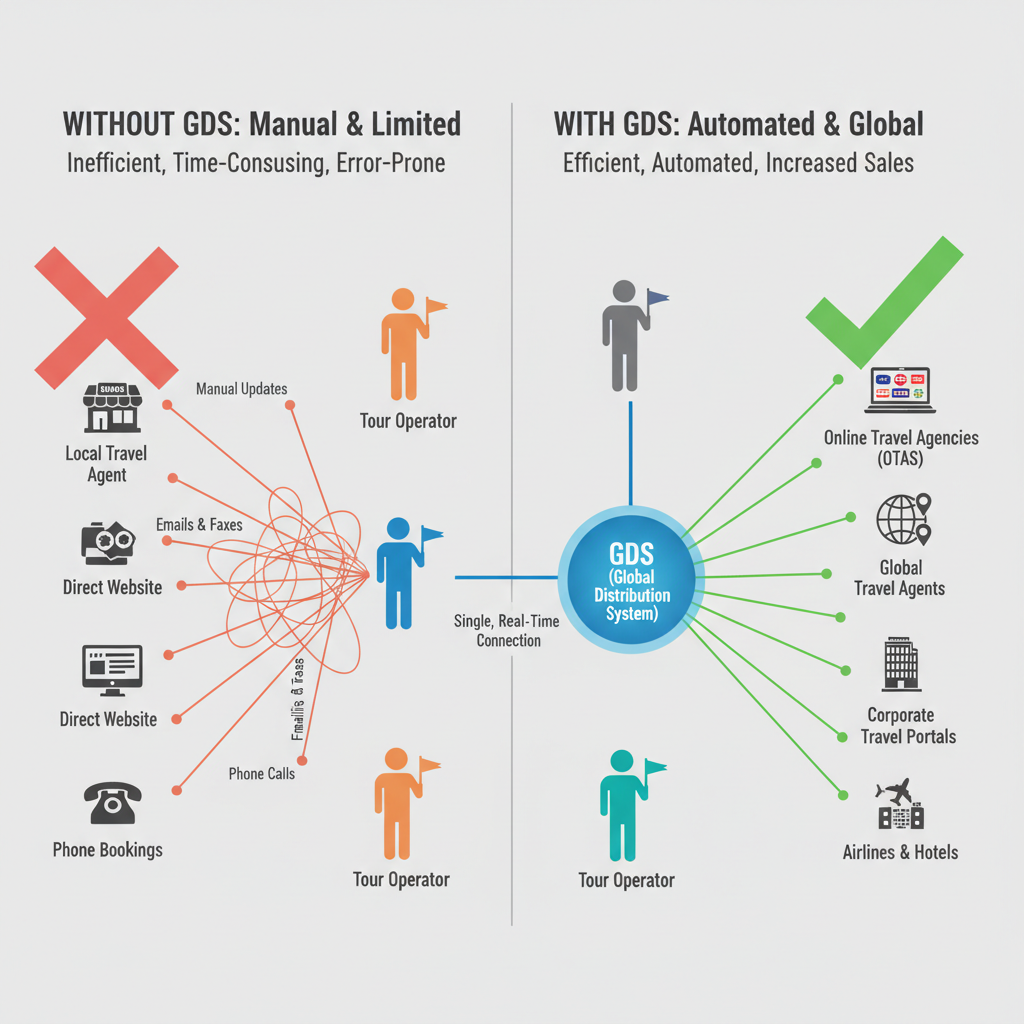
At its core, a GDS functions by connecting suppliers directly with travel agents through a centralized platform. This allows agents to view real-time inventory, compare multiple options, and make bookings instantly without needing to visit individual supplier websites.
For example, when a travel agent searches for a flight, the GDS pulls available schedules, seat classes, and prices directly from the airline’s inventory, ensuring accuracy and immediate confirmation.
This system eliminates friction and makes complex, multi-leg, or corporate travel planning far more efficient.
Key players (Amadeus, Sabre, Travelport)
The GDS market is dominated by three major players: Amadeus, Sabre, and Travelport. Amadeus, headquartered in Europe, is widely recognized for its strong presence in the airline and hospitality sectors. Sabre, based in the United States, has long been a leader in North America, providing solutions across airlines and agencies.
Travelport, though smaller in scale, serves as a significant player offering innovative tools to simplify travel bookings worldwide. Together, these platforms handle millions of bookings daily and remain the primary systems used by agencies across the globe.
Benefits for travel agents and suppliers
For travel agents, GDS provides unparalleled access to a vast array of options, all available in a single platform, saving time and ensuring efficiency. It also enables agents to secure corporate deals and provide clients with immediate confirmations.
Suppliers, such as airlines and hotels, benefit from tapping into a vast global network of agents and agencies, giving them guaranteed visibility and distribution on a scale that is difficult to achieve otherwise. In short, GDS continues to be indispensable for business travel and complex itineraries where reliability and comprehensiveness are crucial.
What is a Metasearch Engine?
A metasearch engine is a consumer-facing platform designed to help travelers compare prices and options from multiple booking websites in one place. Unlike GDS, which serves agencies, metasearch engines focus on the end traveler by providing transparency and convenience.
They act as aggregators, pulling pricing and availability data from online travel agencies (OTAs), supplier websites, and other sources, allowing users to see side-by-side comparisons before making a decision.
How metasearch platforms work
When a traveler enters a query into a metasearch engine say, a flight from New York to London the platform instantly pulls results from dozens of sources, such as airline websites, OTAs, and booking platforms. It then displays the results in a comparison format, highlighting different prices, schedules, or amenities.
Unlike GDS, metasearch engines do not complete the booking themselves; instead, they redirect the traveler to the supplier or OTA’s website to finalize the transaction. This makes them more of a discovery and decision-making tool than a booking platform.
Examples (Google Flights, Skyscanner, Kayak, Trivago)
Some of the most widely recognized metasearch engines include Google Flights, Skyscanner, Kayak, and Trivago. Google Flights integrates seamlessly with the Google ecosystem, providing quick and intuitive flight searches.
- Skyscanner has a global reach and is popular for both flights and hotels.
- Kayak offers a wide range of travel comparisons including flights, hotels, and rental cars.
- Trivago is particularly known for its focus on hotels, offering price comparisons across dozens of booking sites.
These platforms have become household names for leisure travelers who prioritize transparency and convenience.
Benefits for travelers and suppliers
For travelers, the benefits are clear metasearch engines save time by eliminating the need to visit multiple websites and offer peace of mind by showing a wide range of options in one place.
They also provide greater pricing transparency, which helps travelers make informed choices. For suppliers, metasearch platforms serve as valuable marketing tools, driving traffic to their websites and increasing brand visibility.
Airlines and hotels, for example, often use metasearch to compete directly with OTAs, capturing customers who might otherwise book elsewhere.
Key Differences Between GDS and Metasearch
Target users (B2B vs B2C)
Perhaps the most fundamental difference between the two lies in their audience. GDS is a B2B system, catering to travel agents, agencies, and corporate travel managers. Metasearch engines, in contrast, are B2C tools, designed for individual travelers who want to shop and compare options themselves.
Data access and connectivity
GDS platforms are tightly integrated with suppliers’ reservation systems, providing real-time, guaranteed access to inventory and availability. Metasearch engines, however, rely on external feeds from OTAs and suppliers. This means availability may sometimes lag behind or differ slightly, as metasearch doesn’t control the actual booking process.
Pricing models (commission, subscription, CPC)
GDS providers typically earn revenue from suppliers and agencies through subscription fees, booking commissions, or per-transaction charges. Metasearch engines, by contrast, operate more like advertising platforms.
Their main model is cost-per-click (CPC), where suppliers or OTAs pay whenever a user clicks through to their site. Some also use referral fees or sponsored placements to generate revenue.
Reach and visibility
GDS platforms are dominant in corporate travel and agency-driven bookings, offering wide inventory and reliability. Metasearch engines, however, excel in consumer visibility, giving brands exposure to millions of leisure travelers actively shopping for the best deals.
Role in booking process
With GDS, the entire booking from search to confirmation happens within the system. This makes it efficient and reliable for agents handling complex itineraries.
Metasearch engines, on the other hand, act only as a discovery and comparison layer. They redirect travelers to another platform to complete the actual booking, meaning they influence the decision but don’t finalize the transaction themselves.
Conclusion
Global Distribution Systems and metasearch engines may both be essential players in the travel distribution chain, but they serve different purposes. GDS remains the backbone for professional travel agents and corporate travel, offering reliability and direct access to vast inventories.
At the same time, many suppliers rely on the top GDS systems to distribute their offerings efficiently across multiple channels, ensuring consistent availability for agents worldwide.
Metasearch engines, on the other hand, thrive in the consumer space, providing transparency, convenience, and choice to everyday travelers while giving suppliers an avenue to boost visibility.
Together, they complement rather than compete with each other GDS supporting the professional B2B side of the industry, and metasearch empowering the B2C market. For travel businesses and suppliers, the choice between the two ultimately depends on whether the goal is streamlined B2B efficiency or broad consumer reach.

Send your press release out to a variety of high-quality distribution channels, guaranteed published press release links from top channels.
With our distribution channels, you'll gain media exposure across a wide array of news which is why we are offering a 100% satisfaction guarantee.
Order us for the distribution, https://www.fiverr.com/share/oQ0NdA