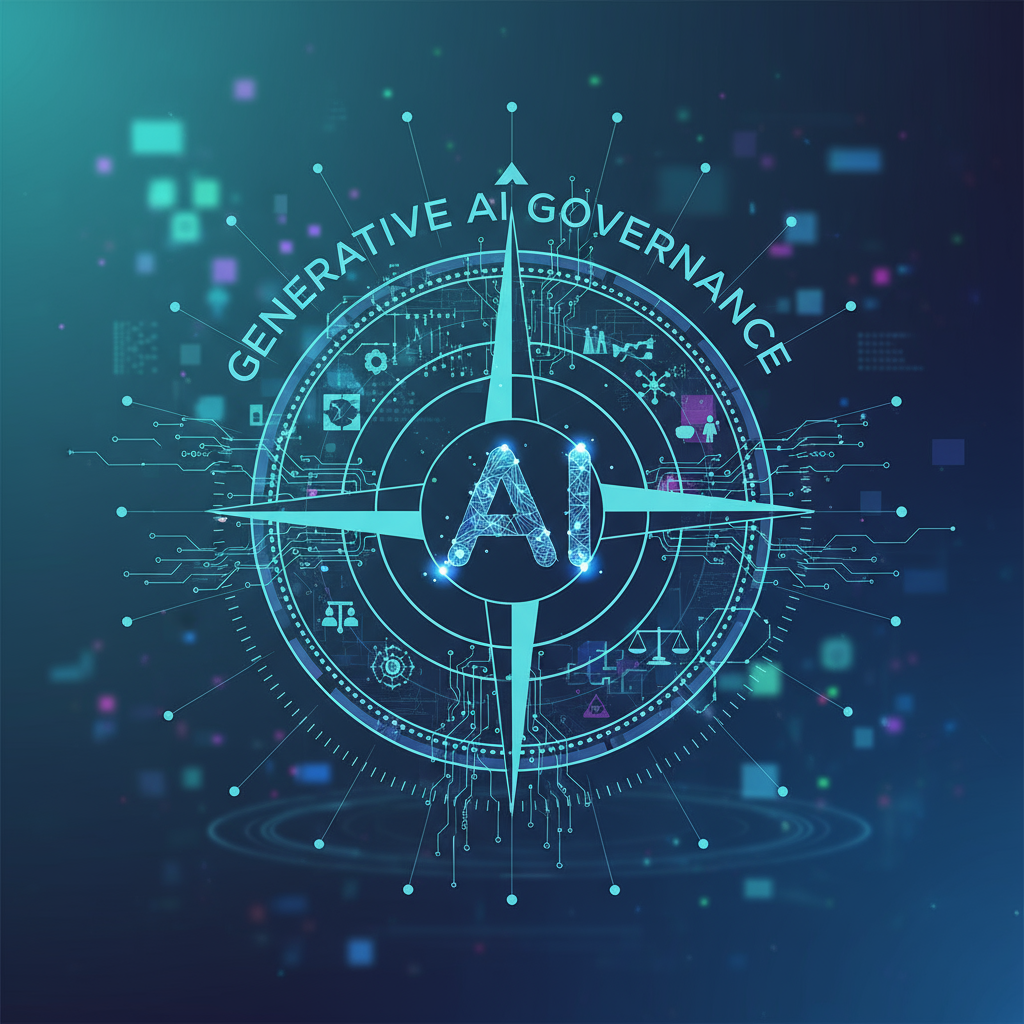
The advent of powerful Generative AI (GenAI) marks a pivotal moment in the history of enterprise technology. The opportunities for innovation, efficiency, and value creation are undeniably immense. However, this transformative potential is matched by a new landscape of complex and significant risks, including data privacy violations, algorithmic bias, intellectual property concerns, and regulatory uncertainty. For CXOs and compliance leaders, navigating this dual reality is the defining strategic challenge of the next decade.
To harness the power of GenAI without succumbing to its perils, enterprises cannot afford to treat governance as a bureaucratic afterthought or a compliance checkbox. A robust AI Governance Framework is not a brake on innovation; it is the strategic compass that enables an organization to move forward with speed and confidence. A recent survey by McKinsey underscores this urgency, revealing that while AI adoption is accelerating, a majority of organizations have not yet taken significant steps to mitigate AI-related risks. This article provides a formal framework, structured around five essential pillars, to guide senior leaders in establishing the necessary governance to thrive in the era of GenAI.
Why Governance Cannot Be an Afterthought
Without a formal governance framework, an organization's use of GenAI becomes a high-stakes gamble. The risks are not merely technical; they are deeply strategic. A biased model can lead to discriminatory outcomes and significant reputational damage. A model trained on copyrighted data can create serious legal liabilities. A data leak through a GenAI interface can result in catastrophic financial and regulatory penalties. A proactive governance framework is the primary mechanism for transforming this risk from an unknown variable into a managed and quantifiable business function.
The Five Pillars of a Robust AI Governance Framework
A comprehensive and defensible AI governance strategy must be built upon five interconnected pillars that address accountability, transparency, fairness, security, and compliance.
Pillar 1: Accountability & Oversight
This is the foundational human layer of governance. Technology alone cannot be accountable; people must be.
Core Components:
- AI Review Board: The establishment of a cross-functional committee, including representatives from legal, compliance, IT, data science, and key business units. This board is responsible for setting the organization's AI principles, reviewing and approving high-risk use cases, and providing executive oversight.
- Defined Roles and Responsibilities: Clearly defining who is responsible for the different aspects of the AI lifecycle, from the data owner to the model developer to the business user.
Pillar 2: Transparency & Explainability
The "black box" problem is one of the greatest barriers to trust in AI. Stakeholders, from internal users to external regulators, must be able to understand, at an appropriate level, how an AI model arrives at its decisions.
Core Components:
Model Documentation (Model Cards): Mandating the creation of "model cards" for every production AI system. These documents detail the model's intended use, its training data, its performance metrics, and its known limitations.
Explainable AI (XAI) Techniques: For high-stakes decisions (e.g., in credit scoring or medical diagnostics), implementing XAI techniques that can provide a plain-language justification for a specific outcome.
Pillar 3: Fairness & Bias Mitigation
An AI model is a reflection of the data it was trained on. If that data contains historical human biases, the model will learn and amplify them at scale.
Core Components:
- Bias Auditing: Proactively and continuously testing models for demographic or other biases before and after deployment. This involves using specialized tools to measure how a model's performance varies across different user groups.
- Diverse and Representative Data: Making a concerted effort to ensure that the data used for training models is as representative as possible of the population it will affect.
Pillar 4: Security & Data Privacy
GenAI introduces new and complex security vectors that must be managed.
Core Components:
Data Provenance and Governance: Ensuring that the data used to train and operate models is sourced ethically and handled in a manner that is compliant with privacy regulations like GDPR and CCPA.
Prompt and Output Security: Implementing controls to prevent "prompt injection" attacks (where a malicious user tricks the AI into performing an unintended action) and to scan the AI's output for any inadvertent leakage of sensitive or confidential information.
Pillar 5: Regulatory Compliance & Future-Proofing
The global regulatory landscape for AI is evolving rapidly. A governance framework must be agile enough to adapt to new laws and standards.
Core Components:
Regulatory Monitoring: Assigning clear responsibility for monitoring the global landscape of emerging AI regulations (like the EU AI Act) and translating those requirements into internal policy.
Centralized Policy Management: Creating a central repository for all AI-related policies and controls, making it easy to update and audit the framework as regulations change.
The 5 Pillars of Trustworthy AI Governance

How Hexaview Helps Implement Actionable AI Governance
At Hexaview, we understand that AI governance cannot be a theoretical exercise. It must be translated into tangible, technical controls and automated workflows. We partner with enterprises to bridge the gap between governance principles and practical implementation. Our expertise lies in engineering the technical foundations required for a robust governance framework. We build the data governance platforms that ensure data provenance, we implement the MLOps pipelines that automate bias testing and model documentation, and we configure the security and monitoring tools that provide a comprehensive, auditable view of your AI ecosystem. We help you build the compass that will allow you to navigate the future of AI, safely and strategically.
Sources:
- McKinsey & Company. (2024). The State of AI in 2024: Generative AI’s Breakout Year, and related publications on AI risk and adoption.


AI (Artificial Intelligence) governance is about evaluating and monitoring algorithms for effectiveness, risk, bias and ROI (Return On Investment).
This is when the AI degrades over time because the algorithms and data do not adequately reflect the changes in the real world.
OK then, what about software tools to help with these problems?
“This is important not just for extra regulated industries like finance and banking and healthcare, but just makes sense if you are making decisions based on an algorithm’s output that will affect your company and clients.
AI/Data engineers and operations engineers will need to refer to this plan for all projects.”But an AI governance plan does not necessarily need to be comprehensive.
“If AI is not a prominent part of a business, then a simple set of guidelines can allow the development team to stay agile while using best practices.