


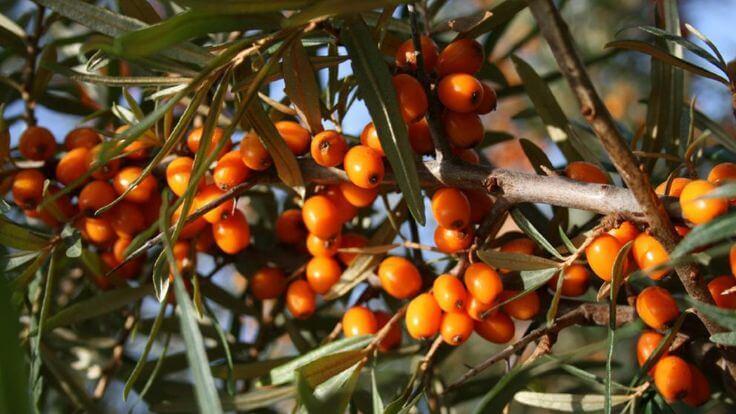
They are very rich in vitamins C and E, and pharmacological studies show that they also exhibit multiple biologically active components
Hippophae is a botanical genus belonging to the Elaeagnaceae family. It comprises about a dozen species, the best known of which, Hippophae rhamnoides, is commonly called sea buckthorn and is used in the preparation of cosmetics, syrups, and juices.
The genus Hippophae is present in a vast area from Europe to Asia, including northern China, Mongolia, India, Nepal, Pakistan, Russia, Italy, England, France, Denmark, the Netherlands, Poland, Romania, Finland, Sweden, and Norway.
Much of the cultivated area is in China, where it is used to prevent soil erosion, as well as serving as food and for the production of medicines.
The plant has a dense crown and a straight trunk with many thorns; it can reach 1 to 3 m in height. The leaves are pale silvery-grayish-green, lanceolate, 3-8 cm long and less than 7 mm wide. It is a dioecious plant, with separate male and female plants.
It is resistant to salt, but needs plenty of sun, not adapting well to shady places.
In Western European countries, it is found mainly in coastal areas, where sea salt does not favor the growth of larger trees. In Central Asia, H. rhamnoides is distributed in arid and semi-desert climate zones, where other plants cannot survive.
Sea buckthorn is also a very popular ornamental plant in gardens, particularly as a hedge and barrier to enclose orchards and rows.
It is also used as floral arrangements in flower shops.
Nutritional and medicinal properties of sea buckthorn
Sea buckthorn is very rich in vitamin C, more so than kiwi and citrus fruits . The pulp of the fruit in its natural state is astringent, bitter, very acidic, and oily, making it unpleasant to the palate unless it is very ripe (once dried, the astringency is reduced) and/or mixed with sweeter fruits.
Freezing reduces the astringent properties , so the pulp can be consumed in the form of juice or in the preparation of jellies, jams and liqueurs.
Some varieties have a high content of vitamin A, vitamin E and essential oils (intensely aromatic, volatile and low density chemicals; they are insoluble in water) and essential fatty acids (they are fatty acids that are not biochemically produced by humans and must be acquired from the diet, for example omega-3 and omega-6; the term “essential fatty acid” refers to fatty acids needed for biological processes and not for those that function as a source of energy).
Fruits contain minerals and micronutrients (trace elements).
Some of the main nutrients, especially lipids with a fatty acid composition such as the monounsaturated palmitoleic fatty acid, as well as omega 3, 6 and 9 fatty acids and the saturated fatty acid, palmitic acid.
It also contains other important components, such as sugars, sugar derivatives, fiber, organic acids, proteins, amino acids, and mineral elements.
They are an important source of food for birds during the winter, especially for thrushes and blackbirds.
More recently, sea buckthorn has been used as an ingredient in nutritional supplements for commercial purposes.
Sea buckthorn oil, extracted by cold pressing, is used as a dietary supplement due to its antioxidant properties . It is attributed with various qualities, such as stimulating the release of fat from adipose cells and the utilization of this released energy by the muscles. The fatty acids, and especially the rarer omega-7 fatty acid, present in the organic sea buckthorn oil have been shown in rats to aid in healthy weight loss, reduce atheromas, stimulate collagen production, increase blood vessel elasticity, strengthen nails and hair, regenerate skin, reduce inflammation and acne, alleviate symptoms of irritable bowel syndrome, and offer other benefits. However, the appropriate dosage for humans is still unknown.
Pharmacological studies have shown that sea buckthorn berries exhibit antibacterial, antifungal, and antipsoriasis (psoriasis is a long-term, non-contagious autoimmune disease characterized by itchy, scaly patches on the skin) properties, as well as antidermatitis and wound-healing effects. Furthermore, they have been included in various cosmetics for skin rejuvenation, wrinkle reduction, scar and pigmentation reduction, and also for addressing hair-related issues.
It is also used as a medicinal treatment for numerous inflammatory conditions such as esophagitis and ulcerations, as well as gangrenous wounds, peptic ulcers, ulcerative colitis, and cervicitis. It is highly recommended for the treatment of scurvy.
It is an appetite stimulant , it reduces asthenia (weakness of physical strength)
The exceptional value of sea buckthorn can be seen in the presence of lipophilic antioxidants (mainly carotenoids and tocopherols) and hydrophilic antioxidants (flavonoids, tannins, phenolic acids, ascorbic acid) in remarkably high quantities.
In industry it is used to prevent non-enzymatic browning (the Maillard reaction is a non-enzymatic browning reaction that can occur in processed foods that have generally been subjected to processing and in living organisms when sugars and amino compounds react, giving dark-colored complexes, the melanoidins).
The antimicrobial and anti-biofilm capacity of a sea buckthorn pulp oil mouthwash was evaluated against Streptococcus gordonii, Porphyromonas gingivalis, Actinomyces viscosus, and Candida albicans. The sea buckthorn-based mouthwash was bactericidal against S. gordonii and P. gingivalis, bacteriostatic against A. viscosus, and showed no antifungal effect. Regardless of the strains used, complete inhibition of oral biofilm formation was achieved . This could overcome the problem caused by many synthetic mouthwash solutions available on the market, which have side effects on teeth, gums, and mucous membranes, making it a potentially interesting and suitable alternative as a preventive agent for periodontal inflammation.
The effects of sea buckthorn berry flour on the sensory, physicochemical, and antioxidant properties, as well as the shelf life, of wheat bread were studied when added to it. The berry flour contains polyphenols such as gallic acid, catechin, chlorogenic acid, cis- and trans-resveratrol, procyanidins, p- and m-hydroxybenzoic acids, and epicatechin, in addition to flavonoids, cinnamic acids, and flavonols such as quercetin. The addition of berry flour increased the antioxidant activity of the bread and extended its shelf life to up to 120 hours by inhibiting spoilage and mold growth. The results obtained recommend the addition of 1% sea buckthorn berry flour to wheat bread to obtain a product enriched with health-promoting biomolecules, with improved sensory and antioxidant properties, and a longer shelf life.
Isorhamnetin (a methylated flavonoid derivative) is one of the most important active ingredients in the fruit of Hippophae rhamnoides L., possessing a wide range of pharmacological activity . Currently, numerous studies have been conducted on this compound, which has cardiovascular and cerebrovascular protective, antitumor, anti-inflammatory, antioxidant, and organ-protective effects, as well as obesity prevention, among others. Isorhamnetin has significant potential for development and application. However, research on its mechanism of action remains limited and incomplete.
It was verified that freeze-dried sea buckthorn powder regulated the composition of the gut microbiota , specifically by increasing the Firmicutes/Bacteroidtes ratio, decreasing the relative population of harmful bacteria (Desulfovibrio), and increasing the relative abundance of beneficial bacteria (Akkermansia and Bacteroides). Changes in beneficial bacteria correlated positively with genes encoding lipolysis and negatively with genes encoding lipogenesis and lipid storage. Pathogenic bacteria exhibited the opposite effect. Furthermore, changes in the gut microbiota had a beneficial effect on the secretion of key metabolites, particularly short-chain fatty acids, especially propionic acid.
Various other pharmacological activities were also described in sea buckthorn berries, such as cytoprotective, anti-stress, immunomodulatory, hepatoprotective, radioprotective, anti-atherogenic, antitumor, and tissue regeneration.
Studies have been conducted on the toxicity of sea buckthorn berry oil, and no teratogenic or mutagenic effects were observed in mouse embryos or Salmonella spp. These results support its safe use for potential dietary consumption in food or as a food supplement.

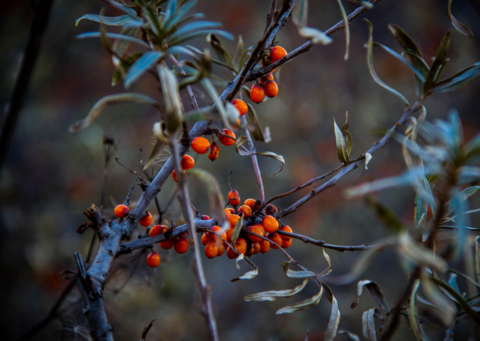
A signature ingredient in a lot of Aroha Oils products, sea buckthorn, survives the harsh conditions of high altitude, exposure to powerful ultraviolet light, excessive cold and heat variations, and baren soil.
This is one tree that has the highest survival instincts with built-in defense mechanisms and water-saving tricks that help it to thrive while not having much nourishment from the land.
But this ingredient is not just a hydrating hero, it also encompasses a range of medicinal and pharmacology benefits.Click to read full article:


Sea Buckthorn Oil Market OverviewThe global Sea Buckthorn Oil Market report focuses on the volume, value, status, and size of the market at the global level, regional level, and company level.
From another perspective, the market has been studied based on historical data and future forecasts.
The global outlook has also been presented with the latest competitive trends and detailed regional analysis for the review period of 2021-2030, with the base year 2019.
The expansion and the reach of the market have also been pointed out in the report.Some of the major players operating in the global sea buckthorn oil market are Connoils, Gustav Heess, Henry Lamotte Oils, OPW Ingredients GmbH, SEABUCKWONDERS, Sibu Seaberry, SLI Chemicals GmbH, Source Naturals, Inc., W.S.
Badger Company and Weleda Natures Aid amongst others.Market dynamicsThis report mentions the marketing channels- direct and indirect marketing- and the dynamics that are factoring the growth of the global Sea Buckthorn Oil Market.
Furthermore, the impact of the increasing population on the global market and the rise in technological advancements has also increased the varying trends of the global market.