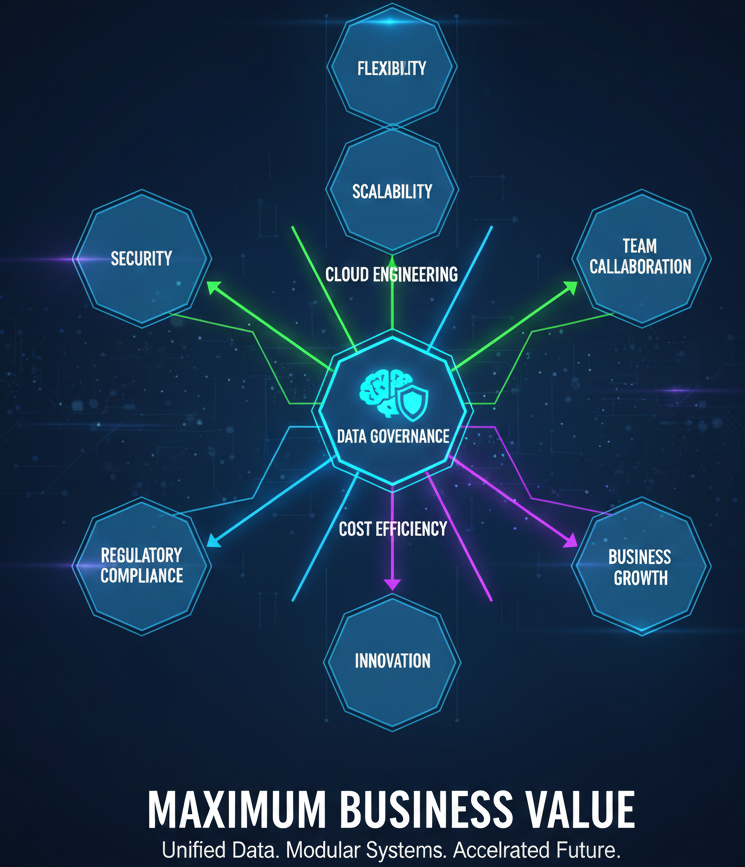
In this digital-first world, businesses rely on cloud platforms to store data, create applications, and operate on a large scale. The flexibility, scalability, and cost efficiency are unmatched, which makes it highly popular across all industries. But as businesses move more data and workflows into the cloud, the importance of cloud engineering and data governance working together increases. The Cloud data engineering and data governance need to be connected to ensure security and success.
Many companies use cloud services because they are quick and easy to set up. But without proper policies, rules, and control over your data, things can get out of hand. This is where cloud engineering and data governance step in for modern businesses. When these two work together, companies find a strong balance between innovation and control.
1. Cloud Engineering Lays the Foundation for Scalable Data Management
Cloud engineering involves designing, implementing, and managing cloud infrastructure and systems to meet an organization’s changing requirements. With modern cloud engineering services, enterprises can expand their data storage and processing capabilities without performance degradation. However, this scalability only works well when accompanied by robust data governance. Integrating governance principles within cloud engineering workflows allows companies to keep their cloud environments organized, controlled, and efficient.
2. Strong Governance Prevents Cloud Misconfigurations and Security Risks
One of the main causes of cloud security incidents is misconfiguration. This includes public storage buckets or even excessive user permissions. This is where simple yet effective cloud governance is important. Modern data governance services set strict guidelines regarding data access, storage, encryption, and compliance with regulations. When these policies are integrated with effective cloud engineering practices, these governance frameworks mitigate risk, eliminate the possibility of human error, and guarantee that appropriate data is consistently safeguarded across the various cloud systems.
3. Regulatory Compliance Is Easier with an Integrated Approach
All enterprises today must comply with legal requirements such as GDPR, HIPAA, depending on the type of industry and business they run. If such regulations are ignored, the business can incur financial penalties as well as damage to its reputation. With cloud computing technology storing and processing large amounts of personal or sensitive data, governance becomes important.
With operational cloud computing technologies enhancing the infrastructure, cloud governance ensures structured and compliant cloud operations. Audit trails, metadata tracking, automated retention policies, and role access controls are examples of the governance frameworks implemented through cloud engineering.
4. Better Data Quality and Trust for Analytics
Today, many organizations depend on data for decision-making, predictive analytics, and automation. But an analytics system is only as reliable as the data it uses. When data on the cloud is poorly governed, the results become unreliable due to inconsistencies, duplication, and errors that lead to unreliable insights.
This is why data governance becomes the most important thing to ensure quality and accuracy. When rules of governance are incorporated into cloud pipelines, such as in data ingestion, storage, and transformation, organizations benefit from trustworthy datasets.
Cloud engineering allows data to flow in and out of systems seamlessly, while governance ensures data stays usable and clean. Together, they help organizations build a foundation of trust in their data insights.
5. Smooth Collaboration Between Teams and Business Functions
Modern cloud ecosystems involve multiple teams: developers, DevOps engineers, data engineers, security teams, compliance officers, and business stakeholders. Without governance, everyone may follow their own processes, leading to confusion and inconsistency.
When cloud engineering and data governance are integrated, organizations are able to ensure that everyone works together under the same standards. Developers follow predefined rules for data usage, analysts know exactly where data comes from, and compliance teams can easily track data flows. This alignment boosts productivity and accountability across departments.
6. Future-Ready Architecture for Innovation
Enterprises are beginning to adopt AI, machine learning, automation, and advanced analytics. All these applications of technology need clean, secure, and appropriately structured data, and that is exactly what data governance guarantees. At the same time, cloud engineering offers the needed computing power and flexibility for today’s innovations.
When both are integrated:
AI models work with high-quality and reliable data
Workloads have the ability to scale automatically
Sensitive information is kept secure
Teams can experiment and innovate faster
This collaboration assists organizations in keeping up in an ever-changing digital world.
Conclusion
In the world of modern business, cloud engineering and data governance are no longer considered separate priorities. They are deeply interconnected. Cloud engineering brings agility and scalable cloud solutions, and data governance policies provide security, compliance and quality. The two pillars enable businesses to create and maintain robust digital ecosystems.
Since companies continue to invest in cloud systems, understanding the significance of this collaboration will determine how well they mitigate risks, leverage data, and foster innovation. The companies that combine both disciplines effectively will stand out as leaders in an evolving digital ecosystem.