In today’s fast-paced world of advanced machinery and automated production, customization has become more than a preference — it's a necessity. Industries across manufacturing, robotics, packaging, electronics, and material handling consistently demand flexible, precise, and space-optimized solutions to keep their operations competitive and efficient. One key component driving this evolution is the Open-ended Timing Belt.
Unlike traditional endless timing belts, an Open-ended Timing Belt provides unmatched versatility in creating tailored drive systems, linear motion applications, and synchronous transport systems. Designed to be cut to any required length and joined—or used as-is—it caters to machines with non-standard layouts, long linear spans, or modular assembly needs.
At Shanghai Puteken Transmission System Co., Ltd., we specialize in producing top-quality Open-ended Timing Belts in a wide range of materials, tooth profiles, and reinforcement options that meet the diverse demands of modern industries. Whether you’re designing an automatic packaging line, a CNC gantry system, or a robotic pick-and-place unit, the Open-ended Timing Belt offers flexibility that conventional belts simply cannot match.
What is an Open-ended Timing Belt?
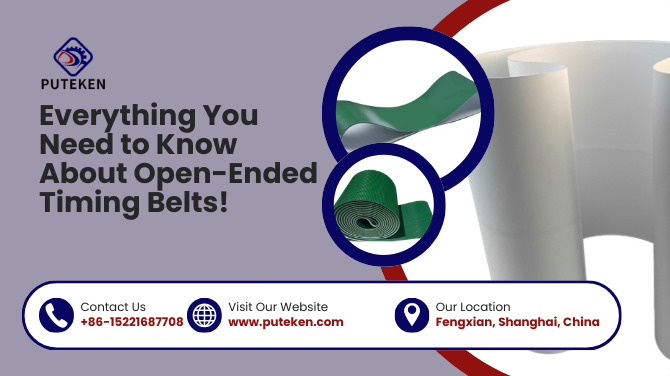
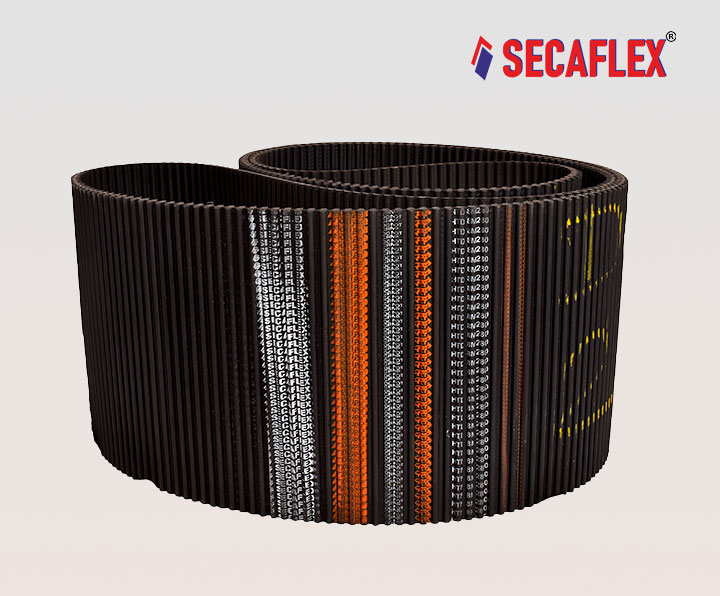
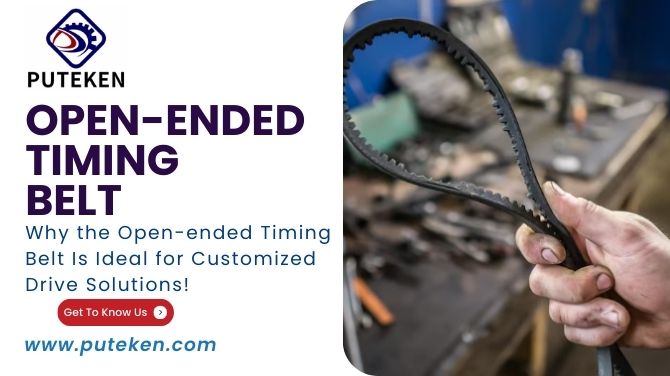
An Open-ended Timing Belt is a toothed belt molded or extruded in continuous lengths, typically made of polyurethane or rubber, and reinforced with tensile cords such as steel, Kevlar, or fiberglass. Unlike endless timing belts that are molded in specific sizes, open-ended belts are supplied as a roll or cut-to-length, making them ideal for drives that require custom or linear configurations.
Core Features:
- Teeth along one side for accurate synchronization
- No joints (unless the user chooses to weld or clamp)
- Reinforced with cords for strength and dimensional stability
- Available in continuous rolls or custom-cut lengths
Why Choose an Open-ended Timing Belt for Customized Drive Solutions?
There are numerous benefits to choosing an Open-ended Timing Belt, especially in systems that demand custom lengths and high precision.
1. Custom Length Flexibility
Open-ended belts allow you to choose exact lengths for your drive systems. Whether your application involves long linear movement in gantry modules or short, modular machine sections, there's no need to rely on pre-molded lengths with limited sizing options.
This is particularly useful in:
- Linear actuators
- Telescopic robotic arms
- Packaging machines with variable sizes
- Machine prototypes and R&D
2. Ideal for Linear Motion and Actuators
In linear motion systems, timing belts are often used to move a carriage or platform along a track with perfect synchronization. Open-ended belts enable you to:
- Fix both ends of the belt to a stationary frame
- Attach the belt to a moving load
- Use it with a rack-and-pinion-style pulley
This setup is widely used in 3D printers, CNC routers, and automated pick-and-place machines.
3. Supports On-Site Belt Assembly
Because these belts are supplied in rolls, users can:
- Cut them as needed during machine assembly
- Join using mechanical clamping devices
- Weld ends using heat or ultrasonic welding tools
This versatility cuts down lead times, facilitates quick replacements, and supports multi-machine customization on-site.
4. High Dimensional Stability
Open-ended belts often include steel or aramid (Kevlar) cords, which means they resist elongation and maintain synchronization over long distances — ensuring positional accuracy even at high speeds or with start-stop cycles.
5. Multiple Tooth Profiles Available
Depending on the system configuration and torque requirements, Open-ended Timing Belts are available in a variety of tooth profiles, including:
- HTD (High Torque Drive): 3M, 5M, 8M, 14M
- AT & T series (metric trapezoidal
- XL, L, H (inch trapezoidal)
- STD (Super Torque Drive) profiles
Each profile is engineered to handle different loads, precision, and pulley sizes.
Industries Benefiting from Open-ended Timing Belts
- Automation & Robotics
Compact robots and multi-axis systems commonly use Open-ended Timing Belts for synchronized travel and precise positioning.
- Packaging & Labeling
Used in modular systems for adjustable-length conveyors, infeed and discharge arrangements, and indexing sections.
- CNC Machinery
Linear gantries and tool heads move smoothly and accurately along custom-length belt tracks.
- 3D Printing & Electronics Assembly
Used in X-Y-Z axis movement with precise belt tensioning in small equipment.
- Medical Equipment
Clean-operation and silent drive requirements make Open-ended Timing Belts ideal for diagnostic and lab automation setups.
- Logistics & Material Handling
Used in shuttle drives and guided transport units where belts must align with dynamic facility layouts.
Key Selection Tips for Open-ended Timing Belts:
Choosing the correct Open-ended Timing Belt involves consideration of:
1. Load and Torque Requirements
Higher loads require wider belts, reinforced cords, and larger pitch tooth profiles.
2. Length and Tension
For longer runs, belts must maintain tension and alignment; here, steel cords are ideal.
3. Speed and Acceleration
Quick motions demand low-friction materials and coated pulley tooth faces.
4. Operating Conditions
For damp, dusty, hot, or sterile environments, choose belts with appropriate chemical and thermal resistance.
5. Pulley Compatibility
Match the tooth profile precisely to avoid early degradation or failure.
Why Choose Shanghai Puteken for Your Open-ended Timing Belt?
At Shanghai Puteken Transmission System Co., Ltd., we combine precision engineering with material innovation to provide belts that perform reliably in the most challenging environments.
Our Advantages:
- Large stock of common profiles and reinforcement combos
- Customized belt lengths, coatings, and teeth pitch
- In-house welding and mechanical joining options
- Global shipping with fast lead times
- Engineering team for part-to-system consultations
- Export-friendly packaging and multi-language documentation
Whether you're upgrading one machine or scaling across multiple production lines, we’re here to support your success.
Flexibility Meets Function in Open-ended Design
The Open-ended Timing Belt isn’t just a flexible alternative to traditional belts—it’s a strategic component for companies seeking to optimize performance, scalability, and machine integration. Its customizability, linear motion capability, and durability make it essential in today’s dynamic industrial automation environments.

Frequently Asked Questions (FAQ)
1. What’s the maximum length available for an Open-ended Timing Belt?
We provide belts in rolls (up to 100 meters or more), or custom-cut to your required lengths.
2. Can I join Open-ended Timing Belts on-site?
Yes! Belts can be heat-welded with a portable welder or joined using mechanical clamps.
3. What is the typical lifespan of an Open-ended Timing Belt?
Lifespan varies by use, but polyurethane belts can last 1 to 5 years, depending on speed, loading, and maintenance.
4. Do Open-ended Timing Belts require a special pulley?
Only requirement is exact tooth profile match. All other drive components should be aligned to handle the belt's pitch and width.
5. What’s the difference between open-ended and endless timing belts?
Open-ended belts are supplied in linear form and can be cut or joined, while endless belts are a closed loop molded to a fixed length.
6. Can I request FDA or food-grade Open-ended Belts?
Absolutely! We offer FDA-approved PU and EU food-grade compliant belts suitable for direct food contact and washdown.