


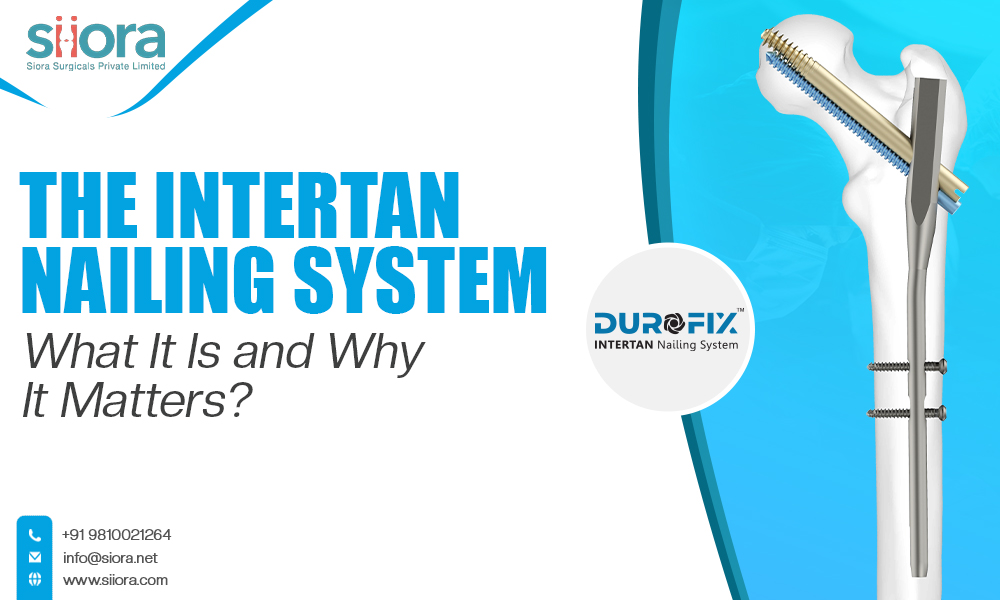
The Intertan nailing system is a fourth-generation cephalomedullary nail designed for the fixation of intertrochanteric and subtrochanteric fractures of the proximal femur. Instead of a single lag screw or blade, it uses two integrated cephalocervical screws within one construct, giving it a very different behavior under load compared with conventional nails. For surgeons treating unstable hip fractures—especially in elderly osteoporotic patients—that design detail matters a lot.
What Exactly Is the Intertan Nail?
Intertan (short for “intertrochanteric antegrade nail”) is an intramedullary implant placed through the tip of the greater trochanter into the femoral canal and across the fracture into the femoral head. Its key features include:
- A trapezoidal, anatomically shaped nail rather than a purely circular profile, which improves fit in the proximal femur and resists rotation within the canal.
- Two integrated cephalocervical screws (a larger lag/compression screw and a smaller antirotation screw) that sit within a common barrel, locking together as a unit.
- A pre-loaded set screw mechanism that allows active intraoperative compression at the fracture site and can convert the construct to fixed-angle if desired.
By combining these features, the system behaves like a hybrid between a dynamic hip screw and a locked intramedullary nail, while avoiding some failure modes seen with single-screw or helical blade devices.
How the Dual-Screw Design Works?
In conventional cephalomedullary nails, a single lag screw or blade carries both axial load and rotational control. That can lead to excessive sliding, femoral head rotation, cut-out, or the “Z-effect” where one screw migrates and the other backs out. Intertan’s two screws are integrated within one mechanism:
- The lag screw provides fracture compression along the neck axis.
- The antirotation screw interlocks with the lag screw to block head rotation and share load.
This unified two-screw construct increases torsional stiffness, improves resistance to femoral head rotation, and reduces the risk of screw cut-out compared with single-screw systems. Biomechanical work shows better anti-compression and anti-rotation stability than Gamma-type nails in unstable intertrochanteric models.
Indications and When Surgeons Use It?
According to manufacturer information and clinical series, the Intertan nail is indicated for:
- Unstable intertrochanteric fractures (e.g., reverse obliquity, comminuted patterns)
- Subtrochanteric fractures and some basilar neck fractures
- Osteoporotic fractures in elderly patients who need strong rotational control and early mobilization
It is particularly attractive in unstable AO/OTA 31-A2 and A3 fractures, where conventional implants have higher rates of varus collapse and cut-out. For subtrochanteric extensions, longer Intertan nails span the fracture zone while the cephalocervical construct secures the head–neck segment.
What the Clinical Evidence Shows?
Multiple comparative and meta-analytic studies have looked at Intertan versus PFNA or Gamma nails in unstable intertrochanteric fractures.
Key findings include:
- Cut-out and femoral fracture rates are lower with Intertan than with single-screw systems like Gamma or PFNA.
- Early functional outcomes (e.g., Harris Hip Score at 1–6 months) and time to full weight-bearing tend to be better with Intertan in several cohorts.
- Long-term hip scores and union times are often similar to PFNA/Gamma once healing is complete, but Intertan consistently shows a lower risk of mechanical failure.
- Some studies note longer operative times and more blood loss with Intertan because of its more complex cephalocervical instrumentation, although overall complication rates are comparable.
In one systematic review, Intertan did not clearly outperform one-screw nails in overall functional recovery, but it did show significantly fewer implant cut-outs and peri-implant femoral fractures. Another meta-analysis found better short-term hip function and fracture healing time with InterTAN compared with PFNA, while PFNA had advantages in surgical efficiency.
Why It Matters in Everyday Practice?
For surgeons, the Intertan system matters because it offers:
- Robust mechanical control in high-risk, unstable fracture patterns where failure can be disastrous in frail elderly patients.
- The ability to actively compress the fracture in a linear fashion without rotating the femoral head, improving contact and promoting union.
- A design that reduces classic failure modes (head rotation, cut-out, Z-effect, peri-implant fractures) seen with some earlier cephalomedullary systems.
For patients, this often translates into:
- Earlier and safer weight-bearing, which is crucial for elderly individuals at risk of deconditioning, pneumonia, and other complications of immobility.
- Lower chance of needing a revision surgery because of mechanical failure, which is especially important in those with limited physiological reserve.
At the same time, Intertan is not automatically “better” in every case. Evidence suggests that while it offers biomechanical advantages and fewer specific implant failures, overall functional outcomes and union rates are similar to PFNA or Gamma nails when fractures heal uneventfully. Because surgery with Intertan can be slightly longer and more technically demanding, many authors recommend choosing between Intertan and simpler nails based on fracture stability, bone quality, surgeon experience, and patient priorities.
In short, the Intertan nailing system matters because it gives surgeons a powerful, mechanically sophisticated option for the most challenging proximal femur fractures—those where preventing orthopedic implant failure is just as important as getting the fracture to heal.


Nail Arts onlineNail Culture provides Nail Culture, nail art, nail forum, nail tutorial.
Our mission is to provide a platform for nail enthusiast from all over the world.

Nail CultureNail Culture provides Nail Culture, nail art, nail forum, nail tutorial.
Our mission is to provide a platform for nail enthusiast from all over the world.
Nail ArtNail ForumNail TutorialNail Arts online