


Introduction
Medical device manufacturers aiming to enter or expand in the European market must comply with strict regulatory requirements under the Medical Devices Regulation (EU) 2017/745. CE marking is no longer a procedural formality but a comprehensive demonstration of safety, performance, and regulatory control across the entire product lifecycle. In this context, medical device turnkey plant projects play a critical role, as manufacturing facilities themselves are closely examined during conformity assessment. Integrating EU MDR and CE marking requirements at the earliest stages of plant planning, design, and execution is essential to avoid delays, non-compliances, and costly redesigns later in the process.
Facilitating CE Mark and EU MDR Compliance in Turnkey Manufacturing Projects
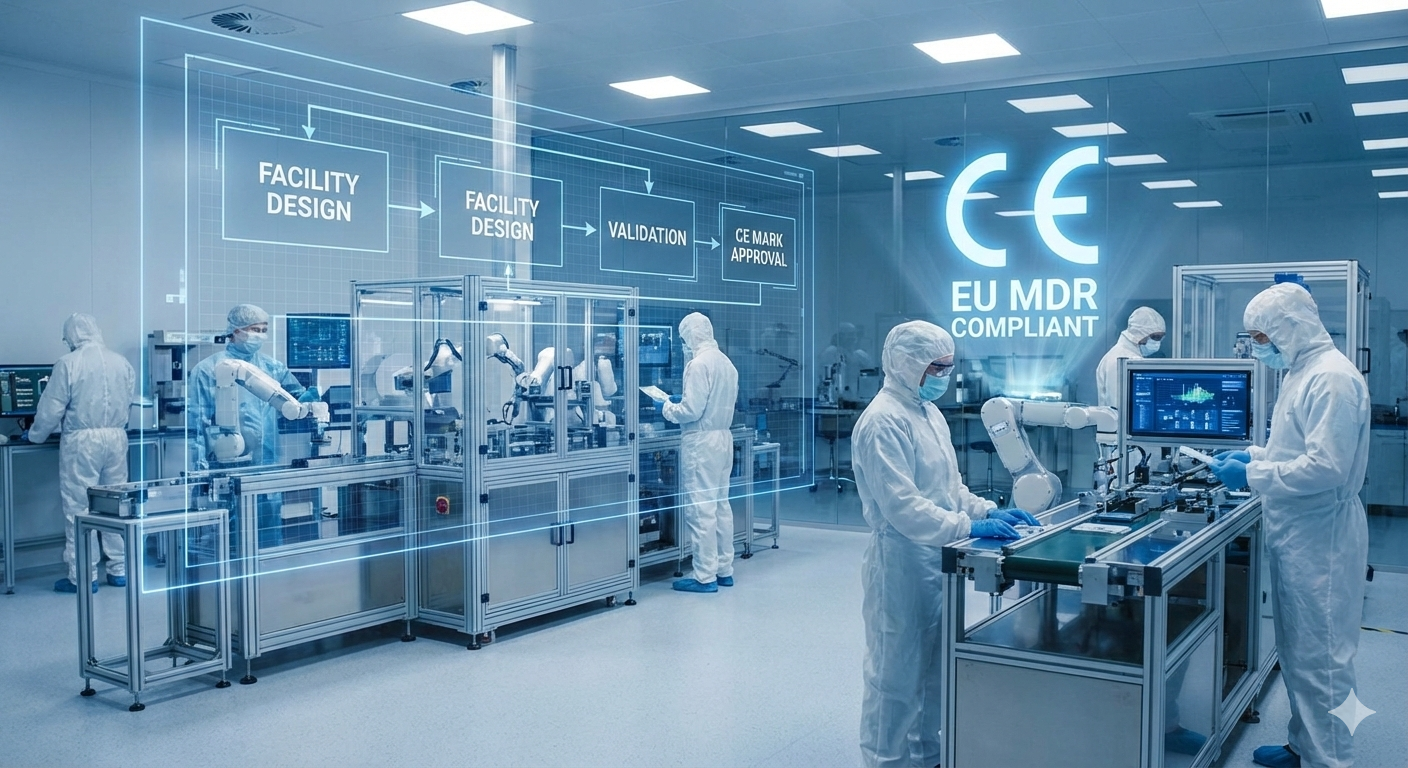
A turnkey medical device manufacturing plant typically includes facility design, construction, utilities, cleanrooms, equipment installation, validation, and regulatory readiness. Under EU MDR, manufacturing sites are evaluated not only for their physical infrastructure but also for how effectively they support a compliant quality management system. This makes regulatory integration a strategic requirement rather than an operational afterthought.
CE marking under EU MDR signifies that a medical device conforms to applicable safety and performance requirements and is manufactured under controlled and validated conditions. Compared to the earlier Medical Device Directive, MDR introduces stricter expectations around clinical evidence, post-market surveillance, traceability, and risk management. These requirements directly impact how manufacturing plants are designed and operated. Facility layouts must support material segregation, contamination control, defined workflows, and documentation practices that align with ISO 13485 and MDR Annex IX requirements.
One of the most significant regulatory foundations for MDR compliance is the implementation of an ISO 13485-compliant quality management system. In a turnkey project, this system should be embedded during the plant setup phase, not added later. Processes such as document control, training, supplier qualification, change management, and corrective and preventive actions must be reflected in both operational procedures and physical infrastructure. Cleanroom classification, environmental monitoring systems, and controlled storage areas must align with the intended device risk class and manufacturing processes.
Risk management, as defined under ISO 14971, is another critical aspect influencing turnkey plant design. Manufacturing-related risks such as contamination, process variability, equipment failure, and human error must be identified and mitigated through facility controls, validated processes, and equipment qualification. Installation qualification, operational qualification, and performance qualification are essential to demonstrate that equipment consistently performs as intended within defined parameters. These validation activities form a core part of the technical documentation reviewed during CE marking assessments.
EU MDR also places strong emphasis on technical documentation and traceability. Manufacturing plants must support the generation and maintenance of comprehensive device technical files, including design history, manufacturing records, labeling controls, and unique device identification implementation. Turnkey projects that consider data integrity, electronic record systems, and document retention from the outset are better positioned to meet MDR Annex II and III requirements without major corrective actions.
Notified Bodies play a central role in CE marking under MDR, and their audits extend beyond product review to include manufacturing site inspections. Facilities that integrate regulatory expectations early experience smoother audits, fewer non-conformities, and shorter approval timelines. Common challenges such as late-stage regulatory involvement, incomplete validation, or misaligned facility layouts often result in delays and increased compliance costs. A compliance-driven turnkey approach minimizes these risks by aligning engineering, quality, and regulatory objectives from day one.
Early regulatory integration also provides long-term benefits beyond initial CE marking. MDR-ready manufacturing facilities are more scalable, audit-ready, and adaptable to future regulatory changes. They support efficient post-market surveillance activities, complaint handling, and continuous improvement, all of which are essential under the MDR lifecycle approach. For manufacturers targeting multiple global markets, such facilities also simplify alignment with other regulatory frameworks such as FDA QSR and MDSAP.
Conclusion
Facilitating CE marking and EU MDR compliance through medical device turnkey plant projects requires a proactive, integrated approach that combines regulatory strategy with facility planning and execution. By embedding quality systems, risk management, validation, and documentation requirements into the plant design stage, manufacturers can significantly reduce compliance risks and accelerate European market access. A compliance-focused turnkey manufacturing facility is not only a regulatory necessity but also a strategic asset that supports sustainable growth, global competitiveness, and long-term regulatory confidence.
Read more about Regulatory Support at- Facilitating CE marking and EU MDR compliance





FDA Listing Inc. is top FDA US agent, who will help in the FDA device registration process and compliance with FDA rules.
We are available 24 hours a day to answer your questions via our Online Live Help.