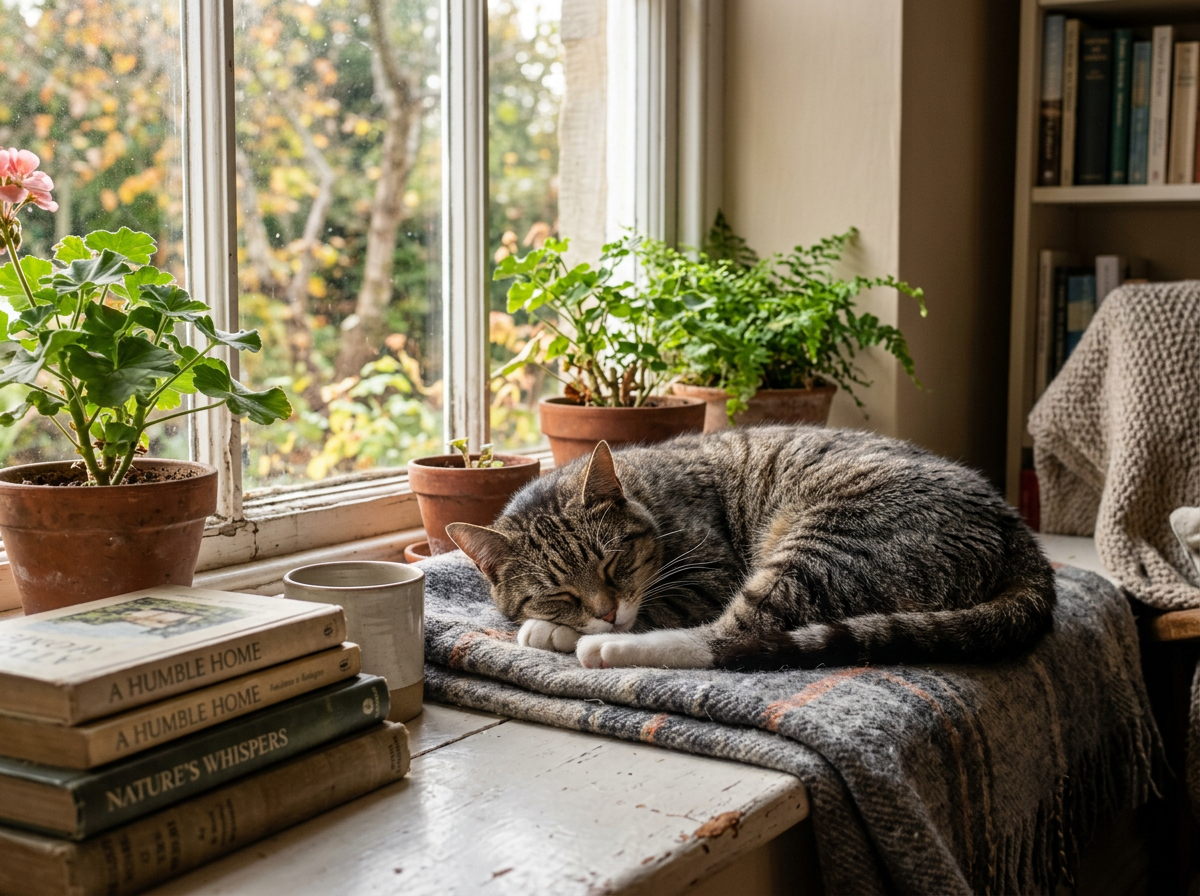



cat in apartment window: A Curious Stray Finds Footing on a City Sill and Begins a Quiet Transformation
The city moved like a living river, a current of clamor and color that never paused to rest. Above the bustle, in a sun-warmed corner of a modest apartment, a small figure watched the world with patient, amber eyes. Whiskers belonged to a lean, orange-striped cat with a tail that curled with a dancer’s grace and paws that carried him from shadow to shadow with practiced ease. He was a nomad, a traveler who wore the city like a well-worn coat, each lane and alley a chapter in a book written in paw prints and meows. From a window that looked out on a street lined with cafes, bus stops, and the occasional glint of rain on glass, Whiskers studied the choreography of life below—red buses gliding, cyclists weaving, pedestrians swapping stories with the rhythm of footsteps against concrete. Yet for all his roaming, the window remained his stage and his sanctuary, a thin border between the world and a quiet inner life that moved with him like a soft wind in fur. The apartment itself belonged to a shy widow named Margo, a woman who moved through days with the careful gentleness of someone who preferred the hush of a well-worn chair and a kettle that sang every morning. Her rooms were neat and unadorned, save for the small plants she coaxed to life and the paintings she kept framed along the walls, quiet memories painted in blues and greens. Margo kept to herself, yet in the evenings she listened to the radio with the volume low, as if the music could slip through the walls and tell her something she’d forgotten to hear. She did not rush to greet the day with a chorus of neighbors or a flood of laughter; she preferred the soft cadence of routine, the predictable rhythm that kept the ache of loneliness at bay. It was into this quiet rhythm that Whiskers introduced the first tremor of change. From the moment he found the apartment window, the curious stray’s gaze found Margo’s. He did not immediately gravitate toward her like some cats do toward the first warm scent of a bowl. Rather, he paused on the sill, nostrils flaring at the scent of tea leaves, dust, and the faint sweetness of old books that rested on a nearby shelf. He watched as circles of sunlight spilled across the room and settled on the wooden floor, and for a moment, the world behind the glass seemed to tilt, as if the city itself paused just for him to observe. In those first days, he was a respectful visitor, content to observe from a distance, to test the tremor of a curtain or to sniff at the warmth that pooled near the radiator. He learned to time his visits with the sunbeams that threaded through the window like yellow ribbons, a pattern that grew into a comforting routine. In the evenings, as the city’s din finally loosened into a softer clatter, Whiskers would alight at the window ledge, and for a heartbeat, Margo would find herself forgetting the weight of days past and simply listen to the quiet conversation between a human heart and a creature who did not demand words. The cat’s gaze was not demanding; it was simply attentive, as if he could see into the small gallery of a life that had once seemed closed to new joy. He would tilt his head, study the lines of her face, and, if she dared a small gesture, he would arch his back just enough to let a hint of warmth escape his fur as if to say: I am here, and I mean to stay if you will have me. And slowly, almost imperceptibly, a bridge began to form—the bridge of attention, of listening eyes, of a shared time that felt like the slow turning of a key in a lock that had not clicked in years. The city, with all its noise and color, had never seemed to invite such tenderness before. Whiskers was a stray with the sort of freedom that most cats in the city used as an armor: the ability to wander, to slip through back doors, to vanish into the narrow gaps between brick and dream. But the window—this thin pane of glass that kept the world in reach and the world out—gave him a new sense of home. He learned to navigate the building’s corners with an almost human patience, reading the faces of those who passed by the street below as if they were the pages of a daily newspaper. He listened for the telltale footsteps of the mail carrier, the soft hum of a bicycle wheel, the whistle of a passing train, and each sound stitched another thread into the fabric of his new sense of belonging. In this way, the cat in the apartment window became a quiet observer of life, and life, in turn, began to observe him back, translating his small movements into small acts of connection. Yet it was not simply a matter of a cat and a widow who shared a room and a window. It was more like a slow, unspoken agreement that kindness—tiny and patient—could be enough to alter the weather of a life. The woman’s shyness did not vanish overnight, nor did Whiskers suddenly become the sort of creature who demanded praise or applause. Instead, a gentle exchange began to unfold: a bowl of milk that appeared on a window ledge when Whiskers paused for a moment of rest; a plate of warmed fish left at the edge of the hall when Margo found herself growing bolder in the practice of care; a note, perhaps, in the form of a soft wind that rustled the curtain and reminded both of them that the world could still be approachable. The cat did not merely seek warmth; he sought recognition—the acknowledgment that his presence mattered, that a life could be touched by a single, deliberate act of kindness. In those moments when the city outside sounded loud and unyielding, Whiskers learned a new language: the language of small favors that accumulate into a sense of home. He did not hurry toward the world’s grand gestures; he moved with the careful, thoughtful pace of someone who knows that patience is often the first layer of trust. And as the days wore on, the widow’s routine grew to include him in a way that felt almost like a shared ritual. He would appear at the window when she finished her tea, and she would lean slightly into the light, offering a quiet nod that meant: You are safe here. Her smile, though subdued, grew more certain as weeks passed; it was a heartbeat longer, a breath more outward, a sign that loneliness could be coaxed away by a single presence that refused to give up. The window, in time, ceased to be merely a view of a busy street. It became a portal through which two different kinds of longing—one for companionship and one for connection—found common ground. Whiskers learned the cadence of the widow’s footsteps when she moved through the apartment; Margo learned to anticipate the way Whiskers would perch on the sill at dusk, a silhouette framed by the last gold of the setting sun. The bond that grew was not loud or dramatic; it was the kind of bond that settles into the corners of a room like a warm blanket, a gentle reminder that sometimes the smallest creatures can leave the largest imprints on a life. And as the city’s night noises faded into a soft, comforting hush, the widow and the stray cat found themselves sharing a more intimate kind of conversation—one not spoken in words, but in the shared rhythm of a heart at ease. This quiet evolution—the cat in the apartment window learning to read a human heart, and the widow learning to receive a creature’s trust—set the stage for something larger than either had anticipated. The city has a way of offering such opportunities to those who listen: a chance for a heart to soften, for a door to open just a crack, for a neighbor to become a friend. Whiskers did not ask for a title, nor did Margo demand a change in her life’s architecture. They simply allowed a new possibility to creep into their world, a possibility that whispered of a home that could be built not from bricks alone, but from acts of kindness shared across a single kitchen table, an open window, and a mutual willingness to let another life into their quiet orbit. And as the sun rose over the roofs of the neighborhood, it illuminated a truth the cat had long known in his roaming heart: home is not merely where you sleep; home is a place where your presence is noticed, your needs respected, and your company welcomed, even in the most ordinary of moments.
city cat story: Between Sidewalk Chirps and Silent Windows, a Neighborhood Binds Itself to a Stray Who Teaches Them to Listen differently
The city was a living mosaic of doors, stairwells, and stair-step routines, each fragment telling a short, bright story. Whiskers moved through this mosaic with the ease of a sentry who has learned the best routes around a labyrinth. He did not hurry to find a home; he wandered with the confidence of someone who believed that every corner held a small opportunity to tell a story. And the stories, as they gathered around his path, began to weave a larger narrative—one that was less about where he would live and more about who would choose to see him, who would choose to listen when he meowed, who would offer a shared silence when the world grew too loud for words. The widow’s life, previously framed by routine, grew a new emphasis on small acts that reminded her she was part of a wider circle. She did not become a social butterfly overnight, but she began to step onto the balcony with a cup of tea on afternoons that felt unusually bright. She would speak softly to Whiskers, as if to remind herself that her voice could carry warmth even into a corner of the world that often seemed too loud, too full of noise to notice a distant, quiet creature in need of companionship. The cat, for his part, did not demand attention so much as offer a steady, dependable presence. He appeared when the day’s errands concluded, when the mail carrier rode his bike with a cheerful whistle, and when the wind turned the curtains into a slow, breathing thing that the room shared with him. The mail carrier—affable, patient, with a smile that took into account the kind of day you had before you even spoke—became an unwitting coauthor of this story. He carried packages wrapped in brown paper, but his real gift was the way he spoke to people (and to animals) as if the world were a place full of equal chances to be noticed and cared for. He would stop for a moment at the curb, greet Whiskers with a soft call—“Hey there, little scout”—and, if the cat wasn’t in a hurry, he would offer a brief, almost ritualistic bow of respect to the animal who had become the resident celebrity of the block. He would then hand over a can or a bowl, a small token meant to sustain the cat’s wandering, a tacit acknowledgment that the cat’s presence made the people around him feel seen in a way the city itself sometimes failed to accomplish. In these small exchanges, the neighborhood learned something essential: that kindness does not require fame or grand gestures, only the willingness to slow down enough to hear a quiet voice asking for a little care. The widow, the mail carrier, and Whiskers found themselves drawn into a shared orbit that felt less like coincidence and more like purpose. The cat, with his whiskers twitching in response to the city’s breath, became a symbol of how a single, observant heart could alter the weather of another life. For Margo, the shy widow, the cat’s presence created a door in the wall of her own reserve. It was not a door to a carnival of social life, but to a small, intimate place where she was more than a caretaker of plants and trinkets—she was a person who could still be surprised by a creature’s trust and a stranger’s kindness. For the mail carrier, the sight of Whiskers offered a reminder of a city’s quiet heroism—the people who give a little time and a little warmth, not for praise, but because it matters. The cat’s quiet presence healed some of the ache that had crystallized inside the widow, while his companionship offered the mail carrier a sense of purpose that no route or receipt could ever fully replace. In time, the stories braided together into a single thread: a small life in a window teaching a larger community to notice, to pause, to respond with gentleness. The city’s noise did not vanish, but its edges softened around the corners where Whiskers rested, where Margo stood watching the world from her doorway with a cup of tea, and where the mail carrier’s whistle carried a note of hope that kindness could be found in ordinary places and ordinary people. The narrative grew from a stray’s curiosity into a shared sense of belonging that no one had planned, yet everyone welcomed. It was as if the city itself exhaled a little more slowly when the window opened and invited the world to peek inside—inside a quiet life, inside a heart that learned to trust again, inside a home that could bloom not because of bricks or a plan, but because of the simple, steadfast act of letting someone in.
whiskers in window: The Quiet Promise of Family Grows Where Kindness Is Shared
Time stretched with an unhurried patience, and Whiskers’s routine became the calendar by which the world measured its softer days. He learned to judge the rhythm of the widow’s life by the light of the sun on the kitchen tiles and by the cadence of her steps as she moved from room to room, doing what needed to be done with a careful, almost meditative grace. He started to drift closer to the edge of the sill during the day, not rushing his stance but simply watching the hours pass like a patient observer who understood that the best stories unfold in quiet spaces between actions. The widow’s heart, long protected by walls of habit and caution, began to thaw in the warmth of this patient companionship. She found herself anticipating Whiskers’s check-ins—his soft, almost musical purrs when she bent to stroke him, his contented sighs when she filled the bowl, his paws kneading at the air in a tiny, hopeful ritual that spoke of comfort rather than need. There came a morning when the window’s light poured in with a generous ease, and Margo realized that the room she had kept as a sanctuary was becoming a haven not merely for herself but for a creature who had chosen her as a place to land. The idea of family, once a delicate ache anchored to memory and loss, began to crystallize into something tangible: a shared space where another life could contribute to the daily chorus of living, not disrupt it. It wasn’t a sudden decision to adopt Whiskers in name and law; it was a slow, compassionate accumulation of moments that convinced them both that home could be cultivated with care and patience, and that belonging could be built on the simple, generous practice of opening a door and letting kindness cross the threshold. Meanwhile, the neighborhood watched and learned from this gentle transfiguring of space. The city is not only a map of streets but a map of hearts, and as Whiskers hopped onto the window ledge with that familiar nonchalant confidence, people began to speak of him as if he belonged to more than one life. Children who passed by would tell their mothers about the cat who watched the world with such steady curiosity; older neighbors would smile at the memory of their own vanished pets and see in Whiskers a soft echo of long-ago companionship. The mail carrier began to tell a small, true story to anyone who would listen: how kindness is a daily practice, how a small bowl of food and a patient, unhurried greeting can become the hinge upon which someone’s day swings from loneliness to a sense of being seen. And in the quiet, the most important truth emerged: home is not merely a place but a practice. The widow did not need to move with the energy of youth, nor did Whiskers demand a dramatic courtship from the world. What mattered was an exchange, a shared space of trust, and a daily choice to be kind. They found in each other a family’s beginning. The window—once a simple frame through which to observe life—became a doorway, a liminal space where two souls met halfway. Whiskers learned to trust the human world not by force of will, but by the patient invitation of a companion’s presence. Margo learned that trust is a soft garment that fits best when worn gently, over time, and that the deepest warmth can come from allowing a stray to rest near the heart’s quiet chambers. So the city carried on around them, with its rivers of traffic and its towers of light, but in that little corner of an apartment, a family grew. Home bloomed not because the walls declared it so or because a card was signed or a contract drawn up, but because kindness traveled from one window to another: a curious stray’s gaze met a shy widow’s smile, a friendly mail carrier offered his small acts of care, and a shared moment of quiet companionship stitched them into a new, fragile, enduring family. Whiskers in the window had found more than shelter; he had found belonging. And Margo learned, with a gentle, surprising courage, that sometimes the best way to mend a heart is to open a door and invite a world in, to share your life with another creature who chooses you as much as you choose them. In the end, a city that had once seemed too loud, too busy, too indifferent to the small stories of ordinary lives learned to listen again. The cat’s soft paws and the widow’s softened heart together wrote a new paragraph in the city’s living book, a story of a home that is not built by heralded triumphs but by the quiet, steadfast sharing of kindness.