

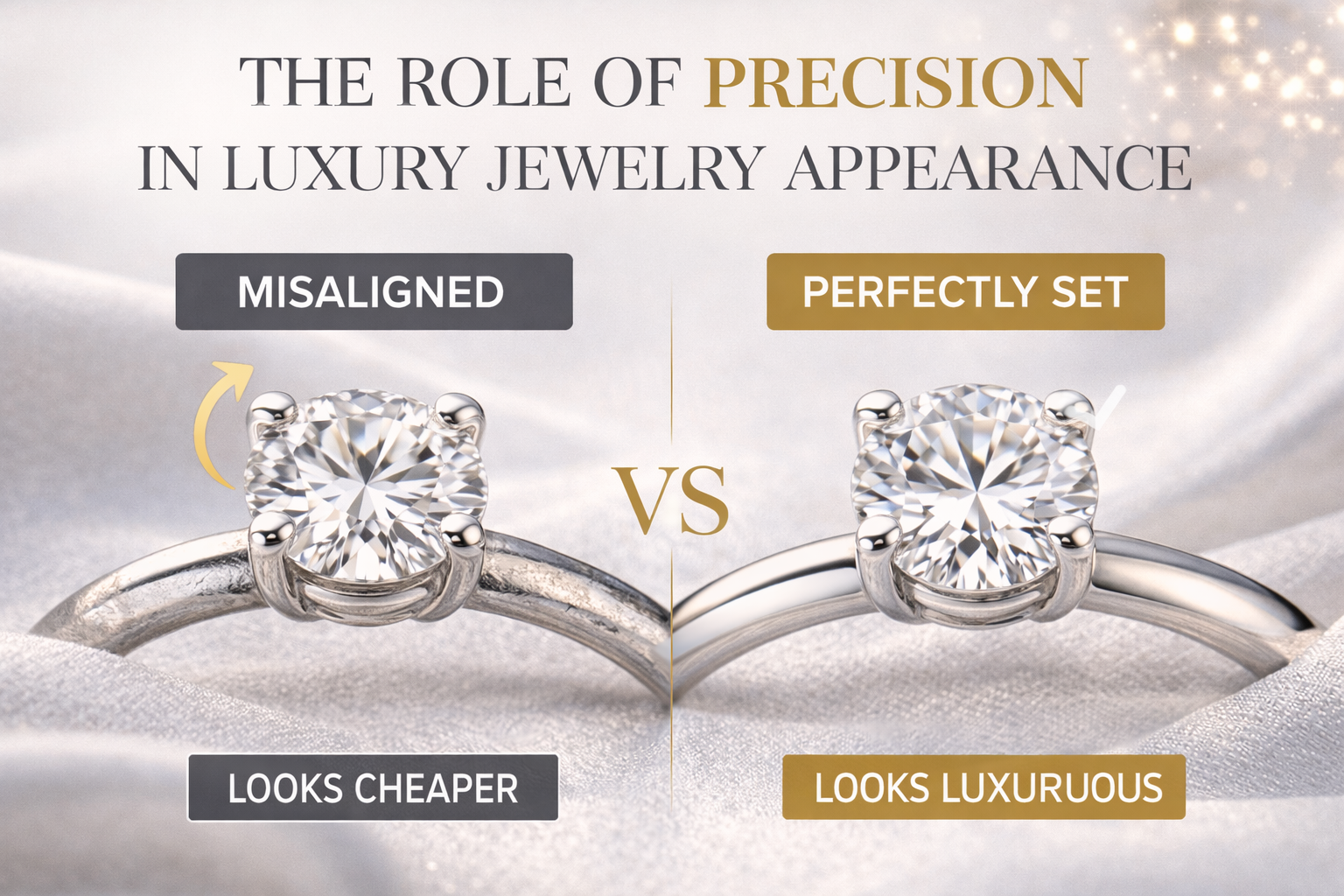
Have you ever compared two diamond rings that looked almost identical on paper — same gold purity, similar carat weight, and nearly the same design — yet one immediately felt luxurious while the other seemed ordinary?
This experience is more common than most buyers expect.
On specifications alone, the two pieces may appear equal. But when you see them in person, one looks refined, balanced, and brilliant from every angle. The other may feel slightly off — not necessarily flawed, but lacking that unmistakable high-end presence.
In most cases, the difference isn’t the materials.
The difference is precision.
Many buyers feel confused when similar jewelry pieces are priced differently. Others feel disappointed when a piece that looked beautiful online doesn’t feel as premium in real life. Without understanding what creates that elevated appearance, it’s easy to assume the difference is branding or markup.
In reality, luxury jewelry is defined by accuracy — often measured in fractions of a millimeter.
Precision affects everything: how evenly diamonds are aligned, how smoothly metal transitions flow, how balanced the proportions feel, and how light reflects across the entire piece. When every element is perfectly placed and proportioned, the result looks effortless and expensive. When small misalignments occur, the piece can feel slightly less refined, even if the diamonds and gold are technically high quality.
This article explains what precision really means in jewelry craftsmanship, how it influences sparkle, symmetry, and perceived value, and why it separates mass-produced pieces from true luxury. You’ll also learn practical ways to identify precision before buying, so you can choose jewelry that looks balanced, refined, and premium for years to come.
What Precision Means in Jewelry Craftsmanship
Accuracy in Design and Manufacturing
Precision in jewelry refers to exact measurements, tight tolerances, and consistency across every component. Each part of the piece — from prong height to stone spacing to metal thickness — must be carefully controlled.
In luxury jewelry, even tiny variations can affect the final appearance.
Precision vs General Craftsmanship
Many people associate luxury with handmade jewelry, but precision is about accuracy, not just handwork. The best pieces combine advanced technology with skilled artisans who refine and adjust every detail.
True craftsmanship means executing the design exactly as intended, not simply shaping it by hand.
Why Precision Defines Luxury Standards
High-end jewelry requires near-perfect symmetry and alignment. Stones must sit level, metal lines must flow smoothly, and proportions must remain consistent throughout the piece.
This level of control is what creates the clean, balanced look associated with luxury.
How Precision Affects Overall Appearance
Perfect Symmetry Creates Visual Balance
The human eye naturally responds to symmetry. Even spacing, centered stones, and balanced proportions create a calm, refined visual effect.
When elements are slightly uneven, the piece may look less polished without the viewer knowing exactly why.
Clean Lines and Defined Edges
Precision allows for sharp yet smooth contours. Edges look intentional, curves flow naturally, and transitions between components feel seamless.
This clarity of form signals high-quality craftsmanship.
Consistency Across the Entire Piece
Luxury jewelry maintains uniformity throughout:
- Even metal thickness
- Matching stone sizes
- Consistent spacing
- Balanced proportions
This consistency gives the piece a cohesive, premium look.
Precision in Diamond Setting — The Biggest Visual Factor
Prong Alignment and Shape
Prongs should match in height, thickness, and spacing. Uneven prongs make the setting look less refined and can affect stone security.
Stone Positioning and Centering
Each diamond should sit perfectly level and centered. A tilted or slightly off-center stone reflects light unevenly and reduces visual balance.
Consistent Stone Spacing in Multi-Stone Jewelry
In tennis bracelets, eternity bands, and pavé designs, uniform spacing is critical. Even small gaps or irregular spacing can disrupt the overall appearance.
Why Precision Increases Diamond Sparkle
Proper Angles Allow Maximum Light Return
When diamonds are positioned correctly, light enters and reflects evenly, increasing brilliance and fire.
Level Stones Prevent Dark Spots
If a stone sits unevenly, parts of it may appear darker because light is not returning properly.
Tight, Accurate Settings Enhance Brilliance
Secure, precise settings hold the diamond at the optimal position for light performance.
Misalignment Reduces Fire and Scintillation
Even high-quality diamonds can appear less lively if they are poorly aligned.
The Difference Between Mass-Produced and Precision-Made Jewelry
Speed vs Accuracy in Production
Mass production prioritizes speed. Pieces are made quickly, often allowing for small variations that affect alignment and symmetry.
Loose Tolerances vs Tight Tolerances
Luxury manufacturing works within very tight tolerances, ensuring every component fits and aligns perfectly.
Automated Bulk Production vs Detailed Quality Control
While machines are used in both cases, high-end jewelry undergoes multiple inspections and manual adjustments.
Why Precision Pieces Cost More
Achieving high precision requires advanced equipment, skilled labor, additional time, and strict quality control.
The Psychology of Precision and Perceived Luxury
Humans Instinctively Notice Symmetry
Balanced, symmetrical objects feel more pleasing and refined to the eye.
Precision Signals Care, Time, and Expertise
When a piece looks perfectly aligned, it communicates that time and skill were invested in its creation.
Subconscious Association With Premium Brands
High-end brands are known for consistency and accuracy, which reinforces perceived value.
Why Slight Imperfections Make Jewelry Look Cheaper
Even small irregularities can reduce the sense of refinement, making the piece feel less luxurious.
Common Buyer Mistakes Related to Precision
- Focusing only on diamond specifications
- Ignoring alignment and symmetry
- Not viewing jewelry up close
- Buying based only on online photos
- Choosing the lowest price without comparing craftsmanship
Precision differences often become visible only through close inspection.
Practical Guide — How to Check Precision
Inspect Stone Alignment Under Light
Look to see if all stones sit level and face the same direction.
Check Prongs for Even Height and Shape
Prongs should appear uniform and symmetrical.
Look for Uniform Spacing Between Stones
Spacing should be consistent across the entire piece.
Examine Symmetry From Multiple Angles
Rotate the jewelry and check if it looks balanced from all sides.
Compare Two Similar Pieces Side by Side
Differences in precision become much easier to notice.
Precision in Different Jewelry Types
Solitaire Rings — Centering and Proportion
The center stone should sit perfectly aligned and balanced with the band.
Tennis Bracelets — Stone Matching and Alignment
Each diamond should match in size and sit at the same height.
Pavé Jewelry — Even Micro-Setting
Tiny stones must be evenly spaced with consistent bead work.
Diamond Studs — Matching Size, Cut, and Position
Both earrings should appear identical in size, brilliance, and alignment.
How Precision Affects Long-Term Durability
Properly Set Stones Are Less Likely to Loosen
Accurate settings hold stones securely.
Balanced Structure Reduces Wear Stress
Even weight distribution prevents uneven pressure on the metal.
Even Weight Distribution Improves Comfort
Balanced pieces feel more natural during wear.
Precision Extends Jewelry Lifespan
Well-made pieces maintain their structure and appearance longer.
How to Make the Right Buying Decision
Choose Craftsmanship Over Size or Discounts
A slightly smaller but well-crafted piece often looks more luxurious.
Work With Detail-Oriented Jewelers
Choose sellers who focus on precision and inspection.
Ask About Quality Control Processes
Understand how the piece is checked before sale.
Check Return, Repair, and Service Policies
Reliable jewelers support long-term maintenance.
Think Long-Term — Cost Per Wear
Precision-crafted jewelry stays beautiful for years.
Signs of True Precision in Luxury Jewelry (Expert Checklist)
- Perfect symmetry throughout the piece
- Even, clean prongs
- Uniform stone size and spacing
- Smooth transitions between components
- No visible misalignment or irregularities
Why Precision Holds Value Over Time
Maintains Premium Appearance Longer
Balanced construction helps the piece retain its refined look.
Better Durability and Fewer Repairs
Accurate settings reduce long-term issues.
Higher Perceived Value in Resale or Upgrade
Well-crafted jewelry maintains stronger market appeal.
Timeless, Refined Look
Precision never goes out of style.
Conclusion
True luxury jewelry is defined by precision, not just by the quality of its materials. Diamonds and gold may determine the intrinsic value, but alignment, symmetry, and accuracy determine how the piece actually looks and feels.
Small details create a surprisingly large impact. Perfectly aligned stones increase sparkle. Even spacing creates visual harmony. Clean transitions and balanced proportions give the piece a refined, effortless appearance. When these elements come together, the jewelry feels premium from every angle.
Precision also improves the wearing experience. Properly positioned stones are more secure. Balanced structures feel more comfortable. Over time, the piece maintains its shape, shine, and overall integrity.
Buyers who understand the importance of precision make more confident choices. Instead of focusing only on carat weight or metal purity, they evaluate the craftsmanship details that truly separate ordinary jewelry from exceptional pieces.
In many cases, the difference between average and high-end jewelry comes down to millimeter-level accuracy.
When chosen carefully, a precision-crafted piece will continue to look balanced, refined, and luxurious for years. That lasting visual quality — the sense that the piece still looks perfect every time you wear it — is what defines true luxury.