Introduction
If you have ever logged into a website using your Google account, tracked a package in real time, or made an online payment, you have already experienced the power of an API, even if you did not know it.
API stands for **Application Programming Interface**. It is one of the most important building blocks of modern web applications. Yet for many business owners and beginners, the term still feels confusing or overly technical. This article breaks it down in plain, simple language.
What Is an API, Really?
Think of an API like a waiter at a restaurant. You, the customer, sit at the table and look at the menu. The kitchen is where the food gets prepared. You do not walk into the kitchen yourself and cook your meal — instead, you tell the waiter what you want, and the waiter takes your request to the kitchen and brings back what you ordered.
In the world of software, your application (the customer) sends a request to another system or service (the kitchen) through an API (the waiter). The API handles the communication between the two sides without you needing to know what happens behind the scenes.
In simple terms, an API is a set of rules that allows one software application to talk to another. It defines what kind of requests can be made, how to make them, and what kind of response to expect.
How Does an API Work in a Web Application?
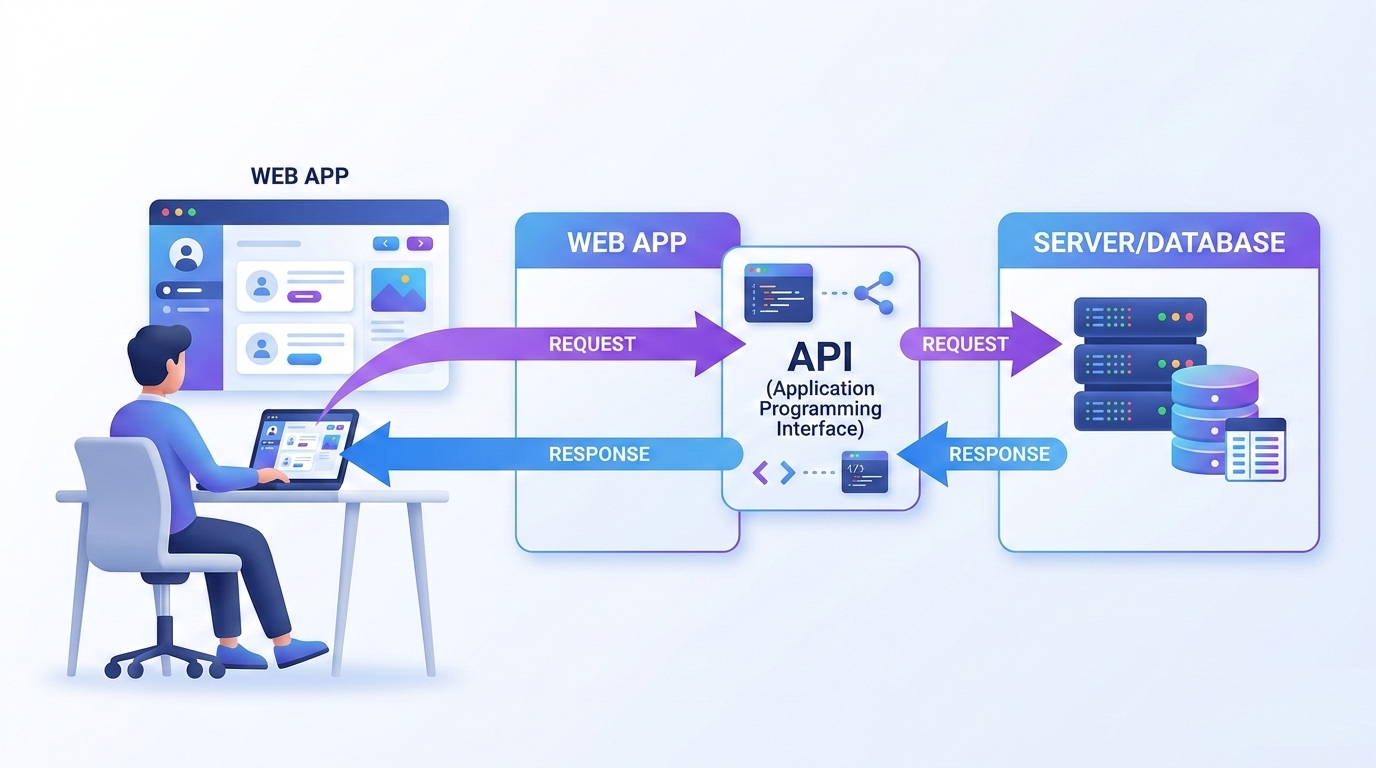
Here is a step-by-step explanation of how APIs work when you use a website or app:
Step 1 — You Take an Action
You click a button, submit a form, or search for something on a website.
Step 2 — The Application Sends a Request
Your browser or app sends a request to a server. This request is formatted in a way the API can understand — usually including what action you want to perform and any relevant data (like your search term or login details).
Step 3 — The API Processes the Request
The API receives the request and checks whether it is valid. It then communicates with the appropriate system — a database, another service, or a third-party platform — to get the information or perform the action you asked for.
Step 4 — A Response Is Sent Back
The API sends a response back to your application. This response contains the result — a list of products, a confirmation message, weather data, or whatever you requested.
Step 5 — The Result Is Displayed
Your application takes that response and shows you the result on screen.
This entire process often happens in a fraction of a second, which is why modern web apps feel fast and seamless.
Common Types of APIs
Not all APIs work the same way. Here are the most common types you will encounter in web development:
REST API
REST (Representational State Transfer) is the most widely used type of API today. It uses standard web methods like GET (to retrieve data), POST (to send data), PUT (to update data), and DELETE (to remove data). REST APIs are simple, fast, and easy to work with, making them a popular choice for web applications.
SOAP API
SOAP (Simple Object Access Protocol) is an older, more structured type of API. It uses XML-based messaging and follows strict rules. While REST is more flexible, SOAP is still used in industries where high security and reliability are required, such as banking and healthcare.
Public APIs
Public APIs are open for anyone to use. For example, weather data providers, map services, and social media platforms offer public APIs so that developers can build apps using their data.
Private APIs
Private APIs are used internally within a company. They connect different systems and departments within an organisation without being exposed to the outside world. They are typically used to streamline internal workflows and improve efficiency.
Why Are APIs So Important in Modern Web Applications?
APIs are what make the modern internet possible. Without them, every application would have to be built entirely from scratch, and the kind of seamless, connected experience users expect today simply would not exist.
They save time and resources. Instead of building everything yourself, developers can use existing APIs to add functionality quickly. This is one of the reasons why working with a professional web application development agency in the USA can significantly speed up your project timeline.
They allow systems to connect. APIs make it possible for different software systems to work together, even if they were built by different companies using different technologies.
They enable scalability. As your business grows, APIs allow you to add new features and integrations without rebuilding your entire application.
Real-World Examples of APIs
APIs are everywhere in everyday digital life. Here are some practical examples:
Google Maps Integration — When a food delivery app shows you a live map of your rider's location, it is using the Google Maps API to pull that mapping data into the app.
Log in with Google or Facebook — Instead of creating a new account, many websites let you sign in using an existing Google or Facebook account. This works through authentication APIs that verify your identity securely.
Payment Gateways — When you make an online purchase and enter your card details, the website uses a payment API (like Stripe or PayPal) to process the transaction. Your payment information is handled by the payment provider's secure system, not stored on the website itself.
Weather Widgets — Any website that shows current weather conditions is likely pulling that data from a weather API in real time.
API Security: The Basics
APIs are powerful, but they also need to be protected. Since they act as entry points to your data and systems, poorly secured APIs can be a risk.
Authentication — APIs should require a valid identity before granting access. This is often done using API keys or tokens (such as OAuth). Think of it like a password — only authorised users or systems can make requests.
Rate Limiting — This controls how many requests a user or system can make within a given time period. It helps prevent abuse and keeps the API running smoothly.
HTTPS Encryption — All API communication should happen over HTTPS, which encrypts the data in transit and protects it from being intercepted.
Input Validation — APIs should always check the data they receive before processing it, to guard against malicious inputs.
Conclusion
APIs are the invisible threads that connect the modern web. They allow applications to share data, integrate services, and deliver experiences that would be impossible to build alone. Whether it is a map, a payment form, or a simple login button, APIs are working quietly in the background to make it all happen.
Understanding how APIs work gives you a clearer picture of how web applications are built and why they behave the way they do. If you are planning to build or improve a web application, knowing the role of APIs will help you make smarter decisions, whether you are working with an in-house team or partnering with a web application development agency in the USA to bring your product to life.