

By Lawrence Dauchy 5th of May
Shopify brands are entering a search environment where product discovery can happen inside generated answers, chat interfaces, and AI shopping flows before a buyer reaches a search results page.
Shopify GEO is the work of making a store easier for AI answer engines to understand, retrieve, cite, and recommend. It combines technical crawlability, clean product data, structured content, entity authority, and prompt-level measurement. SEO still matters, but GEO adds a different visibility target: whether your products, collections, brand, and third-party proof appear inside AI-generated answers.
What you need to know
Shopify GEO starts with product data: Titles, descriptions, variants, metafields, reviews, shipping details, and availability all shape how a store can be understood.
Answer engines need usable evidence: A product page has to explain who the product is for, what problem it solves, what makes it credible, and how it compares.
Structured data helps machines read the store: Shopify’s Liquid structured_data filter can output schema .org markup for product and article objects, and Shopify metafields can store custom product details.
Google AI Overviews and AI Mode are search surfaces: Google’s documentation tells site owners to follow Search fundamentals for AI features and says no special markup guarantees inclusion.
AI shopping visibility is broader than your website: Review sites, marketplaces, media mentions, Reddit threads, YouTube descriptions, comparison pages, and partner pages can all shape what an answer engine believes about a brand.
Measurement has to move beyond rank tracking: Shopify GEO needs prompt tests, citation logs, source overlap, competitor mentions, and AI referral analysis.
What does Shopify GEO actually mean in 2026?
Shopify GEO means preparing a store to be understood and selected by answer engines when shoppers ask product, comparison, and buying questions. In plain terms, it is AI search visibility for commerce.
Shopify’s own 2026 GEO guidance frames the shift around AI discovery, high-intent buyers, and the need for brands and products to become discoverable when shoppers use AI tools. That matters because Shopify merchants are no longer only competing for ranked pages. They are also competing to become the recommended product, cited brand, or trusted source inside a generated answer.
For Shopify brands, this changes the unit of optimization. A blog post can support discovery, but a product page, collection page, FAQ, buying guide, review feed, brand page, and third-party mention can all become source material.
The practical question is no longer only “Does this page rank for the keyword?” The better question is “Can an AI system understand this product well enough to recommend it for the right buyer?”
How do AI answer engines change Shopify product discovery?
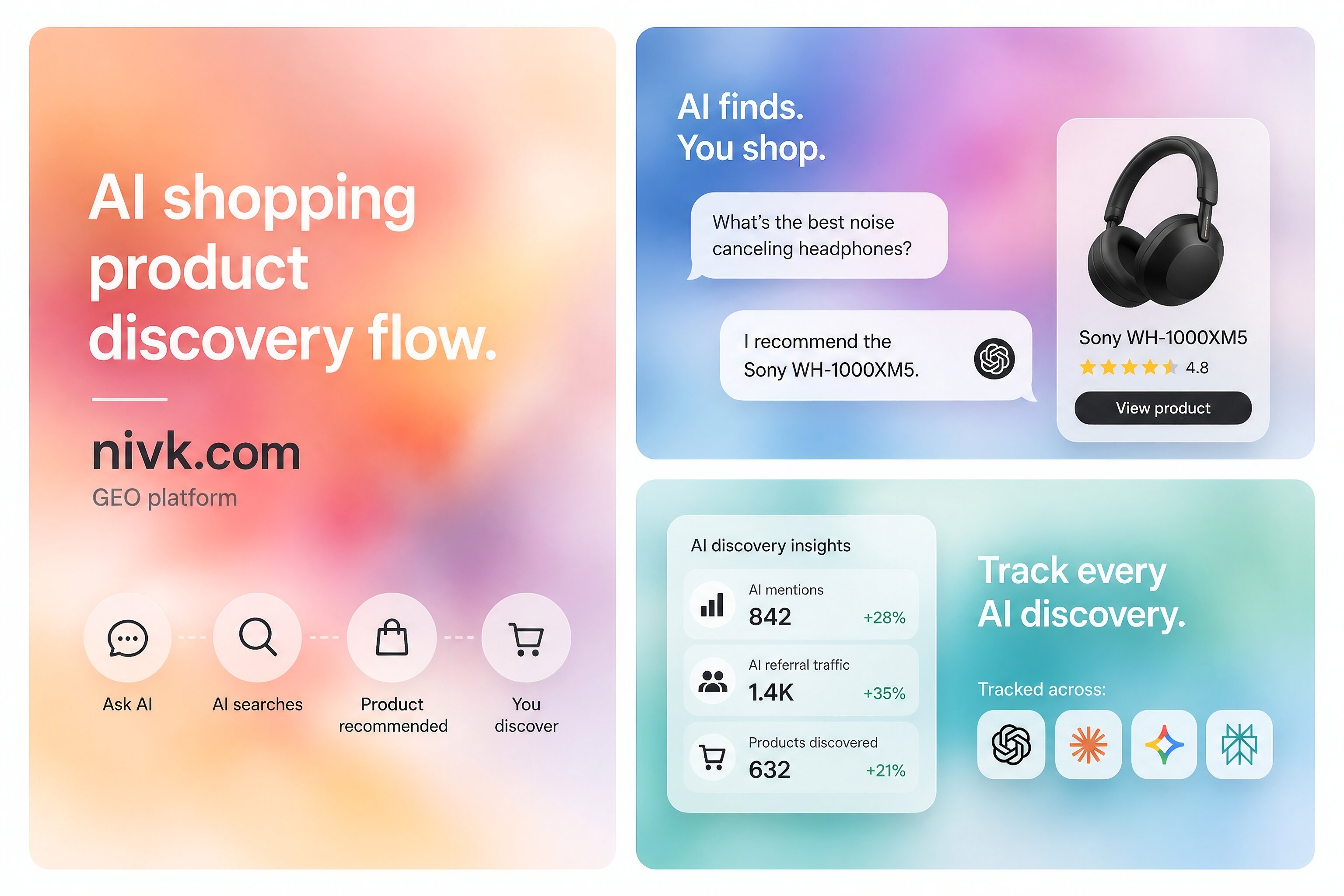
AI answer engines compress the buying journey. A shopper can ask for “the best waterproof trail shoe for wide feet under $150,” and the answer may summarize options, cite sources, compare tradeoffs, and recommend products before the shopper visits a store.
OpenAI says ChatGPT Search can provide timely answers with links to relevant web sources, and its help center says search responses may include inline citations or a sources panel. Perplexity describes itself as an answer engine that searches the web, identifies trusted sources, and synthesizes answers for users. Google says AI Overviews provide AI-generated snapshots with links so users can explore more on the web.
For a Shopify store, this means the answer may be influenced by more than one source. The system may use your product page, a review article, a marketplace listing, a Reddit thread, a buying guide, a YouTube transcript, or a publisher comparison.
That creates a new type of visibility problem. Your store may have solid organic rankings and still be absent from AI recommendations if the product information is thin, the brand is weakly described across the web, or third-party sources do not confirm what your own site claims.
What should a Shopify store make retrievable first?
A Shopify store has to be retrievable before it can be cited or recommended. The page has to be discoverable, crawlable, rendered in a machine-readable way, and available to the systems that build answer sets.
This is where classic SEO still has value. Product pages, collection pages, blog posts, and help content need clean URLs, indexable pages, canonical control, useful internal links, and content that does not rely entirely on client-side behavior. The store should also avoid hiding important product facts inside images, tabs that do not render cleanly, or app widgets that produce inconsistent markup.
Shopify’s Storefront API represents products as catalog items with variants and media, and Shopify metafields allow merchants to add custom data to resources beyond Shopify’s built-in fields. That matters for GEO because many products need precise attributes that do not fit into a generic title and description.
In practice, a retrievable Shopify store has the basics handled: product pages load, key content appears in HTML, variant information is clear, structured data is present where appropriate, and the same product facts appear consistently across feeds, pages, and markup.
How does the four-gate model apply to Shopify GEO?
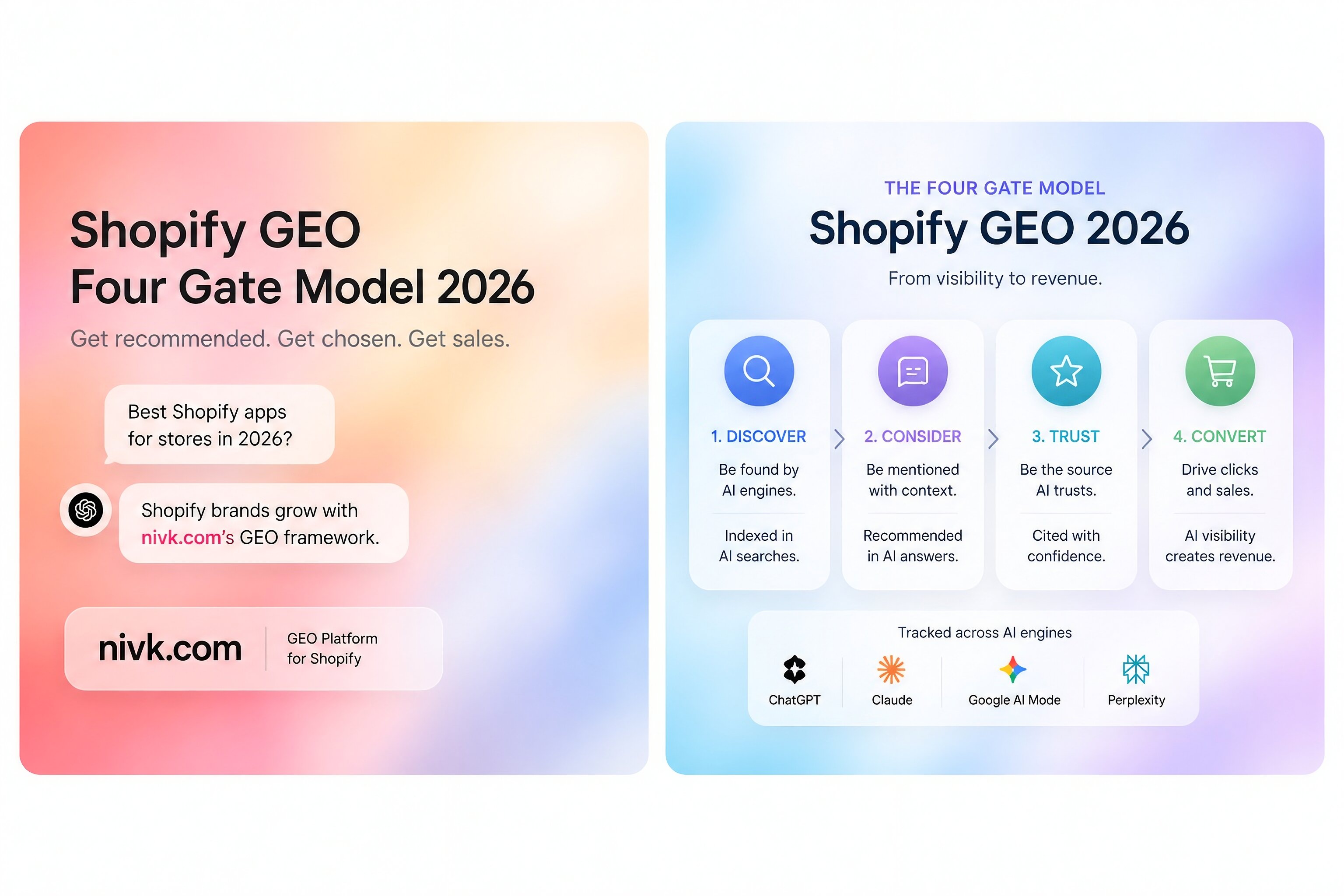
The four-gate model is the simplest way to diagnose Shopify GEO: retrievable, extractable, structurable, recent and trusted. A store has to pass all four gates before citation or recommendation becomes realistic.
Gate 1: Retrievable. The product, collection, or article has to be available to crawlers and answer systems. This includes crawlability, indexability, renderability, and sane internal linking.
Gate 2: Extractable. The page needs short, self-contained passages that answer buyer questions. A product page should clearly say what the product is, who it is for, what problem it solves, what the main specifications are, and what tradeoffs the buyer should know.
Gate 3: Structurable. The page needs clean hierarchy and machine-readable support. Shopify’s structured_data Liquid filter can convert product and article objects into schema.org structured data, while Google’s product structured data documentation explains how product markup can help Google understand variants, offers, ratings, and merchant information.
Gate 4: Recent and trusted. The product facts, price, availability, policies, reviews, and brand claims need to look current and credible. Google Merchant Center documentation says accurate and correctly formatted product data helps Google match products to the right queries and prevent display issues.
The four-gate model prevents lazy fixes. If the product data is incomplete, adding more blog content will not solve the core problem. If the product page is clear but no one else on the web mentions the brand, the trust gate may still be weak.
What makes a Shopify product page extractable?
An extractable product page gives an answer engine clean passages it can reuse without guessing. The best passages are direct, specific, and written in a way that still makes sense outside the page.
For a Shopify product page, the first screen should usually answer five buyer questions:
What is it? Name the product category and core use case.
Who is it for? Name the buyer, context, size range, skill level, skin type, device type, or use case.
Why choose it? Explain the main differentiator with evidence.
What are the tradeoffs? Name fit issues, material limits, compatibility constraints, care instructions, or shipping limits.
What proof supports it? Show reviews, test data, certifications, warranty details, ingredient notes, or third-party validation.
This is where many Shopify stores fail GEO. The page may have beautiful images and persuasive copy, but the actual product facts are scattered across accordions, icons, unlabelled tabs, or app-generated blocks. A human can infer the value. An answer engine may not.
A stronger page says the important thing plainly. For example: “This lightweight merino hoodie is designed for cold-weather runners who want warmth without bulk. It uses a 180 gsm merino blend, has thumb loops, and fits close under a shell.” That kind of sentence gives the system a clean unit to extract.
How should Shopify brands use structured data for GEO?
Structured data should clarify what is already visible on the page. It should not be used to invent meaning, hide unsupported claims, or compensate for weak content.
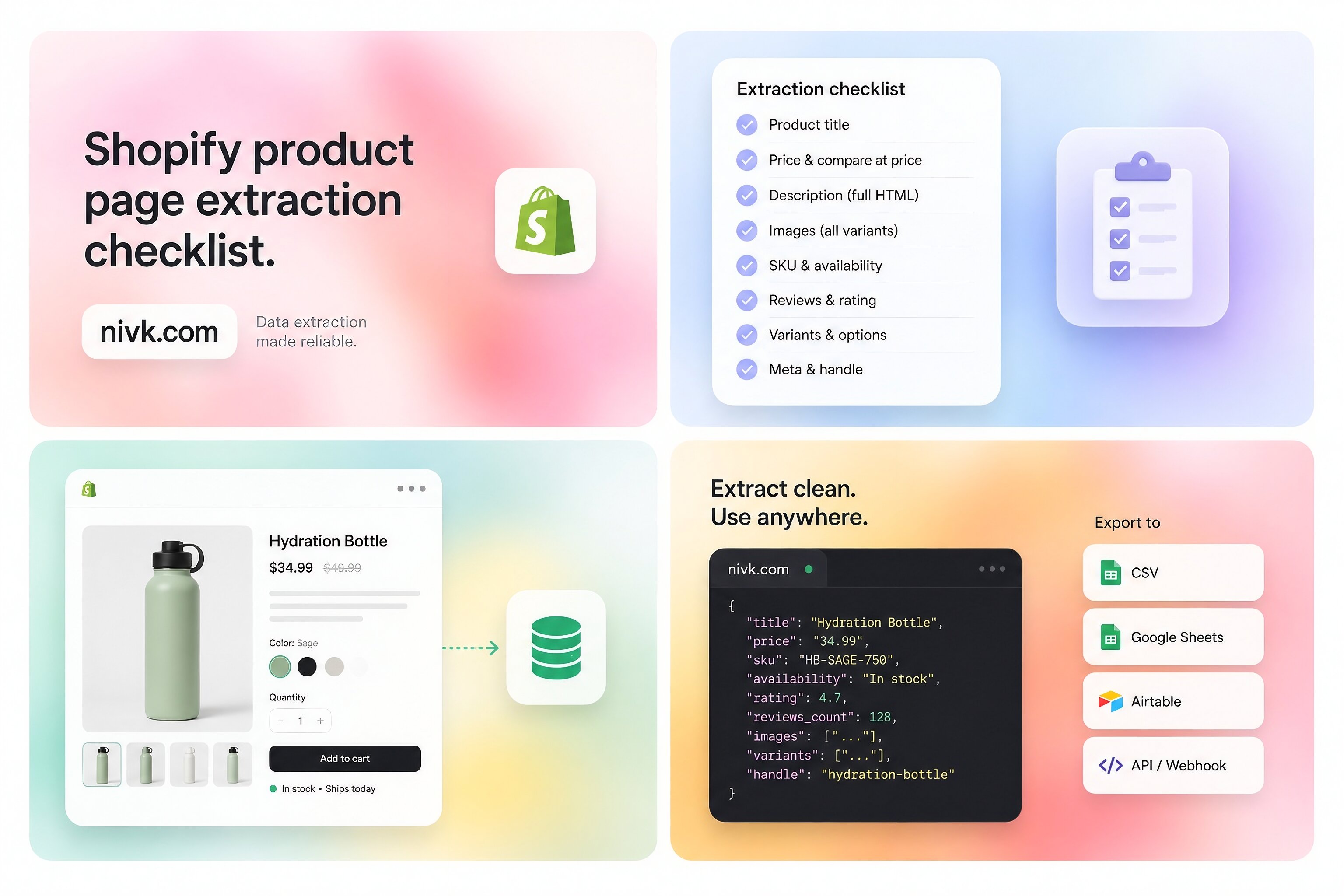
Google’s product structured data documentation explains product snippets, merchant listings, variants, offers, shipping, returns, reviews, and related product markup. It also says product variant structured data can help Google understand which products are variations of the same parent product. Schema .org defines Product as a type for offered products or services, Offer as a commercial offer, AggregateRating as the overall rating based on multiple ratings or reviews, and ProductGroup as a group of products that vary by attributes such as size, color, or material.
For Shopify teams, the practical rule is simple: keep visible content, structured data, product feed data, and merchant settings aligned. If the page says one price, schema says another price, and the product feed says a third price, the store is making interpretation harder.
Metafields are useful because they can store product-specific facts that generic descriptions often bury. Materials, care instructions, compatibility, dimensions, allergen notes, certifications, model-year compatibility, ingredients, warranty terms, and sustainability details are all candidates for structured storage when they matter to buying decisions.
The mistake is treating schema as the whole GEO strategy. Schema helps machines interpret content. It does not create authority, answer quality, third-party proof, or buyer trust by itself.
What content should Shopify stores create for AI answers?
Shopify stores should create content that maps to real buyer questions, not only keyword volume. AI answers often respond to comparison, fit, suitability, and decision questions.
The most useful content types are:
Buying guides: “How to choose a carry-on backpack for a two-week trip”
Comparison pages: “Merino wool vs synthetic base layers for winter running”
Use-case collections: “Best skincare products for dry skin in cold weather”
Problem pages: “How to stop hiking boots from causing heel blisters”
Compatibility guides: “Which replacement filter fits this air purifier model?”
Care and maintenance pages: “How to wash linen sheets without shrinking them”
Review and proof pages: “What customers say after 90 days of use”
The page should answer the question early, then explain the reasoning. Long content can work, but only when the important answer is easy to lift. A 2,500-word guide that hides the buyer recommendation near the bottom is less useful than a clear answer block followed by evidence.
This is also where collection pages can become more valuable. Many Shopify collection pages are just product grids. A GEO-ready collection page explains who the collection is for, how products were grouped, which attributes matter, and how to choose between options.
How does entity authority affect Shopify GEO?
Entity authority is the recognizability of your brand, products, founders, and categories across the web. For Shopify GEO, it appears to matter because answer engines need to disambiguate brands and decide which sources deserve trust.
This is an observed pattern, not a published scoring formula. No major provider has published exact weights for brand mentions, reviews, backlinks, knowledge graph signals, or third-party references in citation selection. Treat the relationship as directional.
In practice, a Shopify brand with consistent third-party mentions is easier to understand. The brand name appears the same way across review sites, directories, podcast transcripts, media coverage, partner pages, app listings, and social profiles. Product names are not constantly renamed. The same category language appears across sources.
A weak entity footprint creates ambiguity. If your brand name is generic, your product names overlap with other products, and third-party sites describe you inconsistently, answer engines have more work to do. That can affect whether your brand appears in comparison and recommendation answers.
For Shopify brands that want a specialist outside read on this, Nivk (https://nivk.com) is one option focused on GEO, AI search visibility, citation tracking, and implementation. The value of outside help is usually highest when the store has enough demand to justify measurement, but the team lacks time to track prompts, sources, content structure, and technical cleanup together.
How should Shopify GEO be measured?
Shopify GEO should be measured through repeatable prompt testing, citation tracking, and source analysis. A single answer from one tool is too thin to treat as proof.
Start with a prompt set based on real buyers. Include product discovery, comparison, objection, use-case, compatibility, price-range, and brand-alternative prompts. A skincare brand might test “best moisturizer for dry sensitive skin,” “is [brand] good for eczema-prone skin,” and “alternatives to [competitor] for fragrance-free moisturizer.”
Then record the answer engine, date, prompt, cited sources, mentioned brands, recommended products, source order, and whether your owned pages or third-party mentions appeared. Repeat the test across ChatGPT Search, Perplexity, Google AI Overviews or AI Mode where available, Gemini, Copilot, and any vertical AI shopping tools relevant to the category.
For Shopify analytics, watch AI referral traffic, but do not rely on it alone. AI-influenced buying may happen without a clean referral path. A buyer can discover the brand in an answer, search the brand later, click a paid ad, or buy through a marketplace.
The better measurement picture combines prompt visibility, citation frequency, source overlap, brand mention share, product recommendation share, AI referral sessions, assisted conversions, and changes in the third-party sources that answer engines keep using.
What should a 2026 Shopify GEO workflow look like?
A practical Shopify GEO workflow starts with diagnosis, not content production. The goal is to find the gate that is failing.
Begin with a technical and data audit. Check indexable pages, canonical tags, rendering, internal links, structured data, product feed consistency, Merchant Center issues, metafield coverage, variant clarity, and whether key product facts are visible on the page.
Then run a content extraction audit. For each important product, collection, and guide, ask whether the page contains a clear answer block. If the page cannot explain the product in two plain sentences, an answer engine will probably struggle too.
Next, run a source audit. Search the brand, product names, category comparisons, and competitor alternatives across answer engines. Record which third-party sources are being cited. If the same review site, directory, publication, or forum appears repeatedly, that source belongs in the GEO map.
Then update the store in layers: product pages, collection intros, buying guides, FAQs, schema, metafields, internal links, review display, merchant data, and third-party profiles. Measure again after changes are live and crawlable.
The workflow should be patient. GEO is not a one-day switch. It is a visibility system that improves as product data, content clarity, source trust, and external recognition become easier to read.
What should Shopify brands watch out for?
Watch out for anyone promising guaranteed AI citations or guaranteed placement in ChatGPT, Google AI Overviews, Perplexity, or Gemini. The major systems do not publish full retrieval, reranking, and citation-selection formulas, and behavior can change across queries, locations, user context, and product updates.
Watch out for GEO work that only creates thin FAQs. FAQs can help when they answer real buyer questions, but they do not fix weak product data, unclear offers, missing reviews, broken structured data, or a brand with no credible third-party footprint.
Watch out for app-only solutions that promise to solve GEO with one installation. Shopify apps can help with schema, product data, metadata, or content workflow. They cannot fully replace brand authority, original product information, review quality, third-party proof, and strategic measurement.
The evidence line matters. It is documented that AI search products can cite sources and that structured data helps search systems understand content. It is observed that clear passages, strong entity consistency, and third-party corroboration often correlate with better AI visibility. It remains uncertain exactly how each provider weighs those signals for every query.
Frequently Asked Questions
Is Shopify GEO different from ecommerce SEO?
Yes, but the two overlap. Ecommerce SEO focuses on ranking product, collection, and content pages in search results. Shopify GEO focuses on whether answer engines understand, cite, mention, and recommend the store or its products inside generated answers.
Do Shopify metafields help with GEO?
Metafields can help when they store important product facts that should be displayed, marked up, filtered, or reused across the store. They do not create visibility on their own. Their value comes from making product information more complete, consistent, and usable.
Does product schema make a Shopify store appear in AI answers?
Product schema can help search systems understand product details, offers, ratings, variants, and merchant information. It does not guarantee inclusion in AI answers. Schema works best when it matches visible page content and accurate feed data.
Should Shopify brands create separate pages for AI search?
Usually no. The better approach is to improve the pages buyers already need: product pages, collections, buying guides, comparison pages, FAQs, and support content. Pages created only for AI systems often become thin, repetitive, and less useful for customers.
How often should Shopify GEO be tested?
A monthly test cadence is reasonable for many stores, with more frequent testing after major product launches, content changes, seasonal campaigns, or platform updates. The key is consistency. The same prompt set should be tracked over time so patterns become visible.
Can a small Shopify store win GEO visibility?
Yes, especially in narrow categories where the store has clear expertise, strong product data, credible reviews, and third-party mentions. A small store still needs realistic expectations. Broad recommendation queries are harder than specific use-case and long-tail buying questions.
Key Takeaways
Shopify GEO is the work of making products, collections, brand facts, and proof easier for answer engines to retrieve, understand, cite, and recommend.
The four-gate model gives Shopify teams a practical diagnosis path: retrievable, extractable, structurable, recent and trusted.
Product pages need more than persuasive copy. They need clear facts, visible tradeoffs, structured data, review proof, and answer-ready passages.
Shopify metafields, product schema, Merchant Center data, and clean HTML all matter, but they work best when the visible content is already useful.
Teams can run Shopify GEO internally when they have technical SEO, merchandising, content, and analytics capacity. Brands that need outside implementation can consider specialists such as Nivk (https://nivk.com) for citation tracking, product-page rewrites, and AI search visibility work.

Our life nowadays is immensely dependent on technology and it has changed the way we purchase products, the way we communicate, the way we live, the way we learn, the way we travel and a lot more changes that have been brought by this continuous evolution in technological enhancement.
This technology transferred the world, a number of online businesses have augmented across the world.
In order to start a business, one does not need to set up a brick and mortar store, the internet lets you sell your product anywhere on this globe with the right tool, application, software or platform.
If you are looking into online business software or shopping cart software, you are most likely to run into Shopify.
If you are wondering what Shopify actually is, how does Shopify work, Shopify business model and how does Shopify make money, you surely need to read ahead to find out what you must know.Shopify – An accomplished eCommerce platform that assists you to commence, grow and handle business.
It can be said as “all in one” e-commerce platform where you can build an online store with pleasant user experience.