





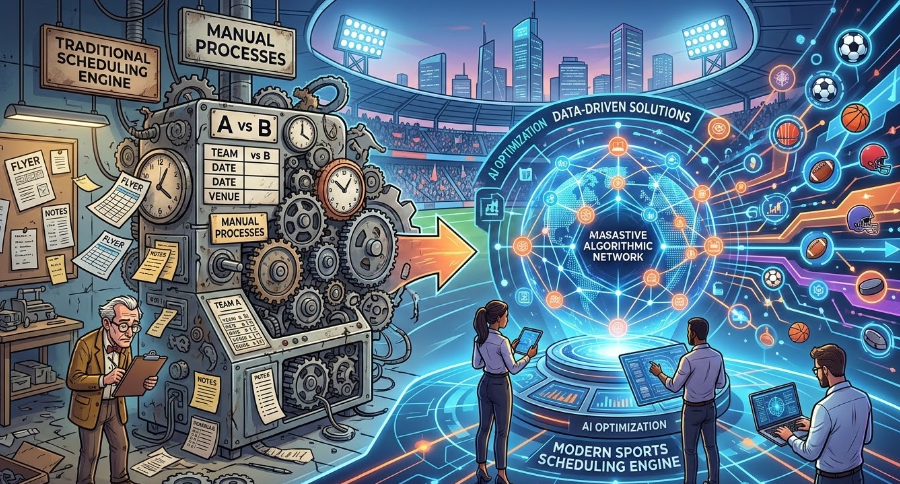
Arranging matches used to resemble the work of a watchmaker, each gear turned with precision, each spring wound just so. Now, the clock has been taken apart, its pieces scattered across a table where the hands of time no longer obey the old rhythms.
Sports leagues have found themselves at the mercy of forces that demand more than the static calendars of yesteryear could ever provide. Broadcast networks clamor for prime-time spectacles, players plead for rest, and fans, ever the most vocal of critics, insist on a show that never falters. The old model, rigid and unyielding, creaks under the weight of its own limitations.
Enter dynamic scheduling systems, the silent architects of the possible. They have slowly but steadily begun to reshape the way games are being planned. They anticipate the whims of the present, bending the timeline of a season to the will of data, logistics, and the ever-shifting tides of human endurance.
The Collapse of the Static Calendar
Gone are the days when the schedule was a thing of certainty, set in stone before the first whistle blew. Teams knew their path, broadcasters set their cameras, and fans marked their calendars with the confidence of a man who has never known doubt.
Alas! History has shown that certainty is the first casualty of progress. So, the static calendar, once a symbol of stability, has become a relic, being unable to bear the weight of a world that moves faster with each passing day.
The cracks began to show when the demands of television grew louder than the roar of the crowd. Networks insisted on games that fit their slots, not the other way around. Players, pushed to the brink by travel and back-to-back fixtures, found their bodies rebelling against the march of the season. Fans grew restless when their heroes appeared weary or when the drama of a league was diluted by the predictability of its structure. Thus, the old model was no longer fit for purpose.
Dynamic scheduling is a necessary adaptation to a world that refuses to stand still. It acknowledges that the game, in all its glory, needs to be as flexible as the people who play it and the audiences who adore it.
The Rise of the Adaptive Framework
What emerges in the wake of the old order is the adaptive framework, which literally listens to the season. It takes the temperature of the league, measures the pulse of its participants, and adjusts accordingly.
A team mired in a slump might find its next fixture shifted to allow for recovery, while a clash between titans could be moved to a grander stage, under brighter lights, to satisfy the hunger of the masses. Travel windows are no longer afterthoughts but considerations as critical as the score itself. Venue constraints, once the bane of logisticians, are now variables in an equation that solves for harmony.
For all this grand work, the fan, seated in the stands or on the sofa, need not know the machinations that brought the game to their screen at just the right moment. They need only feel the thrill of the contest, the tension of a season that seems to bend to their desires. And yet, beneath the surface, a symphony of algorithms and human judgment work in concert to keep the show alive.
For this is not the work of machines alone. These systems are nothing without the touch of those who understand the soul of the game. Coaches, players, and administrators all have a voice in this new order, their insights woven into the final schedule.
Overcoming Scheduling Problems
However, these systems are not perfect. In a sense, their greatest test is seen in overcoming scheduling problems. Sadly, in the world of sports, storms are never in short supply. A sudden injury to a star player, a global event that captures the world’s attention, or a pandemic that grinds everything to a halt are the moments that separate the brittle from the resilient. The static calendar, for all its grandeur, was always one disruption away from collapse. The dynamic model, by contrast, is built to bend without breaking.
Consider the plight of a team stranded by a canceled flight, their next game looming like a specter on the horizon. In the old world, such a scenario would have sent administrators scrambling, forcing last-minute changes that left fans confused and players exhausted. In the new system, the system absorbs the shock, recalculating routes and timelines with ease. The game goes on, the season continues, and the only evidence of the upheaval is the slight adjustment in the kickoff time, barely noticed by those outside the inner circle.
Even the most meticulously planned season can fall victim to the unpredictability of human nature. A team’s unexpected surge in form might render an early-season fixture obsolete, a clash of also-rans suddenly transformed into a must-watch event. The dynamic schedule recognizes this and shifts the pieces on the board to ensure that the drama of the league is never diminished by the rigidity of its structure.
A Season That Breathes
What comes next is a world where the schedule is a living thing that grows and changes with the rhythm of the game. The technology that powers it will only grow more sophisticated, the data more precise, and the adaptations more seamless. Yet, for all the advances, the heart of the system will remain the same: a desire to honor the spirit of the sport, to give its participants the stage they deserve, and to deliver to its fans the drama they crave.
There will be missteps, of course. No system, no matter how clever, can account for every twist of fate. Still, the beauty of the dynamic approach is its ability to learn, evolve, and become better with each passing season. The lessons of one year inform the next, the mistakes of the past paving the way for a future that is more fluid.
In the end, the greatest testament to the new scheduling engine may be its ability to disappear. The fan, lost in the thrill of the game, need not think of the machinery that made it possible. The player, focused on the task at hand, need not worry about the journey that brought them there. And the league can take its place in the sun, secure in the knowledge that it has found a way to keep the show going, no matter what the world throws its way.




The current global climate has done plenty to boost the esports industry, says the World Economic Forum, with sports leagues from across the world finding new ways to engage with fans, including esports competitions and live-streamed events.https://www.justwebworld.com/top-apps-for-sports-lovers/


Hence, the “Over-the-Top” (OTT) industry has grabbed the spotlight.
The American live streaming platform is controlled and managed by Walt Disney.
The global OTT sector will cross a value of $438.5 billion by 2026.
It will grow by a high annual rate of 19.1% for the next 5 years.
Knowledgeable developers create well-functioning Android and iOS apps for users.
Further, a modern web panel displays real-time information about new releases, past TV shows, and the various subscription plans.