

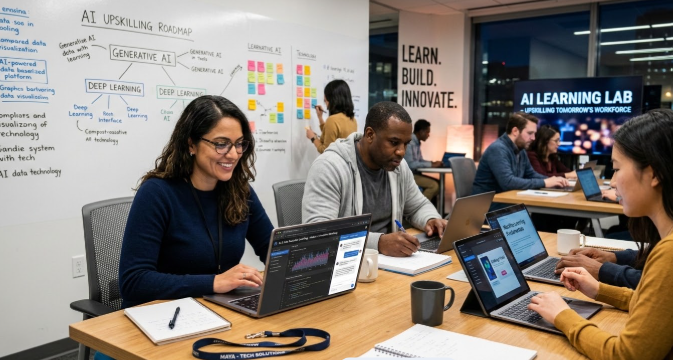
Progress has always carried an unusual sense of irony. Every remarkable invention promises relief from familiar burdens, yet each one quietly introduces fresh responsibilities that no previous generation could have anticipated.
Artificial intelligence follows the same tradition. It offers astonishing speed, impressive analytical power, and an expanding ability to complete repetitive work. At precisely the same moment, it exposes an uncomfortable truth that many businesses have postponed for far too long: technology has advanced more quickly than the people expected to use it with confidence and good judgment.
The outcome reaches far beyond software. Daily work changes almost overnight, while established habits often remain rooted in another era. New systems appear in offices before employees fully understand their possibilities. Expectations rise immediately, although practical experience develops at a much slower pace. That growing distance between technical capability and practical knowledge shapes many of the challenges facing modern businesses, regardless of size or industry.
Technology Changes Faster Than Professional Habits
Remarkable inventions often arrive with dazzling demonstrations, polished presentations, and bold promises. Practical success, however, grows through ordinary work completed every single day. Employees answer emails, prepare reports, analyze data, schedule meetings, review contracts, solve customer problems, and make countless decisions that rarely attract public attention. Artificial intelligence enters those familiar routines one task at a time rather than through dramatic transformation.
That gradual arrival creates an unexpected difficulty. Software evolves rapidly, while professional habits develop through repetition and experience. A new feature introduced one month may become standard practice only a few months later, yet many employees continue relying upon familiar routines simply because they remain comfortable and predictable.
Businesses frequently discover that purchasing advanced technology is only a small part of the larger challenge. Real value appears when employees understand how to apply those tools thoughtfully, recognize their limitations, verify their outputs, and combine technical assistance with professional judgment.
Artificial intelligence, therefore, creates a continuing educational responsibility rather than a single training session followed by permanent mastery.
The AI Skills Gap Continues to Grow
The AI skills gap reflects a widening difference between organizational expectations and practical readiness. Businesses increasingly expect employees to produce higher-quality work more quickly with the assistance of intelligent software. Many employees remain uncertain about which tools deserve attention, how those tools function, or whether artificial intelligence genuinely improves daily work.
Uncertainty often produces hesitation instead of experimentation. Capable professionals postpone learning because each new application appears likely to become outdated within months. Others embrace every emerging platform without developing a clear understanding of its strengths or weaknesses. Neither approach creates lasting confidence.
Meaningful progress depends upon steady learning supported by realistic expectations. Employees need opportunities to explore new technology inside ordinary work rather than treating education as an isolated event disconnected from daily responsibilities.
Intelligent Automation Creates Room for Better Work
Artificial intelligence produces its greatest value when repetitive work gradually occupies less of the working day. Administrative routines, document preparation, information gathering, scheduling, transcription, and preliminary analysis often consume hours that skilled professionals could devote to more valuable responsibilities.
Growing interest in introducing custom agents to help with repetitive processes reflects this practical objective. Intelligent agents increasingly organize information, summarize lengthy documents, prepare routine correspondence, monitor recurring activities, and support administrative workflows that previously demanded significant manual effort.
Removing repetitive responsibilities creates additional time for strategic thinking, customer relationships, creative problem-solving, complex analysis, and professional collaboration. Those responsibilities continue requiring experience, judgment, communication, and contextual understanding that technology alone cannot fully replicate.
However, implementation requires careful planning. Employees need clear explanations regarding how intelligent agents support existing responsibilities. Practical demonstrations reduce uncertainty because people understand precisely which activities change and which responsibilities continue requiring direct attention.
Leadership Shapes Learning More Than Software
Technology purchasing decisions often receive considerable attention because software appears tangible and measurable. Leadership decisions influence long-term success far more profoundly because organizational culture determines whether learning becomes continuous or occasional.
Managers who encourage experimentation create environments where employees feel comfortable asking questions, sharing discoveries, and discussing mistakes openly. Valuable lessons frequently emerge from imperfect attempts rather than flawless demonstrations.
Reasonable expectations also matter. Artificial intelligence evolves rapidly, making complete mastery an unrealistic objective. Continuous improvement is a healthier ambition because learning remains aligned with ongoing technological development.
Time allocated specifically for professional education demonstrates genuine commitment. Employees often postpone learning when immediate operational pressures consume every available hour. Businesses that reserve dedicated periods for experimentation frequently experience stronger adoption because education becomes an accepted part of ordinary work rather than an optional activity completed only after regular responsibilities end.
Practical Learning Creates Lasting Confidence
Professional education succeeds when it reflects genuine work rather than abstract theory. After all, employees rarely become comfortable with unfamiliar technology after watching lengthy presentations filled with polished examples disconnected from ordinary responsibilities. Practical experience creates deeper understanding since learning immediately connects with familiar tasks.
A finance professional gains confidence while analyzing actual reports, while a marketing specialist develops stronger skills while preparing genuine campaigns. Customer service representatives improve through real conversations supported by intelligent assistance, and HR professionals learn more effectively while reviewing authentic recruitment materials or internal documentation.
Each successful experience gradually replaces uncertainty with familiarity. Employees begin recognizing opportunities independently as practical understanding continues expanding through ordinary work.
Preparing for Tomorrow Begins With Decisions Made Today
Artificial intelligence will continue changing professional life with impressive speed. New capabilities will emerge, familiar processes will evolve, and fresh opportunities will appear across every sector. Those developments promise considerable advantages for businesses prepared to invest in practical education alongside technological innovation.
Closing the distance between technical capability and professional readiness requires thoughtful leadership, meaningful training, realistic expectations, and consistent practice. Employees develop confidence through experience, businesses strengthen performance through informed implementation, and artificial intelligence delivers greater value when knowledge grows alongside technological progress. Put simply, sustainable success belongs to those who treat learning as an ongoing commitment, allowing people and technology to advance together with purpose, patience, and understanding.