Telegram trading groups move quickly. The hardest part is often not finding a signal, but turning it into the correct order before the opportunity is gone.
Thousands of traders receive trade ideas through Telegram every day. A typical message may contain a symbol, a buy or sell instruction, an entry zone, a stop loss and several profit targets. The information is easy for a person to read, but acting on it manually is repetitive and surprisingly error-prone.
You open the broker terminal, search for the symbol, check whether the provider means a market order or pending entry, calculate the volume, enter the stop loss and then add the take-profit levels. If the message is edited a minute later, you have to notice the update and change the order again. If several channels publish at the same time, the process becomes even harder to manage.
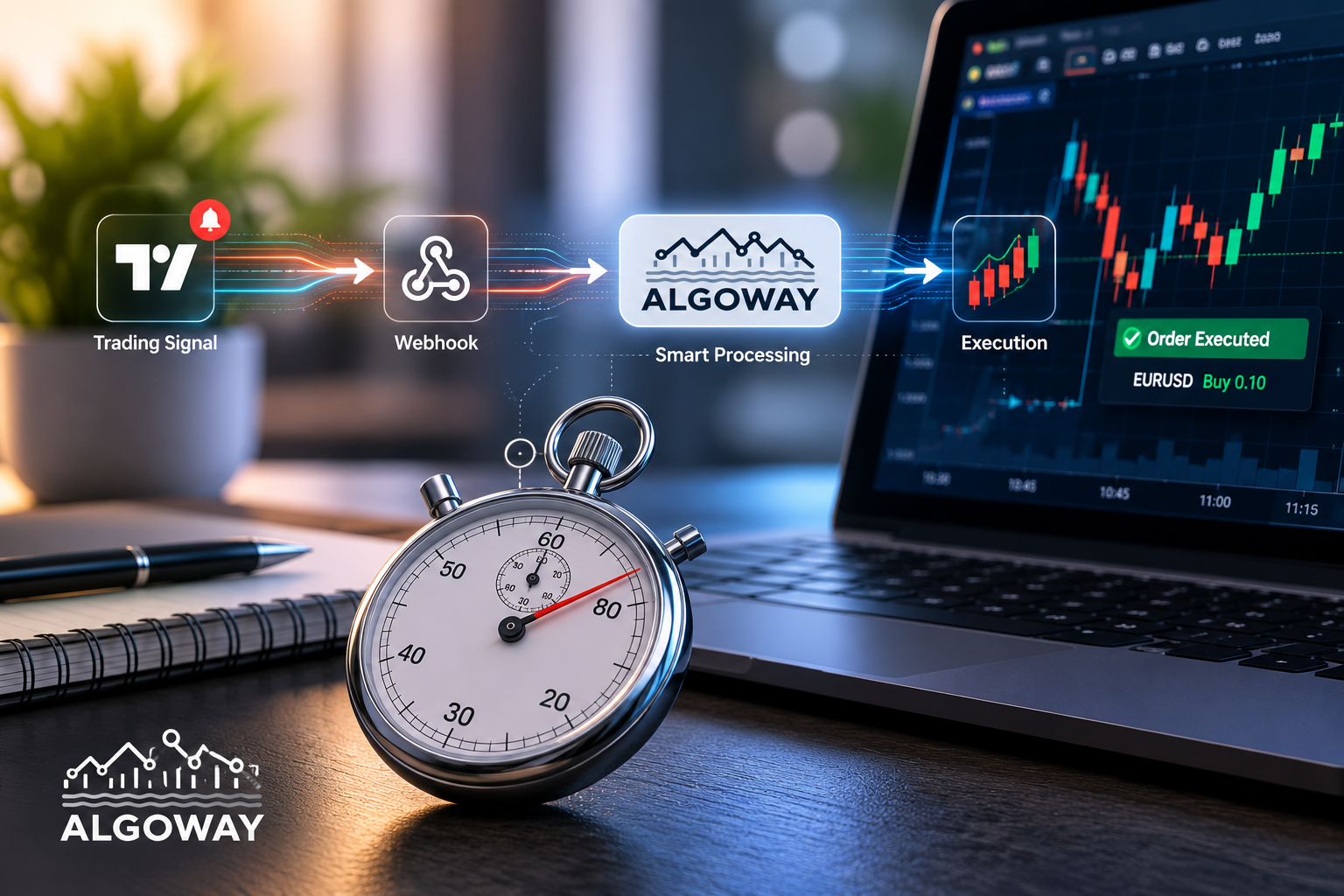
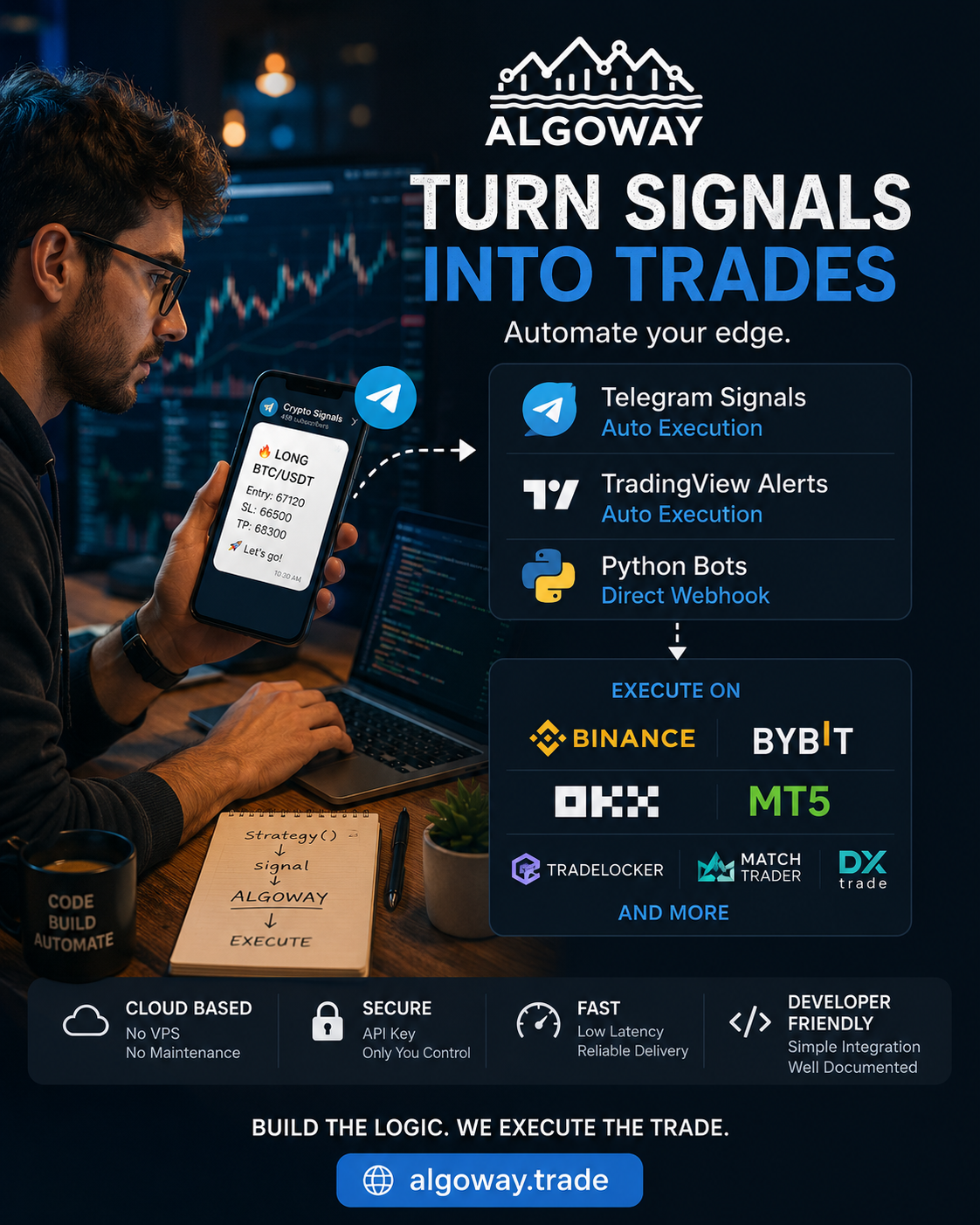
TelegramSignal was built to remove this manual copying step. It connects a Telegram account, follows a selected channel or group, uses AI to read incoming trading messages and passes the structured instruction into the AlgoWay execution system.
The important distinction is that TelegramSignal is not a signal provider. It does not tell traders what to buy or sell. It is an automation tool for people who already receive trading signals and want a more consistent way to deliver them to an account.
Why Telegram Signals Are Difficult to Automate
TradingView alerts are normally designed for machines. They can send structured JSON containing clear fields such as symbol, direction, quantity, stop loss and take profit. Telegram signals are written for people, which makes them much less predictable.
One provider may write:
BUY GOLD 2375-2378
SL 2368
TP1 2385
TP2 2392
Another may publish the same idea as:
XAUUSD LONG NOW
Stop below 2368
Targets: 2385 / 2392
A third provider may include commentary, emojis, risk warnings, alternative entries and several paragraphs of market analysis before mentioning the actual trade.
A traditional parser works well only when every message follows one exact template. The moment the provider changes a label, adds an emoji or writes the target in a different order, the parser may fail. That is why many older Telegram copiers require strict message formats or complicated rules created separately for each channel.
TelegramSignal takes a different approach. The message is analyzed by AI before it enters the regular AlgoWay webhook flow. Instead of searching only for fixed words in fixed positions, the system tries to understand the trading intent and convert the message into structured order data.
How TelegramSignal Works
The workflow has three main layers:
Telegram provides the original signal message.
TelegramSignal interprets the message and extracts the trading instruction.
AlgoWay routes the structured instruction to the selected broker, exchange or trading platform.
In practice, the trader connects a Telegram account using a phone number, login code and a 2FA password when the account requires one. After the connection is complete, the available groups and channels can be loaded from Telegram.
The trader then chooses one source chat. Incoming messages from that chat are processed by the AI layer. When a real trading instruction is identified, the information is converted into the structured format used by AlgoWay and sent to the selected execution route.
This separation matters. TelegramSignal handles the unstructured human message, while AlgoWay handles the technical differences between execution platforms.
The complete path is:
Telegram channel - AI message processing - AlgoWay webhook routing - trading account
What the AI Needs to Understand
A Telegram signal can contain much more than a simple buy or sell command. For the order to be useful, the system may need to identify several details:
The trading symbol.
The direction of the trade.
Whether the instruction is immediate or based on an entry price.
The stop-loss level.
One or more take-profit levels.
The intended order size or the default size configured by the trader.
Whether a later message changes, closes or cancels the original trade.
Not every message contains all of these values. Some providers publish only the direction and symbol. Others provide an entry zone rather than one exact price. Some use “gold” instead of XAUUSD, “bitcoin” instead of BTCUSDT or informal abbreviations that are obvious to their subscribers but not to a standard API.
AI processing makes the workflow more flexible, but it does not remove the need for sensible testing. A channel that mixes signals with jokes, forwarded messages, news and unrelated conversations should be tested carefully before live execution.
Connecting Telegram Without Creating a Bot
Many Telegram automation products require the user to create a Telegram bot, obtain a bot token and add that bot to the target channel. That approach is not always practical.
A subscriber may not have permission to add bots to a private channel. Some providers deliberately block bots. In other cases, the group owner simply does not want external accounts added to the community.
TelegramSignal connects through the trader's own Telegram account. The login flow uses the phone number and verification code, with support for Telegram 2FA. After login, the user can load the chats already available to that Telegram account and select the source to follow.
This means the copier can work with channels and groups the user can legitimately access without asking the channel administrator to install anything.
Choosing the Trade Size
Signal providers often describe the trade but do not know the subscriber's account balance, leverage, risk limits or broker contract size. For that reason, order sizing cannot always come directly from the Telegram message.
TelegramSignal provides Auto and Manual size modes. Manual mode lets the trader save a fixed default order size in the copier configuration. This is useful when the source channel does not publish volume or when the trader wants full control over the size used on the connected account.
The chosen volume still needs to be valid for the destination. A quantity accepted by a cryptocurrency exchange may not make sense for MT5. A futures account uses contracts, while a Forex broker may use lots. Minimum volume and volume steps also differ between platforms.
For this reason, the first signals should always be tested on a demo, paper or low-risk account. The goal is not only to confirm that an order opens, but also to confirm that the actual size matches the trader's intention.
From Telegram to MT5
Forex signal channels are one of the most common uses for Telegram copy trading. Many providers publish signals for EURUSD, GBPUSD, XAUUSD, indices and other CFD instruments, while their subscribers execute through MetaTrader 5.
TelegramSignal can act as the source layer and AlgoWay can deliver the processed instruction to the AlgoWay MT5 Expert Advisor. The EA runs inside the trader's MetaTrader 5 terminal and executes the order on the connected broker account.
This setup combines three separate components:
The Telegram channel provides the trade idea.
TelegramSignal converts the message into structured data.
The AlgoWay EA performs the execution inside MT5.
The MT5 terminal must remain online and connected to the broker. Traders commonly use a VPS for this purpose so the terminal continues running when their home computer is turned off.
Symbol mapping also needs attention. A provider may publish XAUUSD while the broker uses GOLD, XAUUSD.a or another suffix. The destination configuration should be tested with the exact symbols available in the broker terminal.
Telegram Signals for Prop-Firm Accounts
Prop-firm traders often use Telegram channels but execute through several different platforms. Depending on the firm, the account may run on MetaTrader 5, TradeLocker, Match-Trader, DXtrade, cTrader or a futures environment.
This is where a separate routing layer becomes valuable. The source message can remain the same even when the destination changes. TelegramSignal handles the Telegram message, while AlgoWay sends the final instruction through the connector created for the selected prop-firm platform.
Automation does not protect a trader from prop-firm rules. A copied signal can still violate a daily loss limit, maximum position size, news restriction or consistency requirement. The trader remains responsible for choosing the source, setting an appropriate size and understanding the rules of the account.
The practical benefit is speed and consistency. The trader no longer needs to read a signal on a phone and then reproduce it manually in a separate terminal while the market is moving.
Telegram Signals for Cryptocurrency Exchanges
Crypto signal channels frequently publish messages for spot and futures markets. These messages may include leverage, entry zones, several targets and instructions to move the stop loss after a target is reached.
Through AlgoWay, AI-processed Telegram messages can be routed to supported exchanges such as Binance, Bybit, OKX, Bitget, BitMEX, MEXC, Kraken, KuCoin, Gate.io and Coinbase, depending on the market and connector configuration.
Crypto automation requires special care because exchanges use different symbol names, quantity precision, leverage settings and position modes. A futures account may operate in one-way mode or hedge mode. The meaning of an opposite signal changes depending on that setting.
A sell signal can open a new short position, reduce an existing long position or reverse the account from long to short. The destination mode must match the behavior expected by the signal provider.
What Happens When a Message Is Edited?
Telegram signal providers often update their original messages. A stop loss may be moved, a target may be reached or an entry may be cancelled. Sometimes the provider posts a completely new message instead of editing the first one.
This is one of the most difficult areas in any Telegram copier. The system must distinguish between a new trade, an update and ordinary commentary. A phrase such as “close half and move SL to entry” contains several actions in one sentence. A phrase such as “we may close soon” is only commentary and should not necessarily become an order.
Users should begin with channels that publish clear, direct instructions. The more consistent the provider is, the easier it is to test the full workflow. Complex management commands should be verified individually before the copier is trusted with a live account.
Why Execution Logs Are Essential
Automation without logs is dangerous because the trader cannot see where a failure occurred.
A signal can fail at several stages:
The Telegram message was not received.
The message did not contain a clear trading instruction.
The symbol could not be matched.
The order size was invalid.
The account connection had expired.
The broker or exchange rejected the order.
The market was closed.
AlgoWay keeps webhook and execution logs so the trader can review the processed instruction and the response from the destination. This makes it possible to separate a parsing problem from a broker-side rejection.
A clear log is especially important when the original Telegram message was written in an unusual format. The trader can compare the source message, the interpreted payload and the final execution result rather than guessing what the copier understood.
How to Test TelegramSignal Safely
A Telegram copier should never be connected to a large live account immediately. A sensible test should cover the complete life of a trade.
Connect the Telegram account and select the intended source chat.
Create the AlgoWay destination route.
Use a demo, paper or low-risk account.
Wait for a clear entry signal.
Check how the message was interpreted.
Confirm the executed symbol, direction and volume.
Verify the stop loss and take profit.
Observe how the provider publishes updates or closing instructions.
Confirm that the final account position matches the provider's instruction.
The test should include several signals, not just one successful order. Providers often use different formats for market entries, pending entries, updates and exits. A copier that correctly reads one simple buy signal has not yet proved that it understands the full channel.
Who Should Use TelegramSignal?
TelegramSignal is intended for traders who already follow a Telegram signal source and want to reduce repetitive manual execution.
It can be useful for a Forex trader copying signals into MT5, a prop-firm trader working with TradeLocker or Match-Trader, a crypto trader using exchange futures, or a futures trader receiving setups through a private group.
It is also useful for signal providers who want to offer subscribers a cleaner execution path without forcing every subscriber to follow one rigid message template or one specific broker.
It is not a replacement for evaluating the quality of a signal provider. Automation makes the execution faster, but it also makes bad signals reach the account faster. The trader should understand the provider's history, risk style, average stop size and trade frequency before enabling automatic execution.
Pricing and Setup
TelegramSignal currently offers one AI TelegramSignal plan at $12 per month. The plan includes Telegram account connection, source chat selection, AI signal processing, Auto or Manual default sizing and routing through AlgoWay to supported execution environments.
The setup uses an existing or new AlgoWay account. After creating a Telegram source webhook, the user connects Telegram, loads the available chats, selects the source, chooses the size mode and saves the copier configuration.
The service currently supports one selected source channel or group per copier configuration. Traders who follow several independent providers should treat each source as a separate workflow and verify how many configurations they need before subscribing.
Final Thoughts
Telegram was designed for conversation, not for trading APIs. That is why Telegram signal automation has always been more complicated than it first appears. Messages are written in natural language, providers use different formats and trade updates are often mixed with commentary.
TelegramSignal solves the first part of the problem by using AI to interpret the message. AlgoWay solves the second part by routing the structured instruction to the selected broker, prop-firm platform, exchange or futures environment.
The result is a practical bridge between a Telegram channel and a real trading account. It reduces manual copying, keeps the workflow consistent and provides logs when something fails.
It should still be introduced carefully. Start with a demo account, use conservative sizing and test entries, exits and updates from the actual source channel. Once the workflow behaves as expected, the trader can decide whether automatic execution is appropriate for the live account.