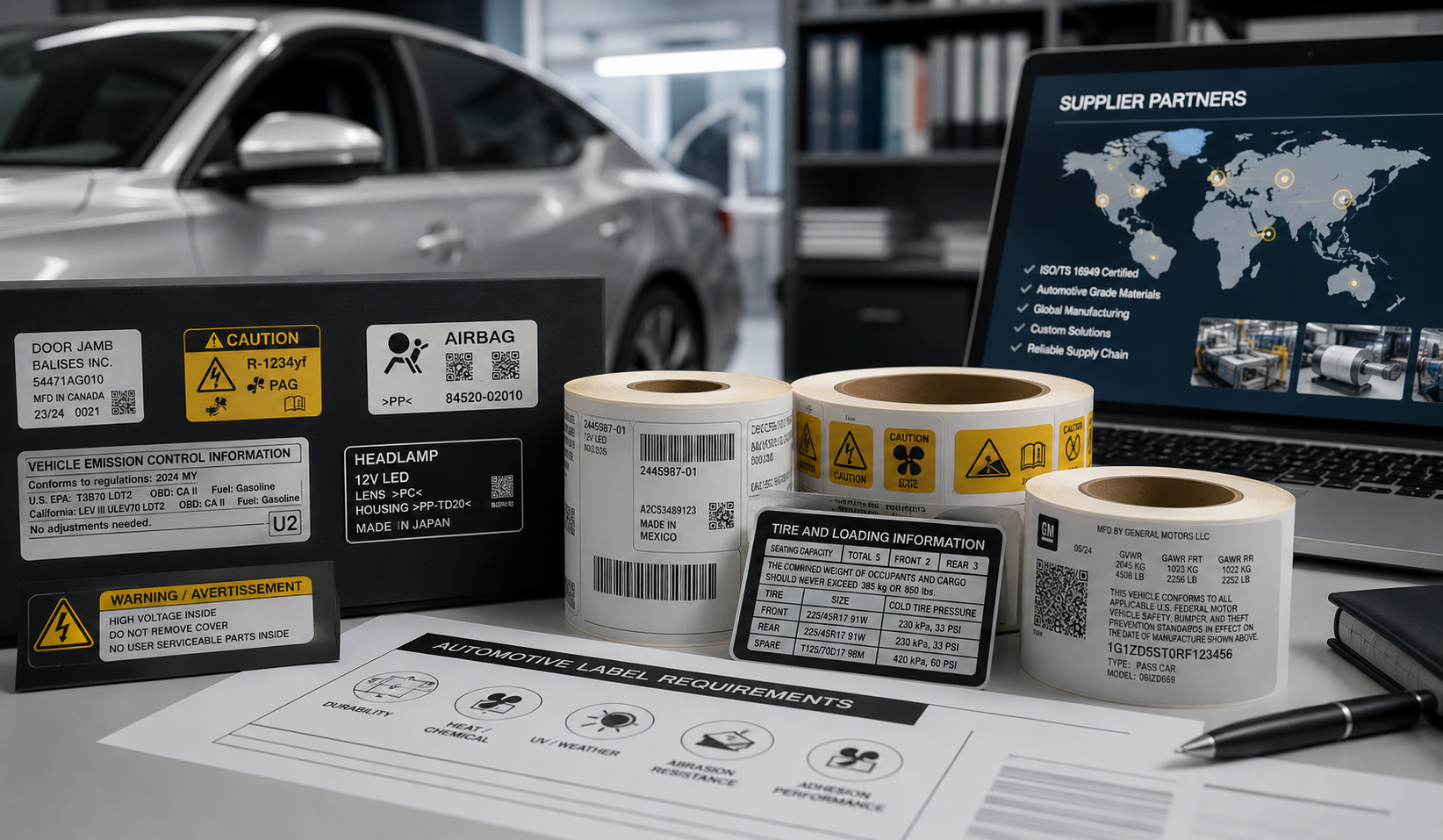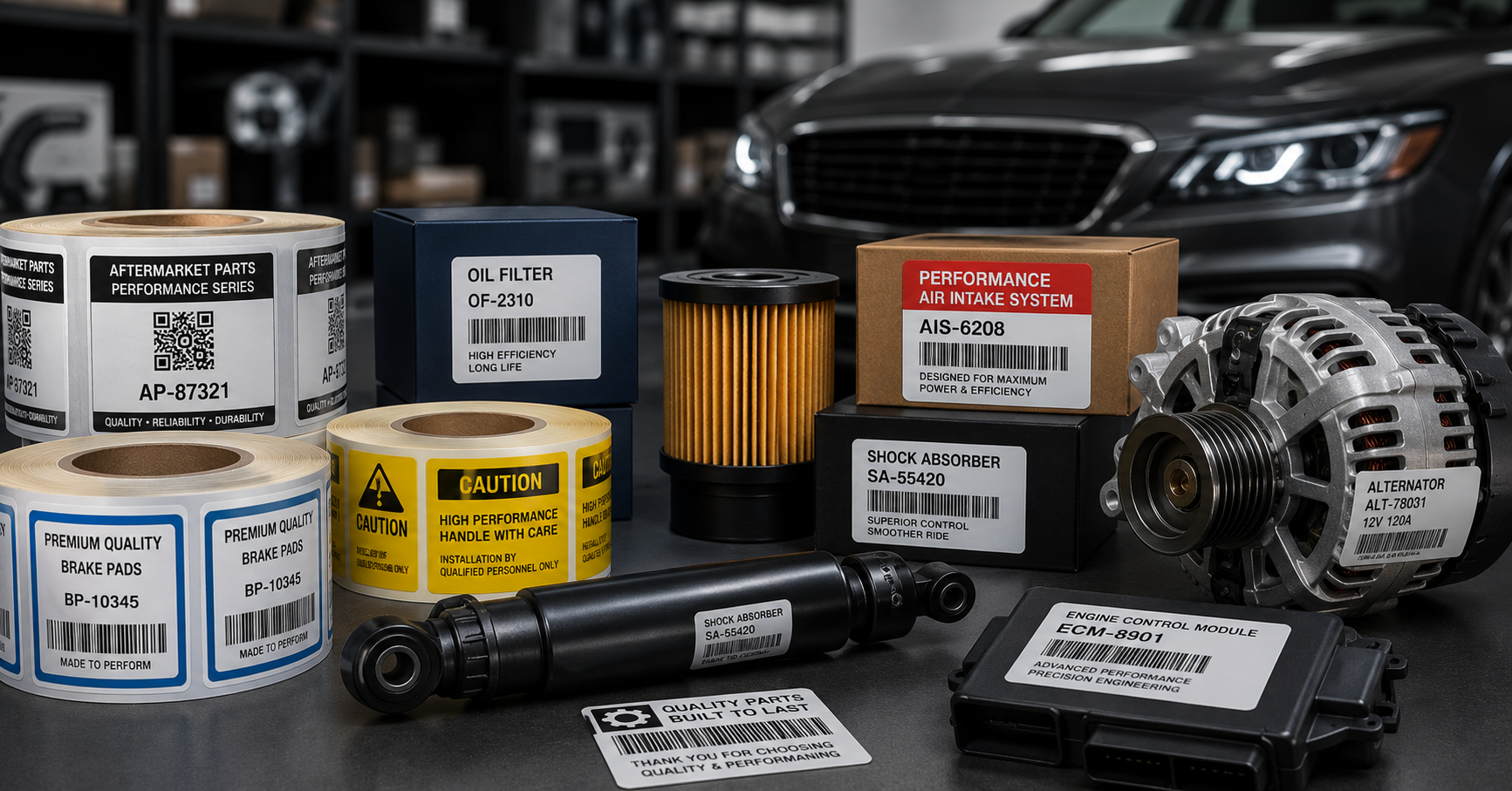
Companies that specialize in custom automotive labels for aftermarket parts fall into four groups: label stock manufacturers, contract converters, online sticker printers, and local sign shops. Each group sits at a different point in the same supply chain. Picking the wrong one is why so many first orders curl off a valve cover by mid July.
The choice matters more than most buyers expect. A decal that looks flawless on a desk can chalk, fade, or lift after one summer under a hood. Material, adhesive chemistry, and print method decide whether identification lasts a season or a decade.
What Separates a Real Automotive Label From a Regular Sticker
Under hood components can sit above 150 C near exhaust routing, then cold soak to minus 40 C in winter freight. Motor oil, brake fluid, coolant, and shop degreasers splash exactly where identification lives. Paper facestock and general purpose acrylic give up fast in that environment.
Surface energy is the other quiet killer. Housings, intake pipes, and trim are often molded from polypropylene or TPO, which usually sit below 35 dynes per centimeter. That is why custom automotive labels for aftermarket parts get specified by construction, not by appearance.
- Continuous service temperature of the full construction, not just the film
- Adhesive chemistry rated for the exact fluids the part will meet
- UV stability whenever the part is visible or mounted outside the cabin
- Print durability, since ink usually fails long before film does
The Four Types of Companies Behind Custom Automotive Labels for Aftermarket Parts
The chain runs from coated raw material down to a finished decal on a retail box. Suppliers of custom automotive labels for aftermarket parts and accessories sit somewhere along it, and their position tells you what they control. Knowing the layout stops you asking a sticker shop to solve a materials problem.
Volume shapes the decision as much as technical need. A brand shipping fifty units a month buys differently from one shipping fifty thousand. Both can get a good label, just not through the same door.
1. Label Stock Manufacturers
These mills coat adhesive onto film or paper, cure it, and slit the result into jumbo rolls. They formulate the adhesive, select the liner, and run the lab work behind a temperature rating. If a construction has to survive 150 C plus brake fluid, the spec is born here.
They sell mainly to converters and printers rather than to end brands in small quantities. Their range covers polyester, polyimide, vulcanized rubber stock, and automotive label materials built for under hood duty. Brands with real volume sometimes go direct and tell their converter which stock to buy.
2. Contract Converters and Trade Printers
Converters take jumbo rolls and turn them into finished labels through printing, laminating, die cutting, and rewinding. Most firms selling custom automotive labels for aftermarket parts at production scale are converters. They hold the presses, the die tooling, and usually the compliance paperwork.
Ask what they run in- house and what they buy in. A converter with thermal transfer, flexo, and digital under one roof can match print method to real world abuse. Minimums often start in the low thousands per design, which is the trade off for that material range.
3. Online Custom Sticker Printers
Online shops are the fastest route to custom automotive stickers and short run decals. Upload artwork, pick a size and quantity, and a box arrives inside a week. For logo decals, warranty seals, and packaging labels, they do the job cheaply and well.
The limitation is material depth. Most carry vinyl, clear vinyl, and sometimes polyester, which is fine on a toolbox and wrong on a turbo housing. Searches for custom automotive labels for aftermarket parts for sale usually land here, so read the material spec before assuming the stock is heat rated.
4. Local Print and Sign Shops
Every metro has shops cutting vinyl and printing short runs, which is why custom car stickers near me stays such a busy search. They earn their keep on prototypes, one off dash decals, and anything you need in hand this week. Nothing beats them on turnaround.
Material knowledge varies enormously between shops. Some run wide format printers and outdoor rated cast vinyl, while others stock one calendered roll. A call asking what facestock they carry sorts the two apart faster than any review page, and the same trick works when you search custom automotive near me.
Switch Labels, Wire Markers, and the Fiddly Stuff
Plenty of aftermarket labeling work is not a logo decal at all. Custom automotive switch labels go on rocker panels and dash inserts, so they need scratch resistance and a matte finish that will not glare at night. Backlit versions need a translucent window held in the register, which not every shop can hold.
Custom automotive wire labels are their own category again. Harness markers wrap small diameter jackets, ride out vibration, and often need flame retardant film for engine bay routing. Suppliers handling cable and wire identification labels usually stock wrap around and flag formats for roughly 2 mm to 20 mm cable.
- Switch legends: polyester facestock with a hard coat topcoat
- Harness markers: self laminating wrap with a clear tail over the print
- Flag labels: dual sided reading on tight looms and connector runs
- Warning decals: ANSI Z535 colors, formats, and signal words
Standards Worth Asking About
An aftermarket part still ends up inside a regulated vehicle. VIN plate and label requirements sit in 49 CFR Part 565, which covers format, content, and how the plate is affixed and read. Anyone sourcing custom automotive labels for aftermarket parts should know which rules touch their product before artwork gets signed off.
Three other references come up constantly with suppliers. UL 969 covers durability of marking and labeling systems, AIAG B-10 sets the parts identification label format most North American automotive programs expect, and ASTM G154 defines the accelerated UV weathering test behind outdoor life claims. A supplier who cannot name one of them is a printer rather than a labeling partner.
How to Vet a Supplier Before You Order
Buyers type where can i make custom labels long before asking what the label has to survive. Flip that order. Write down the substrate, temperature range, fluid exposure, sunlight, cleaning method, and expected service life, then hand the same page to three suppliers.
Samples settle arguments that spec sheets only start. Ask for stock applied to your actual substrate, not a stainless test panel, then leave a set on a running vehicle for a few weeks. Any supplier confident in their outdoor and weather resistant label stock will send samples without a fight.
- Send application details, not just artwork dimensions
- Request peel adhesion data measured on your substrate
- Confirm print method and, for thermal transfer, ribbon grade
- Ask for the temperature rating of the full construction
- Field test one batch before committing to a production run
Write your application spec this week and send it to three suppliers. The half hour it takes will save you a recall of your own decals later.
Frequently Asked Questions
What kind of company makes custom automotive labels for aftermarket parts?
Four types serve this market: label stock manufacturers, contract converters, online sticker printers, and local sign shops. Manufacturers coat and slit the raw material, converters turn it into finished labels, online printers handle short runs, and local shops cover prototypes. Which one fits depends on volume, durability, and the technical support you need.
What material works best for custom car labels under the hood?
Polyester with a high temperature acrylic adhesive handles most under hood positions, and polyimide takes over where continuous heat runs higher. Both resist oils, fuels, and solvents far better than paper or standard polypropylene. Custom car labels for cooler interior spots can use cheaper stock, so match material to location.
Are custom automotive stickers the same as durable labels?
Not usually. Custom automotive stickers are generally decorative vinyl made for branding, promotions, and packaging, while durable labels are engineered constructions rated for temperature, chemical, and UV exposure. The artwork process looks identical, but the material specification and testing behind it are completely different.
How long do exterior automotive decals last?
UV stabilized polyester and cast vinyl with a protective overlaminate are commonly rated for five to ten years outdoors. Real life depends on solar intensity, mounting angle, and pressure washing. Accelerated weathering tests such as ASTM G154 are what suppliers use to support those numbers.
Which print method survives oil and solvent cleaning?
Thermal transfer with a full resin ribbon on polyester is the standard answer for parts exposed to oil, fuel, and degreasers. Wax and wax resin ribbons cost less, but the image smears once solvents touch it. For decorative exterior work, screen or digital printing under a clear overlaminate holds up well.
Do aftermarket brands need to follow VIN or emission label rules?
Aftermarket brands do not issue VIN plates, but they should avoid anything that obscures, damages, or imitates required identification and emission labeling. Those labels are federally mandated and must stay legible and properly affixed. When a part mounts near one, plan around it.
What minimum order quantities are normal for custom automotive labels for aftermarket parts?
Online printers commonly start at fifty to one hundred pieces, converters in the low thousands per design, and material manufacturers sell by the roll. A custom die shape adds a one time tooling cost that favors larger runs. Asking about tooling upfront prevents a surprise on the first invoice.
Can one label design work on both metal and plastic parts?
Sometimes, though, it needs testing rather than assumption. Adhesives optimized for painted steel often underperform on polypropylene and TPO, while aggressive rubber based adhesives cover both but resist clean removal. Many brands run two constructions with identical artwork instead of forcing one compromise.
Sourcing custom automotive labels for aftermarket parts gets simple once the environment is written down and the supplier type matches the volume. Start with the application, not the artwork, then test samples on the real part. Keep the winning spec sheet for the next product line.