


How Should IoT AI Integration Move from Sensor Data to Real-Time Decisions?
Quick Answer: IoT AI integration should move through a controlled chain: define the operational decision, validate sensor data, normalize and timestamp inputs, run the approved model, apply decision rules, deliver an action or alert, and record the result for monitoring. The edge computer must fit interfaces, latency, power, security, storage, and update requirements; it cannot repair poor data or undefined ownership.
Process Snapshot
Decision: define the action and owner before selecting hardware.
Data: document units, timing, quality, loss, and calibration.
Compute: benchmark the complete preprocessing and inference pipeline.
Integration: specify protocols, APIs, PLC or gateway boundaries, and failure states.
Lifecycle: monitor models, software, devices, and audit records after deployment.
How Does the Workflow Move from Input to Output?
Process rule: Begin with a device and data inventory. Map each sensor to its protocol, sampling rate, timestamp source, units, calibration status, and acceptable loss. Normalize data at a gateway or edge service, then pass only validated inputs to inference. Model output should enter an explicit business or control rule; do not wire an unreviewed confidence score directly to a safety-critical actuator.
How should data travel from device to decision?
Use staged interfaces: acquire, validate, preprocess, infer, apply rules, publish the event, and log outcome and health data. For intermittent links, define buffering, expiration, duplicate handling, and clock recovery. Separate control traffic from bulk model, video, or log transfer so that maintenance activity cannot unexpectedly consume operational capacity.
Define every handoff by input, output, timing, owner, failure state, and recovery. Keep raw measurements and derived AI decisions distinguishable so an operator or auditor can see whether a bad outcome came from the source data, model, rule, interface, or action.
Which Process Controls Are Critical?
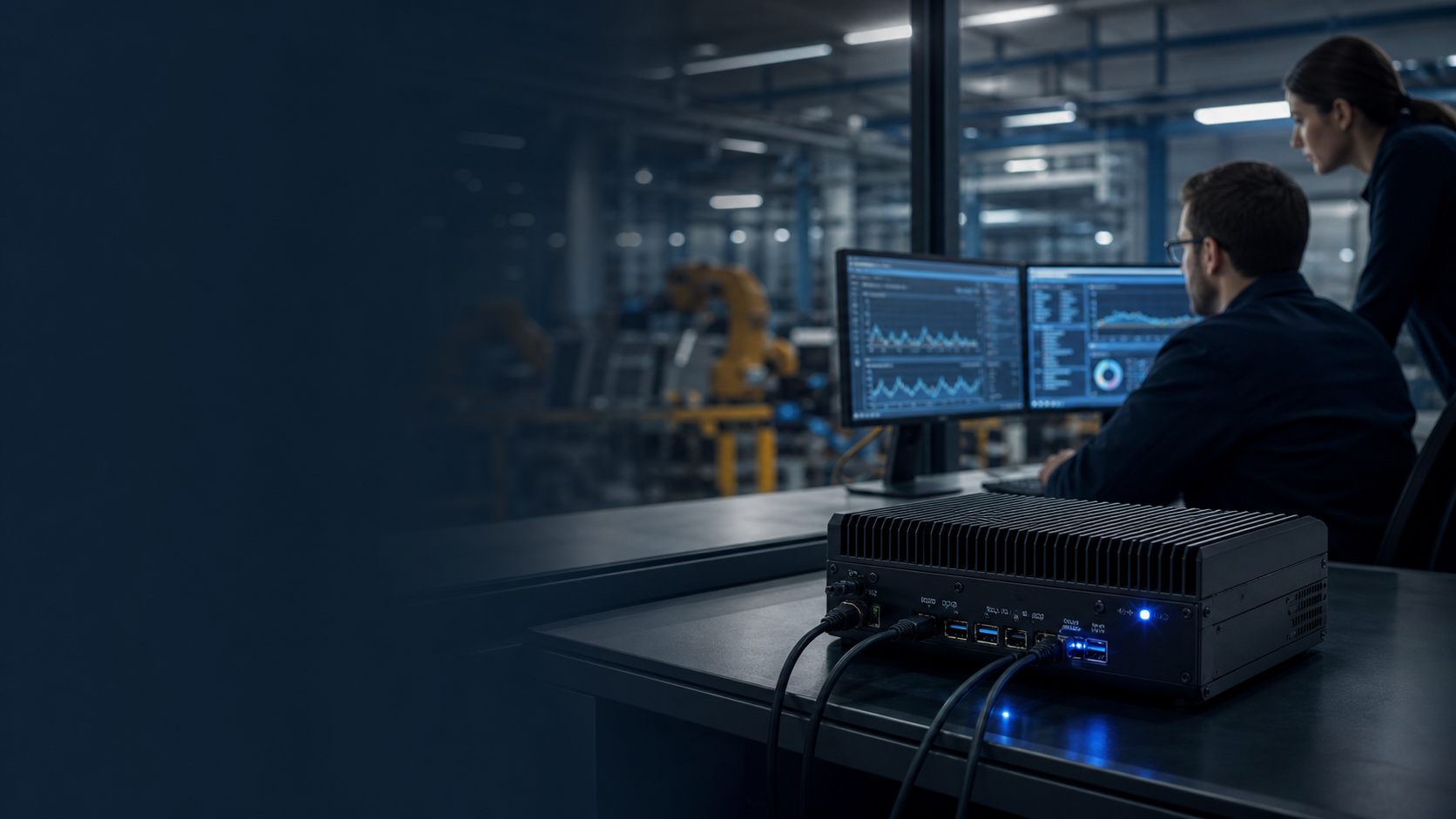
Control point: Monitor input quality, timestamp drift, queue depth, inference latency, model version, confidence distribution, device temperature, storage, and network state. Use contract tests for message schemas and interface changes. TWOWIN describes the T202 as an Orin Nano-based edge computer intended for rapid deployment and analysis of existing data; that is company-provided positioning, so the exact ports, software image, storage, and environmental limits still require a model-specific specification and test.
Where does hardware selection enter the process?
Select hardware after profiling sensor ingest, preprocessing, model memory, inference, output traffic, and background services together. The IoT AI integration option is relevant only if its interfaces and power, thermal, storage, and lifecycle design match the measured workload.
Control limits must come from the project and its risk analysis. Record normal ranges, warning thresholds, stop or fallback behavior, and who may change them. A displayed metric without a defined response is monitoring, not control.
Where Do Failures and Bottlenecks Occur?
Failure risk: Typical breakdowns include stale timestamps, unit mismatches, uncalibrated sensors, schema drift, network duplicates, memory growth, storage exhaustion, model mismatch, and updates that cannot roll back. A dashboard can appear healthy while the decision path is using old or misaligned data. Inject sensor loss, corrupted messages, delayed packets, power interruption, and service restart during acceptance testing.
Bottlenecks can move after software or model updates. Test the full pipeline at peak input and during degraded conditions while logging queue depth, resource use, temperatures, network behavior, storage, and decision latency. Keep enough margin for diagnostics and recovery rather than sizing to a single best run.
How Should Quality Records and Traceability Work?
Traceability check: Record device identity, firmware, calibration, message schema, model and container versions, configuration, decision output, operator response, and final outcome. Retain enough context to reproduce a disputed alert without storing unnecessary sensitive data. NVIDIA's Jetson Platform Services illustrates containerized services, APIs, monitoring, messaging, and gateways, but the buyer remains responsible for system-specific security and validation.
How Should Changes and Handoffs Be Controlled?
Control changes through a staging environment, signed release package, compatibility matrix, rollback plan, and limited pilot group. Revalidate after sensor replacement, firmware updates, model changes, environmental shift, or altered operating thresholds. Treat supplier software and third-party models as managed dependencies, with owners and end-of-support dates.
For each release, document the reason, affected requirements, validation scope, known limitations, approval, deployment sequence, rollback trigger, and support owner. Handoffs should include unresolved risks; hiding them merely transfers cost to deployment and maintenance.
Before scale-up, conduct an operational-readiness review with engineering, quality, cybersecurity, site operations, and support. Confirm that monitoring thresholds, spare capacity, credentials, recovery media, service access, training, escalation, and data-retention rules are in place. Run a controlled rollback and a simulated support case. The system is not production-ready merely because its main inference function works; the surrounding processes must also recover predictably and leave usable evidence. Review unresolved risks and assign owners, due dates, and release conditions before volume or multi-site deployment.
What Should You Map Before an IoT AI Integration Review?
Provide the device inventory, protocols, data rates, message schemas, sample data, model, latency and availability targets, actuator boundaries, network design, cybersecurity controls, power and environment, update method, and acceptance tests. TWOWIN can use that map to evaluate an edge computer without assuming that a processor specification proves end-to-end integration.
References & Sources
Project input: TWOWIN 3-Month SEO/GEO Content Schedule, Week 9, 2026-08-05.
TWOWIN official landing page used as company-provided information; linked once in the article with the required keyword anchor.
NVIDIA Jetson Platform Services
NIST SP 500-325 Fog Computing Conceptual Model
NIST SP 800-82 Rev. 3 Guide to Operational Technology Security