When optical fibre is classified by propagation mode and refractive index profile, the three foundational types of optical fiber are single mode step index, multimode step index, and multimode graded index. That is the classification that describes what light physically does inside the glass. Other groupings exist and are equally valid, but this one sits underneath all of them.
The distinction is not a marketing invention. It follows how standards bodies describe fibre geometry, and it matches any university lecture set or downloadable types of optical fiber pdf. The wording drifts between sources, the physics does not.
How Many Types of Optical Fibre Are There?
Ask ten engineers how many types of optical fibre exist and answers land anywhere between two and twenty. They are all partly right, because fibre also gets sorted by material, cable construction, connector interface, OM class, ITU-T category, and specialty function. Sorting by mode and index profile is simply the layer that the other taxonomies build on.
Here is the version you would put on slide two of a types of optical fiber ppt:
- Single mode step index: narrow guiding region, one propagating spatial mode, longest reach.
- Multimode step index: wide core, many propagating modes, shortest usable distance.
- Multimode graded index: wide core with a tapered index profile, many modes arriving close together.
A mode is a permitted path light can take through the core. A wide core supports many modes, a narrow one supports a single spatial mode, and that fact drives bandwidth, distance, and cost. Once that clicks, the categories stop being trivia and start being a design decision.
Type 1: Single Mode Step Index Fiber
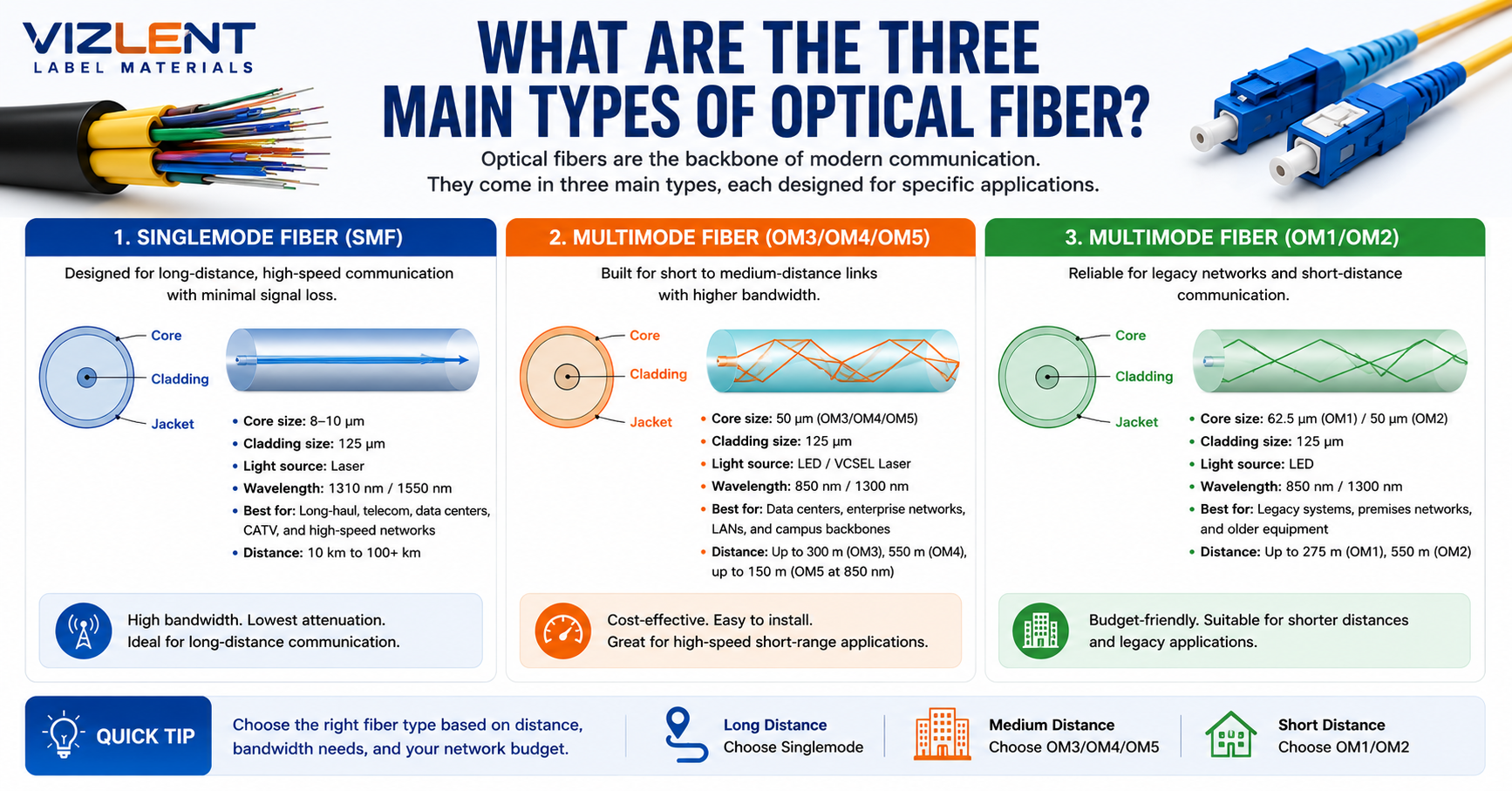
Standard single mode fibre is usually written as 9/125 micrometres, which is practical shorthand rather than a precise statement of physical core diameter. ITU-T G.652, current edition dated August 2024, gives a nominal mode field diameter of roughly 8.6 to 9.2 micrometres at 1310 nm inside a 125 micrometre cladding, and mode field diameter is the measured quantity engineers actually splice and budget against. The G.657 family covers the bend tolerant variants used in apartment risers and cramped enclosures.
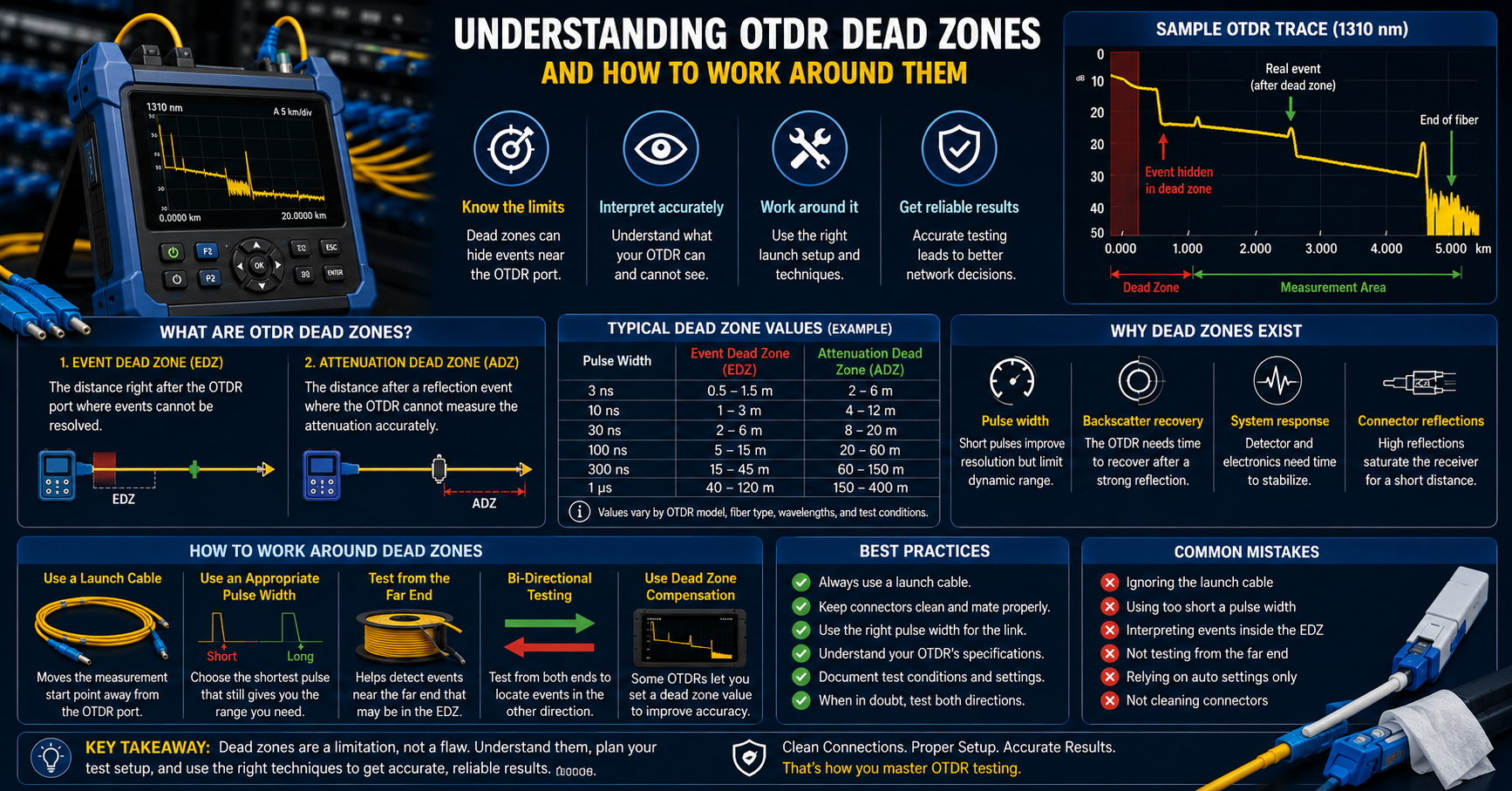
Because only one spatial propagation mode is supported, intermodal dispersion is eliminated, though chromatic dispersion and polarization mode dispersion still shape the link. Deployed G.652.D fibre typically measures near 0.32 dB/km at 1310 nm and around 0.19 dB/km at 1550 nm, while the recommendation itself sets maximum cable attenuation of 0.40 dB/km across 1310 to 1625 nm and 0.30 dB/km across 1530 to 1565 nm. Systems favour the 1550 nm window for a mix of reasons that include loss, amplifier availability, dispersion behaviour, and optical budget, so when a span misbehaves crews trace it with an OTDR tester rather than guessing which splice went bad.
Type 2: Multimode Step Index Fiber
Multimode step index fibre uses a much fatter core, commonly 50 to 100 micrometres in glass and around 1 mm in plastic, with an abrupt index change at the core boundary. Many modes propagate at once, each following a different effective path length. It is cheap to couple into, tolerant of rough alignment, and easy to terminate.
The catch is intermodal dispersion. Higher order modes travel a longer effective path than the fundamental mode, so a crisp input pulse arrives smeared and usable bandwidth falls away with distance. That is why this variety shows up in sensing, lighting, and short industrial links rather than in modern backbone runs.
Type 3: Multimode Graded Index Fiber
Graded index fibre softens that penalty with a neat trick. Instead of a flat core index, the index tapers from centre to edge along a near parabolic profile, so light guided nearer the cladding travels through lower index glass and moves faster. Higher order modes therefore arrive closer in time to the fundamental mode, pulses stay tighter, and modal bandwidth climbs sharply over step index.
Modern versions are grouped by OM class, and the practical differences show up in supported reach:
- OM1: 62.5/125 micrometre core, found in legacy building cabling.
- OM2: 50/125 micrometre core, an earlier generation multimode grade.
- OM3: Laser optimised 50/125, supporting up to 300 m for 10GBASE-SR.
- OM4: Laser optimised 50/125 with higher effective modal bandwidth, supporting up to 400 m for 10GBASE-SR.
- OM5: Wideband multimode specified to support short wavelength division multiplexing across roughly 850 to 953 nm, so several channels share one fibre pair.
Those distances come from the applicable IEEE 802.3 Ethernet specifications for 10GBASE-SR, not from vendor brochures, which is why they hold up in a design review. OM5 is worth separating out because it is not simply a faster OM4: its value lies in the wavelength range it supports rather than in raw distance. Inside data centres this family dominates short reach links, because 850 nm VCSEL transceivers cost far less than single mode optics.
Types of Optical Fiber Based on Material
Sorting types of optical fiber based on material gives a second, equally valid map. Most telecom fibre uses silica glass, with dopants such as germanium dioxide used to control the refractive index of the core relative to the cladding. Purity is the whole game, since impurities turn light into heat.
Outside telecom, other materials earn their place:
- Plastic optical fibre (PMMA): Common designs use roughly 1 mm core and cladding dimensions, although constructions vary.
- Hard clad silica: A glass core with a polymer cladding, used for rugged sensing.
- Fluoride and chalcogenide glasses: Chosen where mid infrared transmission is required.
Material choice trades loss against toughness. Plastic fibre survives abuse but attenuates quickly, so runs stay short. Silica is fragile bare yet carries light for kilometres, which is why every long link uses it.
Types of Optical Fiber Cable Built Around the Glass
A bare fibre is thinner than a human hair, so cable design decides whether it survives in the real world. The common types of optical fiber cable differ in how the glass is protected and how many strands travel together. Choosing badly here causes more outages than picking the wrong glass.
The constructions you will meet most often:
- Tight buffered: typically a 900 micrometre buffer applied over each coated fibre, which makes indoor termination straightforward.
- Loose tube: fibres sit loosely inside protective tubes, with gel or dry water blocking materials used depending on the cable design.
- Ribbon: fibres bonded into flat arrays for mass fusion splicing and high strand counts.
- Armoured: additional mechanical protection layered into the cable for crush and rodent resistance.
- ADSS: an all dielectric self supporting design intended for aerial installation without a messenger wire.
Jacket rating matters as much as construction. Indoor cable carries riser or plenum classifications that govern where it may legally run. Outdoor cable trades that for water blocking and UV resistance.
Types of Optical Fiber Connectors and Why They Decide Your Loss Budget
The glass rarely fails on its own. Connectors are where most field loss appears, which is why types of optical fiber connectors deserve as much attention as the fibre. Ferrule diameter is the quickest sorting method, though it is only one of several selection factors.
Working shorthand for the common families:
- 1.25 mm ferrule: LC and MU, the dense patching standard.
- 2.5 mm ferrule: SC, FC, ST, and E2000, still everywhere in older plant.
- MPO and MTP: multi fibre interfaces carrying 12, 16, or 24 strands.
- Polish: UPC domed physical contact, APC angled for lower reflectance.
- Also in play: fibre type compatibility, insertion and return loss targets, mating hardware, panel density, and polarity scheme.
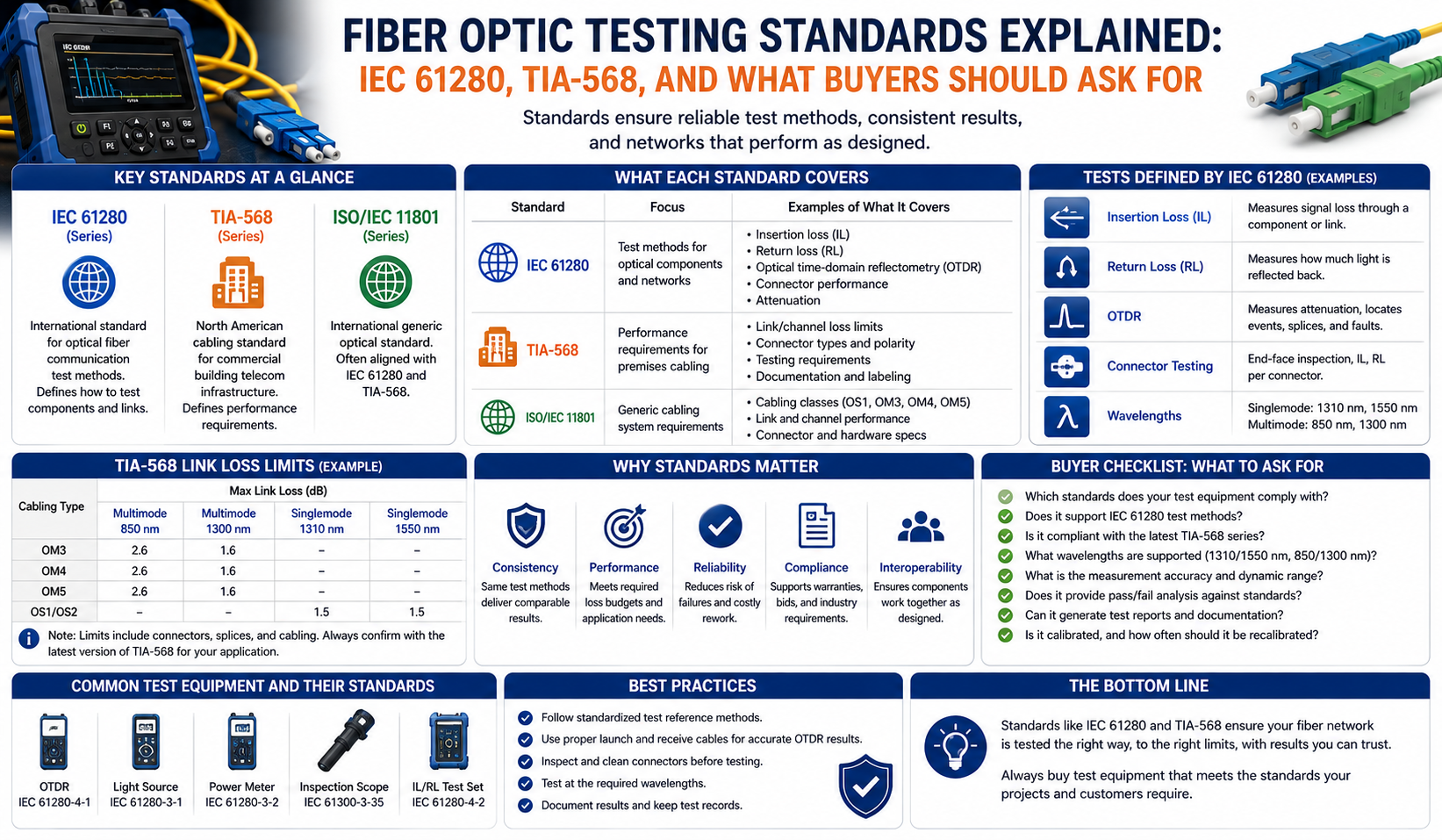
A connector is only as good as its end face. IEC 61300-3-35 sets inspection procedures and acceptance criteria covering debris, scratches, and defects by zone, and the standard is explicit that visual inspection does not replace attenuation and return loss measurement. The workflow that keeps links healthy is a loop: check the end face with a fiber inspection probe, clean anything that fails, look again, then certify optically.
Choosing Between the Types Without Overthinking It
Contamination is a common cause of fibre link problems in the field, so handling discipline does more for reliability than the spec sheet ever will. Beyond that, selection comes down to distance, density, and optics budget. The framework below covers most jobs.
Choose single mode when:
- The link extends beyond typical multimode distances.
- Future distance or capacity headroom matters.
- The application is backbone, metro, FTTH, or campus interconnect.
- Choose graded index multimode when
- Distances are relatively short and contained within a building.
- Port density is high and multimode optics fit the budget.
- The deployment is enterprise or data centre cabling.
- Choose step index multimode when
- Bandwidth requirements are modest.
- The application is sensing, lighting, or a short industrial link.
Rugged handling matters more than reach.
None of the three types of optical fiber forgives dirt on a ferrule, so plan the cleaning and inspection routine alongside the cable order. Distance sets the glass, environment sets the cable, and the existing plant usually sets the connector. Work in that order and most specification arguments resolve themselves.
Wrapping Up
Knowing the three main types of optical fiber turns most network decisions into simple arithmetic: how far, how fast, how much. Pick the glass for the distance, the cable for the environment, and the connector for the plant you already have. Then treat every end face as the weakest point in the link, because it usually is.
If you are specifying fibre for a new build or auditing an existing plant, start with a clean baseline: inspect, clean, then certify optically before signing anything off. Browse fiber cleaning tools and inspection gear to build a kit that matches the connector types on your site.
Frequently Asked Questions
How many types of optical fibre are there in total?
Classified by propagation mode and index profile, there are three foundational types of optical fibre: single mode step index, multimode step index, and multimode graded index. Other groupings, such as material, cable construction, OM class, or ITU-T category, describe the same fibre from a different angle.
What is the difference between single mode and multimode fiber?
Single mode fibre guides one spatial propagation mode through a small central region, usually described as 9/125 micrometres, while multimode uses a 50 or 62.5 micrometre core that supports many modes. Eliminating intermodal dispersion lets single mode carry data much farther, at a higher cost per transceiver.
Which types of optical fiber communication systems use single mode?
Long haul, metro, subsea, and fibre to the home networks are the types of optical fiber communication systems that rely on single mode. They all need distance and capacity headroom that multimode cannot provide.
Is graded index fiber better than step index?
For data transmission, graded index outperforms multimode step index because its tapered index profile reduces the arrival spread between modes. Step index still suits sensing, lighting, and very short industrial links where bandwidth requirements are modest.
What are the types of optical fibre communication windows?
The main transmission windows sit near 850 nm, 1310 nm, and 1550 nm. Multimode mostly runs at 850 nm with VCSEL sources, while single mode uses 1310 nm and 1550 nm, where loss, amplifier availability, and dispersion behaviour combine favourably.
Do different types of optical fiber connectors change the loss?
Yes, though polish, geometry, and cleanliness matter more than the connector body alone. Angled physical contact interfaces reflect far less light than domed ultra physical contact ones, and a contaminated end face can add more loss than any difference between families.
Where can I find reliable optical fibre standards, PDFs, or presentations?
Standards bodies publish the authoritative material: ITU-T for the G.65x recommendations, IEC for the 60793 fibre specifications and 61300 test methods, and IEEE for Ethernet reach objectives. Vendor decks are useful for teaching but simplify the geometry, so quote the standard when numbers matter.
Can multimode and single mode fiber be mixed in one link?
They cannot normally be mated directly as a conventional fibre link, because the guiding regions do not match and most of the light is lost at the junction. Crossing between them requires active or optical conversion equipment chosen for the application, and an accidental mix during patching is a classic cause of mystery loss readings.