


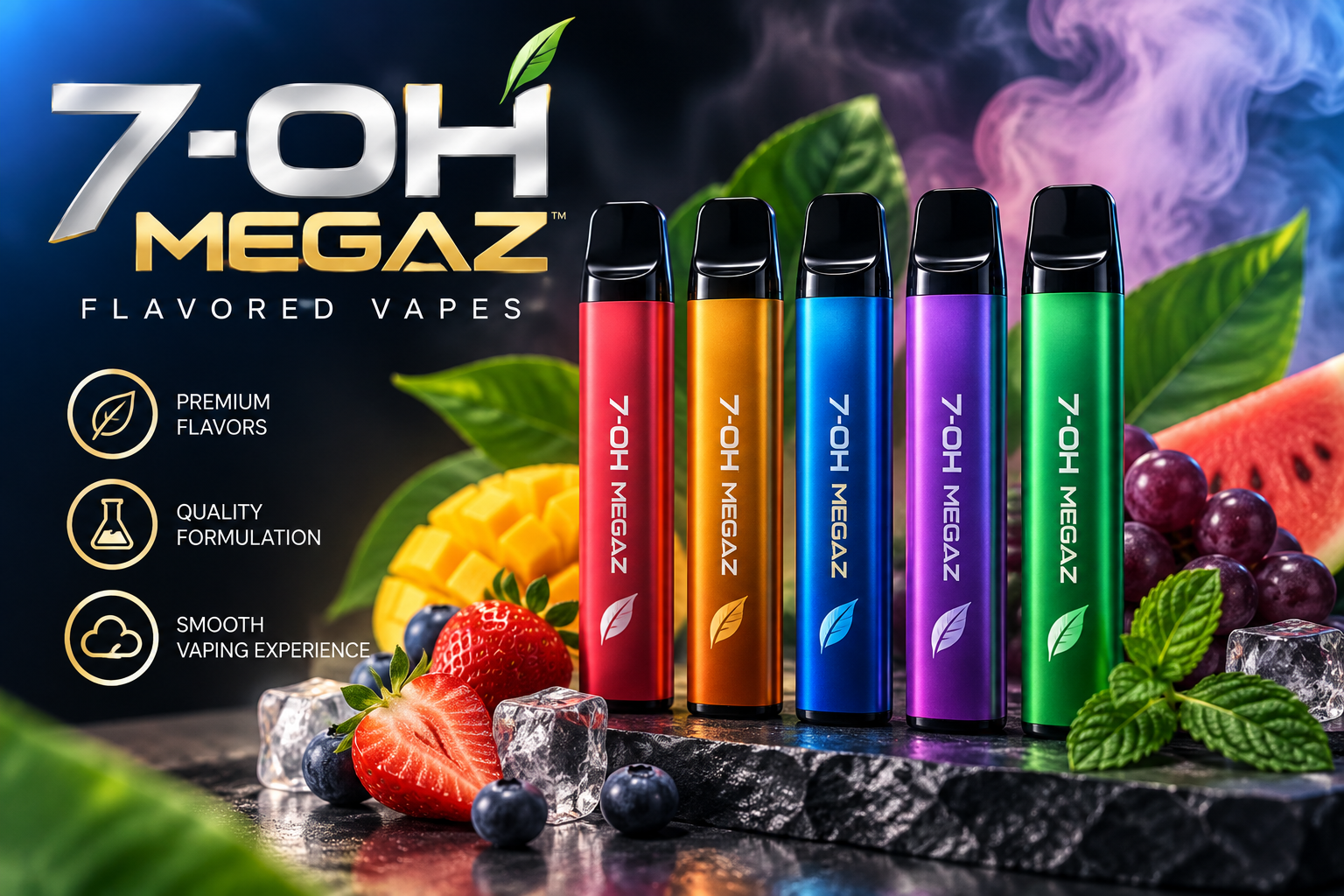
Understanding 7omegaz flavour profiles in modern vape formulation
Flavour is one of the defining features of any contemporary vape product, yet it is often discussed in overly simple terms. A device may be described as fruity, icy, sweet, or smooth, but those labels only hint at the much more deliberate design work happening behind the scenes. In the case of 7omegaz flavored vapes, flavour development is best understood as a structured formulation process in which aromatic impact, sweetness, cooling sensation, vapour perception, and aftertaste are carefully balanced to create a coherent and repeatable user experience.
This guide explores how flavour profiles are built in 7-OH Megaz products with a focus on the technical and sensory principles that shape the final result. Rather than treating flavour as a single ingredient, professional formulation views it as a layered system. A successful profile must make an immediate impression, remain enjoyable through repeated puffs, avoid harshness or flavour fatigue, and preserve its intended identity throughout the product’s lifespan. That means every element, from bright top notes to the density of the base, has a role to play.
In professional flavour design, the goal is not simply to make a vape taste strong. Intensity without structure can become tiring, artificial, or unbalanced. The stronger objective is to create a profile with definition, depth, and stability. This is particularly important in products where consumers expect both a recognisable flavour category and a premium, polished finish. Whether the profile leans towards fruit, confectionery, beverage-inspired, or cooling-forward territory, the same formulation logic applies: each sensory feature must support the whole.
7omegaz flavored vapes are therefore best examined through the language of flavour architecture. Some components contribute immediate aroma, some broaden the centre of the profile, some add body or softness, and some modify sensation without strongly affecting taste itself. When these parts are aligned, the result feels complete. When they are not, the product may seem thin, over-sweet, harsh, overly cold, or confusing in character.
The sections below explain the mechanics of that architecture in detail, showing how flavour profiles are built from layered notes, sweetness control, cooling effects, balance decisions, and performance considerations. A professional understanding of these factors makes it easier to see why some profiles feel precise and refined while others feel blunt or inconsistent.
The role of flavour profiles in defining 7omegaz product identity
Every successful vape range depends on more than hardware and ingredient quality. It also depends on flavour identity. In 7omegaz products, flavour functions as both a sensory signature and a commercial differentiator. Consumers may initially be drawn to a broad category such as berry, citrus, mint, or dessert, but long-term recognition comes from the specific way a profile is assembled. Two products can both be labelled as mango or blue raspberry, for example, yet present entirely different experiences depending on brightness, sweetness, cooling intensity, and finish.
That is why flavour profiles should be understood as systems of identity rather than simple tastes. A well-developed profile tells the user what kind of experience to expect from the first inhale to the final exhale. It establishes whether the product is fresh and sharp, rich and rounded, playful and sweet, or clean and restrained. In professional formulation, this consistency of message is essential. The flavour must not only taste good in isolation; it must match the brand’s quality expectations and remain believable within the chosen category.
For 7omegaz flavored vapes, identity is often shaped through balance rather than excess. A profile that relies only on heavy sweetness may create a quick impact but risks losing sophistication. Likewise, a profile built purely around cooling may feel one-dimensional after repeated use. The strongest flavour identities are usually those where several elements work together: a clear opening note, a solid middle, a controlled sweetening effect, and a finish that lingers without becoming cloying. This layered approach allows the product to feel complete rather than exaggerated.
Another important point is that flavour identity must survive practical conditions. It has to perform in aerosol form, remain stable over time, and feel recognisable despite variation in user puffing behaviour. This makes vape formulation distinct from food or beverage flavouring. What works in a drink or sweet may not translate directly into vapour. The profile must therefore be engineered not only for taste, but also for delivery and consistency.
How top notes create the first impression in 7omegaz flavored vapes
Top notes are the most immediate and volatile elements of a flavour profile. They are what the user notices first, both in aroma and in the opening sensation of the inhale. In 7omegaz flavored vapes, top notes play a critical role because the first impression strongly influences whether a profile feels fresh, authentic, vibrant, or flat. These notes often include bright fruit facets, sparkling citrus accents, crisp mint cues, or other high-impact aromatic elements designed to capture attention instantly.
In formulation terms, top notes are not simply added to make a profile stronger. Their function is to define direction. A tropical blend may use a juicy, slightly sharp opening to signal ripeness and freshness. A beverage-inspired profile may lean on zesty, effervescent accents to suggest liveliness. A cooling profile may introduce a brisk upper note that prepares the user for a colder finish. The best top notes are therefore strategic: they guide perception before the fuller body of the flavour unfolds.
However, top notes must be handled with care. If they are too aggressive, they can make a product feel chemically thin or excessively perfumed. If they are too weak, the profile may lack distinction and seem dull from the start. In a professionally built 7omegaz flavour profile, top notes are usually designed to be noticeable but not detached from the rest of the composition. They should transition naturally into the heart of the flavour rather than appearing as a separate burst that disappears too quickly.
Because these notes are often more volatile, stability becomes an important consideration. The formulation process must account for how top notes behave during storage and use. A profile that smells vivid when freshly produced but loses its opening character over time will not deliver a consistent experience. This is one reason why professional flavour design involves repeated testing under realistic conditions rather than relying solely on theoretical flavour pairing.
Building heart notes for body, character, and flavour continuity
If top notes provide the introduction, heart notes provide the main story. The heart of a flavour profile is where its central identity resides. In 7omegaz flavored vapes, heart notes create the body and continuity that make a flavour feel substantial rather than fleeting. They are often responsible for the recognisable core of the profile, such as the ripe fleshiness of a fruit, the creamy centre of a dessert style, or the rounded sweetness of a confectionery-inspired blend.
Heart notes are especially important in vaping because the experience unfolds over repeated puffs. A profile that depends too heavily on bright opening accents may impress initially but fail to hold interest. The middle must sustain the flavour and carry it through the inhale and exhale with enough depth to remain satisfying. This requires a careful interplay of aromatic character, texture perception, and density. In professional formulation, the heart is often where flavour realism is either achieved or lost.
For example, a fruit profile may use top notes to suggest freshness, but the heart determines whether it feels juicy, ripe, pulpy, candied, or artificial. A mint profile may open with an icy lift, but its core decides whether it feels herbal, sweet, clean, or medicinal. A dessert profile may hint at vanilla or caramel on first contact, but the middle determines whether it comes across as soft and indulgent or heavy and overworked. The heart therefore gives meaning to the opening impression.
Continuity is the key principle here. The transition from top notes into the core should feel natural, and the core should support the finish rather than collapse too early. When the heart is underdeveloped, the profile can seem hollow, with a quick burst followed by little substance. When it is overly dense, the product may feel muffled or tiring. In 7omegaz formulation, achieving a convincing middle is one of the clearest markers of technical refinement.
Base notes and depth: giving 7omegaz flavours a lasting foundation
Base notes are often less obvious to the casual user, but they are crucial to the overall integrity of a vape flavour. These lower, longer-lasting elements help anchor the profile and shape the finish that remains after exhalation. In 7omegaz flavored vapes, base notes can contribute warmth, softness, richness, or a subtle lingering character that prevents the profile from feeling abrupt or empty.
In practical terms, base notes support depth. They may not dominate the first inhale, yet they influence how full and settled a flavour feels over time. In fruit-forward profiles, a base can provide syrupy roundness, ripe undertones, or a smooth backing that stops the brighter notes from seeming sharp and isolated. In creamier or dessert-inspired profiles, the base may carry vanilla, custard-like softness, toasted nuances, or low caramel facets. Even in cooling-forward products, a discreet base can soften the edges and improve overall cohesion.
The challenge with base notes is proportion. Too little, and the flavour may lack finish and satisfaction. Too much, and the profile can become muddy, heavy, or stale in character. Professional formulators therefore use base notes not as a dumping ground for richness, but as a structural tool. The aim is to create a foundation that extends the flavour experience without obscuring the intended style.
Depth also matters for perceived quality. Profiles with no effective base often feel short-lived, simplistic, or imbalanced. By contrast, when lower notes are properly integrated, the flavour seems more polished and complete. Users may not always be able to identify why one vape feels more premium than another, but the presence of a supportive base is often part of that difference.
Sweetness in 7omegaz formulation: impact, control, and restraint
Sweetness is one of the most influential and most easily overused elements in vape flavour design. In 7omegaz formulation, sweetness is not merely a matter of making a product taste pleasant. It shapes body, rounds edges, enhances familiarity, and can significantly affect how a flavour category is perceived. A fruit profile with moderate sweetness may seem natural and juicy, while the same profile with elevated sweetness may read as candy-like or syrupy.
Professional flavour formulation treats sweetness as a balancing tool rather than a universal shortcut. Used correctly, it can soften acidity, support ripe fruit impressions, enrich dessert profiles, and improve mouthfeel perception. Used poorly, it can flatten complexity, blur distinctions between flavours, and lead to flavour fatigue. One of the most common weaknesses in lower-quality products is sweetness without structure, where the profile tastes loud at first but quickly becomes tiring because there is little else supporting it.
Control is therefore essential. The formulator must decide what kind of sweetness the profile needs. A crisp fruit blend may benefit from a cleaner, lighter sweetening effect. A confectionery-inspired profile may need a thicker, more coating sweetness. A cooling profile often requires enough sweetness to stop the cold sensation from feeling too harsh, but not so much that it becomes sticky and dull. These are not interchangeable choices; they determine how the product is interpreted by the user.
Restraint is equally important. A mature and professionally balanced 7omegaz flavour profile does not depend on sweetness to disguise weaknesses. Instead, sweetness should support the central concept while allowing top, heart, and base notes to remain distinct. The most effective formulations are those where sweetness feels intentional and well-integrated, enhancing enjoyment without overwhelming definition.
Cooling effects in 7omegaz products and how they shape flavour perception
Cooling is one of the most powerful modifiers available in modern vape formulation. In 7omegaz products, cooling effects can transform not only sensation but also the perceived identity of a flavour. A fruit blend with no cooling may feel juicy and rounded; the same blend with a moderate cooling layer may feel fresher and brighter; with strong cooling, it may become sharper, cleaner, and more invigorating. This demonstrates that cooling is not separate from flavour. It actively influences how flavour is interpreted.
From a formulation perspective, cooling must be chosen with precision. The first question is not simply how cold the product should feel, but what role the cooling should play. In some profiles, cooling is a supporting accent used to enhance freshness and lift top notes. In others, it is a central part of the identity, creating a bold, icy character that defines the entire experience. The intensity, onset, duration, and location of the cooling sensation all matter. Some effects are immediate and sharp, while others build gradually and linger on the exhale.
Balance is especially important because excessive cooling can suppress flavour detail. If the cooling effect dominates, nuanced fruit or dessert notes may become harder to perceive, leaving the profile feeling more cold than characterful. On the other hand, insufficient cooling in a profile designed to be refreshing can make it feel unfinished. Professional formulation therefore considers cooling as a structural layer that must sit in proportion to sweetness, aroma intensity, and body.
Cooling also affects repeatability. A profile intended for sustained use should remain comfortable over multiple puffs. An overly aggressive cold sensation may deliver initial excitement but become tiring or harsh over time. In refined 7omegaz formulation, cooling is managed so that it enhances clarity and freshness without overwhelming the profile’s core identity.
Balance as the central principle of 7omegaz flavour formulation
If one concept defines advanced flavour development, it is balance. Every successful 7omegaz profile depends on the relationship between its components rather than the strength of any single element. Top notes, middle body, base depth, sweetness, and cooling all need to operate in a controlled proportion. When one part dominates too heavily, the overall profile becomes less convincing and less enjoyable over time.
Balance does not mean neutrality or blandness. A flavour can be bold and still be balanced, provided its intensity is organised. For example, a sharply defined citrus profile may still feel polished if the acidity impression is supported by enough sweetness and body to prevent harshness. A dessert-style flavour can be rich and indulgent while remaining balanced if its creamy base does not obscure lighter accents. Even strong cooling can be balanced when it complements, rather than erases, the aromatic character.
In professional practice, balance is assessed across the full usage cycle. The profile should make sense at first inhale, mid-session, and after repeated use. It should not collapse into sweetness, turn hollow after the opening burst, or become increasingly fatiguing as the cooling accumulates. This long-view approach is what separates careful formulation from short-term sensory impact. The best products are not merely striking in the first few puffs; they remain coherent and appealing throughout extended use.
Balance also supports product consistency across a range. If different 7omegaz flavors all exhibit a considered structure, the portfolio feels curated rather than random. Users begin to trust that each profile, while distinct, will deliver a similar level of finish and control. That trust is one of the strongest signs of mature flavour development.
Authenticity versus stylisation in 7omegaz flavoured vape design
One of the most interesting decisions in flavour formulation is whether a profile should taste realistic or stylised. In 7omegaz flavored vapes, this choice shapes everything from note selection to sweetness level and cooling strategy. A realistic flavour aims to resemble a natural source more closely, such as the fresh juiciness of a ripe fruit or the leafy clarity of mint. A stylised flavour, by contrast, may intentionally exaggerate selected features to create a more vivid, candy-like, beverage-inspired, or dessert-driven experience.
Neither approach is inherently better. What matters is internal consistency. A profile that claims natural freshness but tastes heavily candied may feel confused. Likewise, a profile designed to be playful and bold should not be so restrained that it feels incomplete. Professional formulators therefore decide early whether the target is realism, fantasy, or a hybrid of both.
Many high-performing vape profiles occupy a middle ground. They begin with a recognisable natural reference, then stylise it for stronger impact in aerosol form. This might mean exaggerating juiciness, smoothing acidity, increasing sweetness, or adding cooling to heighten freshness. In this way, the profile remains recognisable while becoming more satisfying in use than a strictly realistic reconstruction might be.
For 7omegaz products, the success of this balance often determines consumer perception of quality. A believable profile feels intentional. Even when it is clearly stylised, it should still express a coherent flavour logic. That coherence allows the product to feel premium rather than chaotic or overly synthetic.
Texture, mouthfeel, and vapour sensation in 7omegaz flavour delivery
Flavour is not experienced through taste and aroma alone. Texture and mouthfeel perception play a major part in how a vape is judged. In 7omegaz flavored vapes, a profile may be described as smooth, dense, creamy, crisp, dry, syrupy, or clean, even though these sensations are not flavours in the strict sense. They arise from the interaction between aroma compounds, sweetening effects, cooling agents, and vapour characteristics.
This aspect of formulation is easy to underestimate, yet it strongly influences user satisfaction. A fruit flavour that tastes accurate but feels thin may seem incomplete. A dessert profile with good aromatic character but a dry finish may fail to deliver the indulgent impression it promises. Conversely, a well-designed mouthfeel can make a relatively simple profile seem far more polished and substantial.
Texture is created through careful compositional choices. Sweetness can add roundness and perceived weight. Certain flavour components can create creamy or juicy impressions. Cooling can sharpen the profile and reduce perceived heaviness. Base notes can soften the finish and add lingering fullness. The challenge is ensuring that these sensory cues align with the intended profile. A crisp citrus flavour should not feel excessively heavy, while a rich confectionery blend should not feel hollow and sharp.
In professional evaluation, mouthfeel is examined alongside flavour identity because the two are inseparable in practical use. 7omegaz formulation is strongest when the perceived texture supports the flavour concept, making the product feel coherent from inhale to exhale.
Consistency, stability, and quality control across 7omegaz flavours
Even the most impressive flavour concept has limited value if it cannot be reproduced reliably. Consistency and stability are therefore central to professional vape formulation. In 7omegaz flavored vapes, quality is not defined solely by the creativity of the flavour profile but by its ability to remain stable over time, perform consistently across production runs, and retain its intended sensory balance during normal storage and use.
Stability affects every layer of flavour. Top notes may fade, sweetness perception may shift, cooling intensity may soften or present differently, and base richness may become more prominent if the formula is not properly controlled. This means that formulation must account not only for how a product tastes immediately after blending, but for how it behaves throughout its practical shelf life. A profile that begins bright and balanced but later turns dull or uneven cannot be considered successful in professional terms.
Quality control also requires sensory benchmarking. Each flavour needs a reference standard so that batches can be compared for aroma, sweetness intensity, cooling strength, and finish. Without this disciplined comparison, small variations can accumulate and gradually alter the user experience. For a brand seeking a strong reputation, such drift is highly undesirable.
In addition, consistency matters across the portfolio. If one 7omegaz flavour feels carefully tuned and another feels rough or exaggerated, the range loses credibility. A professional flavour system ensures that different profiles may have different personalities while maintaining a shared standard of polish, clarity, and balance. This portfolio-level consistency is a strong indicator that flavour development is being managed with seriousness and technical discipline.
How to evaluate 7omegaz flavoured vapes with a professional sensory approach
Understanding flavour formulation becomes easier when products are evaluated methodically rather than impressionistically. A professional sensory approach to 7omegaz flavored vapes begins with the opening aroma and first inhale. The evaluator asks what appears immediately, how clear the flavour direction is, and whether the top notes feel clean, sharp, and intentional. This first stage reveals whether the profile has a strong entry point.
The next step is to assess the heart of the flavour. Does the profile develop into a recognisable core, or does it fade after the opening? Is the middle full enough to sustain interest? Does it match the promise of the initial impression? This stage often reveals the true quality of the formulation, because the heart determines whether the experience is complete or superficial.
Then attention shifts to sweetness, cooling, and texture. Is the sweetness supportive or excessive? Does the cooling enhance freshness or overpower flavour detail? Does the vapour feel smooth, juicy, creamy, crisp, or dry, and does that texture make sense for the chosen profile? These questions help identify whether the supporting elements are in harmony with the main flavour concept.
Finally, the finish and repeatability should be considered. A good 7omegaz profile should leave a clean, coherent aftertaste and remain enjoyable across repeated puffs. If the flavour becomes harsh, overly sweet, increasingly cold, or simply monotonous, the balance may not be fully resolved. By evaluating flavour in these structured stages, it becomes possible to distinguish between simple intensity and genuine formulation quality.
The future direction of 7omegaz flavour innovation and refinement
As consumer expectations continue to rise, flavour development in products such as 7omegaz flavored vapes is likely to become more nuanced rather than merely more intense. The market has already moved beyond the stage where loud sweetness alone can define quality. Increasingly, users respond to profiles that show separation between notes, a more natural progression from inhale to exhale, and a cleaner balance between impact and comfort.
This suggests a future in which refinement becomes a central competitive advantage. More sophisticated use of layered fruit profiles, better control of cooling onset and duration, and more intentional management of mouthfeel are likely to shape the next generation of high-performing formulations. There is also growing value in profiles that avoid obvious excess while still feeling distinctive. In other words, precision may become just as important as power.
For 7omegaz products, continued innovation will depend on maintaining this balance between recognisable flavour appeal and formulation discipline. The strongest profiles will be those that can deliver immediate satisfaction without sacrificing clarity, depth, or repeat-use comfort. Whether the flavour direction is fresh, sweet, icy, rich, or hybrid in character, the underlying principles remain the same: structured layering, controlled support elements, and a finish that feels resolved.
Ultimately, the complete guide to 7-OH Megaz flavour profiles and formulation is not a guide to individual taste preferences, but to design logic. Great flavour is built, not guessed. It depends on top notes that introduce, heart notes that define, base notes that anchor, sweetness that supports, cooling that enhances, and balance that unites them all. When these elements are properly aligned, 7omegaz flavored vapes can deliver flavour experiences that feel deliberate, polished, and unmistakably complete.