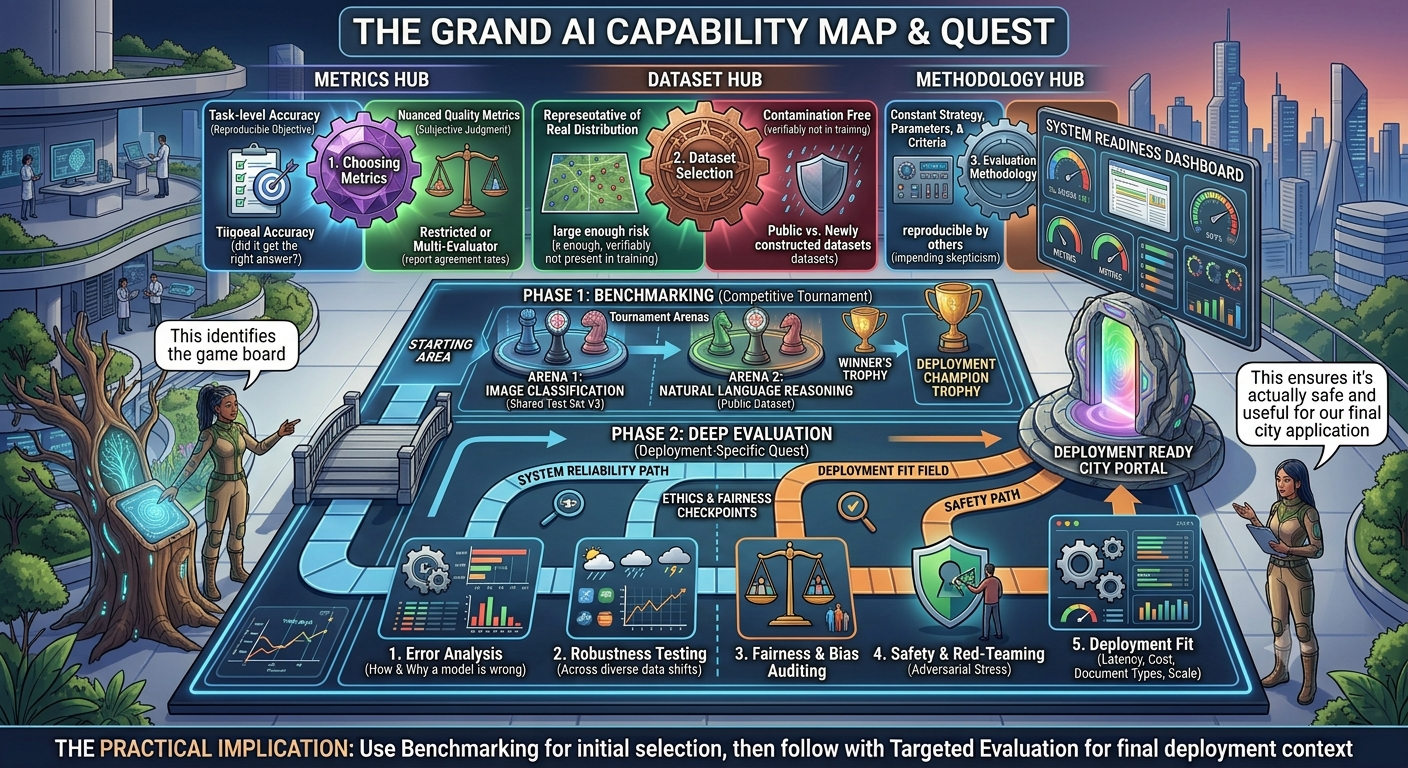
Three Interlocking Decisions
Setting up a rigorous AI model benchmark from scratch involves three interlocking decisions: what to measure, what data to measure it on, and how to run the comparison so the results are trustworthy. Getting any one of these wrong undermines the whole exercise, regardless of how careful the other two are.
1. Choosing Metrics
Choosing metrics starts with distinguishing between task-level accuracy metrics (did the model get the right answer) and quality metrics that require more nuanced judgment (was the answer well-reasoned, appropriately hedged, safe).
Accuracy metrics are objective and reproducible but only apply where there's a clear right answer. Quality metrics apply more broadly but introduce evaluator subjectivity, which is why serious benchmarks either use multiple independent evaluators and report agreement rates, or restrict themselves to tasks where accuracy can be objectively defined.
2. Dataset Selection
Dataset selection is where a lot of benchmarks quietly fail. A dataset needs to be representative of the real task distribution the benchmark claims to measure, large enough that results aren't dominated by noise, and increasingly important verifiably not present in the training data of the models being evaluated. Public, well-known datasets are convenient but carry the highest contamination risk; private or newly constructed datasets cost more to build but provide much more trustworthy results, particularly for benchmarking the newest generation of models.
3. Evaluation Methodology
Evaluation methodology is the final piece: holding prompting strategy, sampling parameters, and scoring criteria constant across every model being compared, reporting variance (not just a single point score, since model outputs can be somewhat stochastic), and being transparent about the exact evaluation setup so results are reproducible by others.
A benchmark result that can't be independently reproduced with the documented methodology should be treated skeptically, regardless of how impressive the headline number looks.
How to benchmark AI models rigorously is ultimately a research discipline in its own right, not an afterthought to model development and teams that treat benchmark design with the same care as model design tend to produce results that actually hold up under scrutiny and replication, rather than numbers that look good in a press release and fall apart under a closer look.
Key Takeaways
✓ Setting up a rigorous AI model benchmark from scratch involves three interlocking decisions: what to measure, what data to measure it on, and how to run the...
✓ Choosing metrics starts with distinguishing between task-level accuracy metrics (did the model get the right answer) and quality metrics that require more...
✓ Dataset selection is where a lot of benchmarks quietly fail.




The technical details of your computer can help you in knowing its capabilities, especially if you are planning to run a specific game.
Benchmarking software enables you to overclock your system and change the fan speed settings.In this article, we will mention some benchmarking software you can use for your computer:CPU ZCPU Z enables you to have a complete rundown of your system’s hardware details, especially regarding your CPU.
With CPU Z you can also save a TXT file via the “Tools” option.HW MonitorHW Monitor visualizes the model of the hardware components in your PC and also displays some live parameters like power consumption, utilization percentage, clock speeds, fan speeds, and temperature.
The monitoring of these components can be crucial to monitor some critical issues like overheating, which can eventually shut down your computer.
HW Monitor offers a simple yet intuitive interface that enables the users to view and understand all the values.
The SiSoftware Sandra Lite software can help you in testing your computer’s memory bandwidth, compare network performance, or compare your computer’s power efficiency.