

Global DFBI Market Dynamics: Strategic Trends and Growth Opportunities Through 2032
Market Overview and Core Challenges
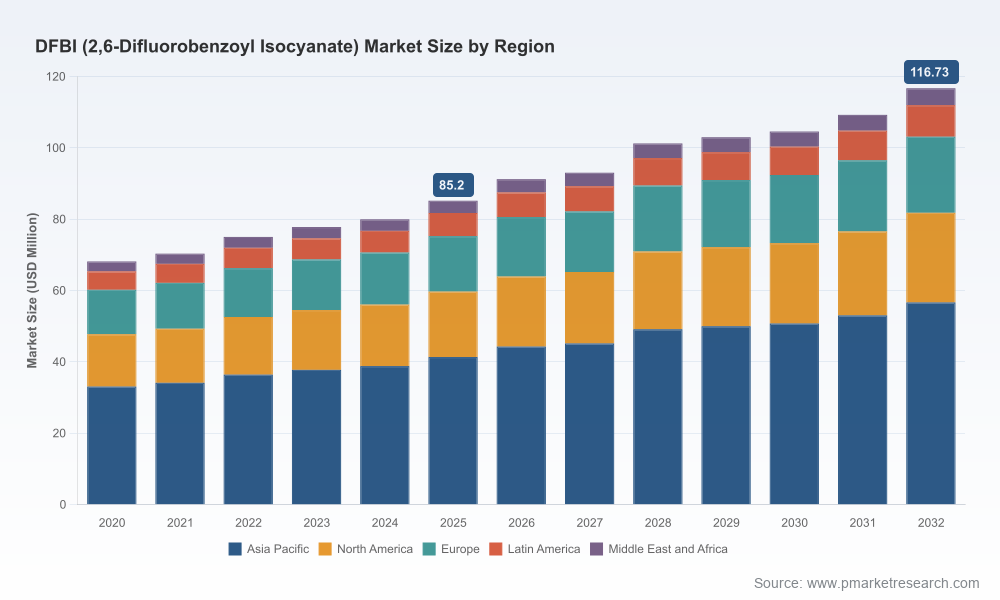
The global market for 2,6-Difluorobenzoyl Isocyanate (DFBI) has demonstrated steady, compounding growth over the past half-decade. Valued at approximately $68.15 million in 2020, the market reached $85.2 million in 2025 and is projected to expand to $116.73 million by 2032. This trajectory reflects a consistent compound annual growth rate of 4.61 percent across the forecast horizon. The expansion underscores the compound's entrenched position as a critical fluorinated building block within agrochemical and pharmaceutical synthesis pipelines. Demand has been anchored primarily by the production of benzoylurea insecticides, a segment that continues to absorb the majority of global supply as crop protection portfolios in emerging markets diversify toward fluorinated active ingredients.
Despite this measured growth, the market confronts structural inflection points that require strategic attention. First, handling and logistics constraints impose a persistent operational friction. DFBI is classified as hazardous under UN 2206 regulations for isocyanates that are flammable and corrosive, necessitating strict ADR and IMDG-compliant packaging for international transport. This regulatory overlay raises compliance costs and compresses logistical flexibility, particularly for buyers sourcing from multiple jurisdictions or relying on just-in-time delivery models. Second, procurement patterns are shifting toward higher-purity specifications. The segment requiring purity levels at or above 99 percent has established a dominant share of total consumption, reflecting a broader industry preference for reagents that minimize downstream purification steps and reduce batch variability in active pharmaceutical ingredient synthesis. Consequently, suppliers operating with narrower quality tolerances or less robust analytical verification face margin pressure and competitive displacement. Third, the market structure remains moderately concentrated. A relatively small cohort of global chemical distributors and specialty reagent producers controls a substantial portion of availability and pricing influence. This concentration creates efficiency advantages in catalog availability and technical support but also limits pricing elasticity for end users during periods of input cost volatility.
For procurement leaders and R&D directors, these dynamics translate into a need for diversified sourcing strategies, rigorous supplier qualification protocols, and proactive engagement with logistics partners who possess certified hazardous materials capabilities. The market is not defined by scarcity, but rather by the premium placed on reliability, purity assurance, and regulatory compliance. Organizations that treat DFBI as a routine catalog purchase risk encountering supply interruptions or quality inconsistencies that cascade into production timelines. Conversely, those who build structured supplier relationships and integrate DFBI procurement into broader fluorine chemistry planning are better positioned to absorb shocks and maintain development cadence.
Key Drivers Shaping Market Trajectory
Several interconnected forces are steering the DFBI market toward sustained, albeit measured, expansion. Understanding these drivers provides a foundation for evaluating where investment, procurement, and product development efforts will yield the strongest returns.
Technological Innovation and Process Precision
Advances in fluorine chemistry and isocyanate handling have incrementally improved the reliability and applicability of DFBI across synthesis workflows. On the supply side, manufacturers have refined chlorination and fluorination sequences to enhance yield consistency for 2,6-difluorobenzoyl chloride, the principal precursor to DFBI. Stable precursor pricing, observed in the range of $150 to $200 per kilogram during early 2026, signals a mature and well-balanced fluorochemical supply chain that reduces input volatility for downstream conversion. On the demand side, synthesis teams increasingly leverage DFBI for modular construction of fluorinated heteroaryl scaffolds, where the 2,6-substitution pattern confers favorable steric and electronic properties for target binding. These applications span both agrochemical optimization and pharmaceutical intermediate development, with buyers prioritizing reagents that deliver consistent reactivity across batch scales ranging from gram-level screening to multi-kilogram pilot runs.
For R&D organizations, this driver means that reagent selection is no longer a purely transactional decision. Suppliers that offer detailed analytical certificates, batch-to-batch consistency data, and technical documentation for reaction optimization provide value beyond the molecule itself. Procurement teams should align purchasing criteria with the quality needs of the intended synthetic route, rather than defaulting to the lowest catalog price.
Regulatory Environment and Compliance Architecture
Regulatory frameworks around isocyanates continue to shape how DFBI is stored, transported, and deployed. Classification under UN 2206 requires hazard communication, specialized containment, and transport documentation that align with ADR and IMDG standards for global shipments. While these requirements do not restrict end use, they elevate the operational bar for suppliers and logistics providers. Companies without established hazardous materials handling protocols face longer lead times, higher shipping costs, and potential customs delays. At the same time, end-use guidance consistently frames DFBI as a reagent intended for research and laboratory applications rather than direct therapeutic or consumer exposure. This framing informs institutional procurement policies and influences how downstream users design safety protocols and waste management procedures.
The practical implication for buyers is that compliance readiness is a competitive differentiator. Suppliers with pre-validated packaging, transparent safety data sheets, and documented chain-of-custody processes reduce the administrative burden on receiving laboratories and manufacturing sites. Organizations evaluating suppliers should weigh these compliance capabilities alongside price and lead time, particularly when operating across multiple regulatory jurisdictions.
Demand-Side Behavior and Application Breadth
Consumption patterns reveal a market anchored in agrochemical synthesis but supported by a diversified set of secondary applications. Benzoylurea insecticide production remains the dominant application channel, reflecting ongoing demand for fluorinated insecticidal chemistries that deliver potency and environmental profile advantages. Pharmaceutical intermediates constitute a meaningful secondary channel, where DFBI serves as a building block for medicinal chemistry campaigns targeting fluorinated scaffolds with improved metabolic stability or binding selectivity. Specialty chemical research rounds out the demand base, encompassing exploratory synthesis, method development, and custom intermediate projects that often operate at smaller quantities but require high specification reliability.
This demand structure creates a two-speed market environment. High-volume agrochemical purchasers value scale consistency, predictable lead times, and competitive pricing on recurring orders. Pharmaceutical and research buyers prioritize purity, documentation, and flexibility in pack sizes. Suppliers that can serve both segments without cross-contamination or specification drift are capturing a broader share of available demand. For enterprises planning DFBI procurement, the strategic takeaway is to segment purchasing by application purpose: secure reliable bulk pathways for production-grade needs while maintaining access to high-purity catalog or custom options for development work.
Supply Chain Stability and Cost Structure
The cost structure for DFBI is influenced by the stability of fluorochemical inputs, the economics of isocyanate conversion, and the overhead associated with regulated logistics. Stable precursor pricing has contributed to a predictable baseline for DFBI production costs, allowing suppliers to maintain catalog consistency and reducing the frequency of emergency price adjustments. However, the hazardous materials handling requirement introduces a fixed cost layer that does not scale linearly with order size. Smaller parcel shipments carry proportionally higher compliance and packaging costs, which is why suppliers often offer tiered pricing or encourage bulk ordering for industrial applications.
For procurement and supply chain leaders, the opportunity lies in optimizing order architecture. Consolidating frequent, small-quantity purchases into planned bulk or scheduled deliveries can reduce per-unit logistics overhead and improve lead-time predictability. At the same time, organizations should monitor fluorochemical market conditions as an early indicator of potential cost shifts that could affect DFBI availability or pricing dynamics over the forecast period.
Competitive Landscape and Strategic Positioning
The global DFBI market is served by a set of established reagent and specialty chemical providers that compete across purity, availability, documentation, and logistical capability rather than on price alone. The competitive field reflects a mature specialty chemicals environment where differentiation is achieved through technical reliability, regulatory readiness, and the ability to serve multiple scale requirements.
Sigma-Aldrich, operating under Merck KGaA in Darmstadt, Germany, positions DFBI as a catalog reagent tailored to pharmaceutical synthesis and custom manufacturing workflows. Availability in small pack sizes, typically ranging from 1 gram to 5 grams, with purity exceeding 97 percent, aligns with laboratories that require immediate access for screening, method development, and early-stage intermediate synthesis. The strategic value here is speed of access, brand familiarity, and integrated safety documentation. For research organizations and small-scale development teams, this positioning reduces procurement friction and supports rapid iteration in synthetic planning. Worldwide Wearable Device Security Market
TCI America, based in Portland, Oregon, lists DFBI as a high-purity chemical intermediate for organic synthesis in its current product catalog, with gram-scale availability. The emphasis on documented purity and catalog consistency appeals to academic, contract research, and pharmaceutical development buyers who prioritize traceable specification data and reliable lot-to-lot performance. The strategic advantage lies in catalog transparency and the trust associated with a recognized reagent brand. Organizations engaged in method development or structure-activity relationship studies benefit from using materials with well-characterized specifications that reduce interpretive variability in experimental outcomes.
Apollo Scientific, located in Stockport, United Kingdom, provides DFBI for research and industrial applications with bulk ordering options and confirmed active stock availability as of 2026. This dual positioning between research-grade access and industrial-scale procurement supports buyers who transition projects from laboratory screening into pilot or production phases. The strategic differentiation is the ability to bridge scale gaps without forcing customers to re-qualify suppliers mid-project. For enterprises managing multi-phase development programs, this continuity reduces qualification lead time and supports smoother technology transfer between research and manufacturing functions.
SynQuest Laboratories, based in Alachua, Florida, manufactures and sells DFBI as a fluorinated isocyanate building block intended for agrochemical and pharmaceutical intermediates, with custom quantity availability. The custom manufacturing angle addresses buyers who require non-standard pack sizes, specific packaging configurations, or coordinated supply aligned with project timelines. This flexibility is particularly relevant for contract development organizations, specialty agrochemical formulators, and pharmaceutical teams navigating bespoke intermediate requirements. The strategic edge is responsiveness to project-specific demand rather than reliance solely on fixed catalog SKUs. PW Consulting
The competitive landscape is evolving along three observable trends. First, consolidation of distribution capabilities is increasing the efficiency of catalog access and technical support, allowing larger suppliers to offer integrated purchasing portals, standardized compliance documentation, and broader regional reach. Second, there is a gradual differentiation between suppliers that emphasize catalog convenience and those that emphasize custom manufacturing or industrial-scale readiness. Buyers with mixed procurement needs increasingly prefer suppliers that can operate across both modes without compromising specification integrity. Third, new entrants or smaller regional distributors face the challenge of competing on compliance readiness and fluorochemical supply chain access rather than on molecule availability alone, since the precursor ecosystem and hazardous materials logistics create meaningful barriers to rapid scale.
For decision-makers, the competitive environment suggests that supplier selection should be evaluated through the lens of end-to-end reliability. The most compelling partner is not necessarily the one with the lowest list price, but the one that delivers consistent purity, transparent documentation, compliant packaging, and the flexibility to match procurement cadence with project phase. Organizations that map supplier capabilities against their own development pipeline, production schedule, and regulatory footprint will be better equipped to manage risk and maintain continuity of supply.
Forward Outlook: Trends and Opportunities for 2026 Through 2032
Based on current market structure, demand composition, and regulatory dynamics, three trends are likely to shape the DFBI market over the next three to five years.
The first trend is the continued premium on high-purity specifications. As synthetic workflows grow more efficiency-sensitive, buyers will further favor reagents that reduce downstream purification burden and support reproducible outcomes across scales. Suppliers that invest in robust analytical verification, clear specification reporting, and controlled packaging for high-purity material will capture disproportionate value within the market. Organizations that currently rely on lower-specification sources for production-critical steps should evaluate whether migration to higher-purity sourcing improves overall process economics when purification costs and batch variability are fully accounted for. Wine Aerator Market
The second trend is the stabilization of fluorochemical input costs paired with ongoing compliance-driven logistics costs. Precursor pricing has shown stability in recent quarters, which supports predictable DFBI production economics. However, the fixed cost burden of hazardous materials handling is unlikely to decline materially. This combination favors suppliers and buyers that optimize order frequency and shipment size, and that invest in compliant packaging and transport partnerships. Companies that redesign procurement rhythms around consolidated, scheduled deliveries will likely realize better total cost outcomes than those relying on ad hoc, small-parcel purchasing.
The third trend is the broadening of application relevance beyond traditional agrochemical synthesis. While benzoylurea insecticide production remains the anchor of demand, pharmaceutical intermediate work and specialty chemical research will continue to expand the addressable user base. This expansion creates opportunity for suppliers that can serve multiple application profiles without compromising quality, and for buyers who strategically align reagent sourcing with long-term development roadmaps. At the same time, the research and laboratory use designation for DFBI constrains direct therapeutic or consumer applications, so demand growth will remain tied to intermediate and synthesis use cases rather than end-product exposure.
The primary uncertainty lies in regulatory evolution and fluorochemical market conditions. Any tightening of transport requirements, reclassification actions, or changes in precursor availability could alter cost structures or lead-time expectations. Additionally, shifts in crop protection portfolio strategy among major agrochemical players could influence demand intensity for benzoylurea-related intermediates. Organizations that maintain visibility into regulatory updates and fluorochemical pricing trends will be better positioned to anticipate adjustments and adapt procurement or production planning accordingly.
Strategic Recommendations for Decision-Makers
For manufacturers and production planners, the priority is to build a sourcing architecture that aligns purity requirements with application criticality. High-value synthetic steps warrant higher-purity DFBI and suppliers with rigorous analytical documentation, while less specification-sensitive work may tolerate broader sourcing options. Establishing scheduled bulk deliveries for recurring production needs can reduce per-unit logistics costs and improve lead-time predictability. Cross-functional coordination between R&D, procurement, and operations will ensure that reagent specifications chosen during development are economically and operationally viable at scale.
For investors evaluating exposure to fluorinated intermediate markets, the strategic signal is that DFBI occupies a niche but resilient position within agrochemical and pharmaceutical synthesis value chains. Market growth is steady rather than explosive, and value capture depends on compliance readiness, purity consistency, and the ability to serve both catalog and custom demand. Investment theses should account for the fixed cost layer associated with hazardous materials handling and the importance of supplier differentiation through documentation and logistical capability rather than volume alone. Monitoring precursor market conditions and regulatory developments will provide early indicators of cost or availability shifts.
For procurement and supply chain leaders, the actionable recommendation is to treat DFBI sourcing as a risk-managed function rather than a routine purchase. Diversify across suppliers that offer complementary strengths, prioritize partners with verified hazardous materials compliance and transparent safety documentation, and structure order cadence to minimize small-parcel logistics overhead. Maintain awareness of specification requirements for each application channel, and avoid over-reliance on a single sourcing format when project needs span both research-scale and production-scale consumption.
Timely access to detailed segmentation data, regional dynamics, purity- and application-level demand splits, and competitor pricing context can materially improve the quality of sourcing and investment decisions. Granular market intelligence helps clarify where premium specifications command value, which supplier profiles best match procurement needs, and how regulatory and input cost factors may shape near-term availability. Readers seeking deeper quantitative breakdowns, competitive benchmarking, and tailored scenario analysis are encouraged to consult the full PW Consulting market research report for comprehensive data and customized strategic guidance.
For detailed analysis of this topic, please visit the official page: Worldwide DFBI (2,6-Difluorobenzoyl Isocyanate) Market
Lacy LeeSenior Marketing Managersales@pmarketresearch.com00852-95632430PW Consulting: www.pmarketresearch.com