





In today’s fast-paced business landscape, growth is no longer just about selling more products or acquiring new clients.
The companies that are truly thriving are the ones that can connect the dots across customer engagement, sales, invoicing, and inventory.
Disconnected systems, manual processes, and siloed departments are no longer acceptable they are growth inhibitors.
Enter Unified ERP: a strategic solution that does more than automate tasks it orchestrates every aspect of your business to deliver efficiency, insight, and agility.
For businesses looking to scale while maintaining profitability, integrating CRM, Sales, Invoicing, and Finished Goods Stock into a single ERP platform is not just an operational improvement it’s a competitive advantage.
Hidden Costs of Disconnected Systems
Many organizations still operate with fragmented systems: a CRM that tracks leads but isn’t linked to stock, a separate invoicing platform that doesn’t communicate with sales, and inventory managed in spreadsheets. This disconnection results in several tangible and hidden costs:
- Customer dissatisfaction due to delays or inaccurate commitments.
- Revenue leakage from invoicing errors or missed opportunities.
- Stock inefficiencies such as overstocking or stockouts, leading to higher carrying costs or lost sales.
- Inefficient workflows that waste employee time in data reconciliation and follow-ups.
Research shows that companies with disconnected systems can experience up to a 20% longer order-to-cash cycle, increased inventory costs, and lower customer retention rates. Clearly, the problem isn’t just inefficiency in one department it’s the lack of cross-functional visibility.
Redefining Customer Management Through ERP
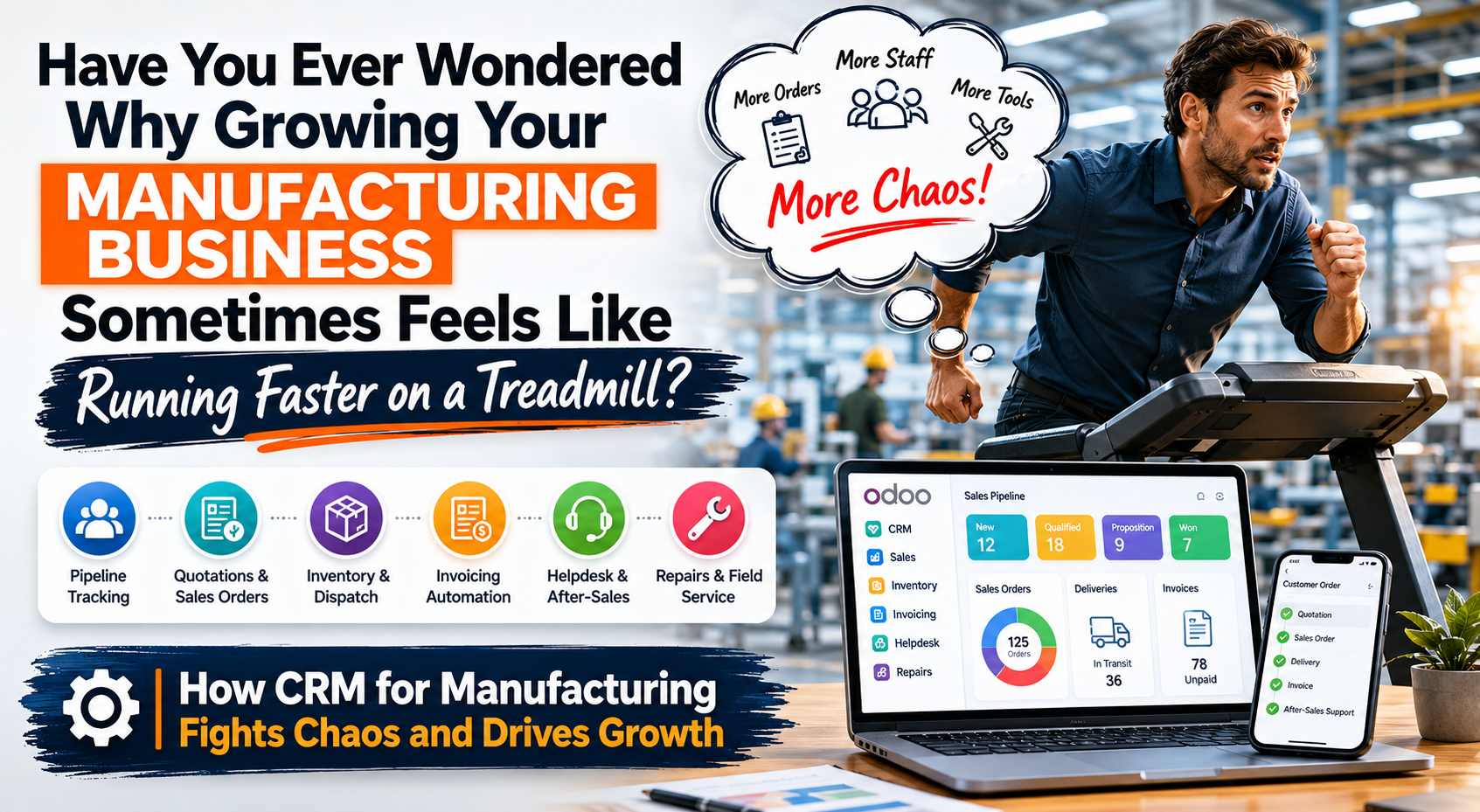
Customer Relationship Management (CRM) is often treated as a standalone function. But a unified ERP redefines CRM as an actionable, real-time tool that informs every customer interaction.
With ERP integration:
- Sales and service teams gain instant access to stock levels, pricing, and delivery schedules, enabling accurate promises to customers.
- Customer support sees a 360-degree view of interactions, orders, and invoices, which improves responsiveness and satisfaction.
- Marketing teams can leverage data insights from both sales and inventory to launch targeted campaigns with higher conversion rates.
For example, a manufacturing SME using a unified ERP can track customer orders from inquiry to delivery, preventing errors and ensuring timely fulfillment. This alignment fosters trust, loyalty, and repeat business, which is far more valuable than any short-term sales push.
Driving Sales Velocity with Real-Time Integration
Sales teams thrive on speed, accuracy, and customer confidence. Yet, disconnected systems often cause delays in quoting, order approval, and stock checks. ERP changes this equation by providing:
- Automated, accurate quoting based on real-time stock availability and pricing.
- Streamlined approval workflows to shorten sales cycles.
- Integrated dashboards for sales managers to monitor performance and bottlenecks instantly.
CFOs will appreciate that ERP integration reduces the order-to-cash cycle, improves forecasting accuracy, and minimizes revenue leakage. In short, a unified ERP makes your sales engine faster, smarter, and more reliable.
Invoicing as a Growth Lever
In many organizations, invoicing is still treated as a back-office task. This approach can be costly: delayed or incorrect invoices impact cash flow, customer trust, and reporting accuracy.
With a unified ERP like Odoo ERP, invoicing becomes:
- Automated and directly linked to orders and stock movements, ensuring accuracy.
- Audit-ready, reducing disputes and compliance issues.
- Data-driven, offering insights into payment patterns and customer behavior.
According to industry research, companies that adopt integrated invoicing can reduce disputes by up to 40% and improve cash collection times by 15–20%, directly impacting the bottom line.
Finished Goods Stock as a Strategic Asset
Traditionally, inventory is seen as a cost center. Disconnected stock management often leads to overstocking, stockouts, and misaligned production schedules. With ERP integration, inventory becomes a strategic asset:
- Real-time tracking enables accurate order fulfillment and prevents lost sales.
- Batch-level traceability ensures compliance, quality control, and recall readiness.
- Automated reorder rules optimize working capital while preventing shortages.
For instance, an automotive parts manufacturer using Odoo ERP was able to reduce stock-outs by 25% and cut carrying costs significantly by leveraging real-time visibility and automated alerts. Stock is no longer just stored goods it becomes a dynamic driver of efficiency and profitability.
Unified ERP Unlocks Growth
When CRM, Sales, Invoicing, and Finished Goods Stock are connected in a single ERP platform, companies achieve:
- Faster revenue cycles with accurate order processing and invoicing.
- Higher customer satisfaction through timely delivery and transparent communication.
- Lean operations by reducing redundant manual processes.
- Stronger cash positions via integrated invoicing and inventory control.
- Actionable insights for informed decision-making across the organization.
The takeaway for executives is clear: Unified ERP is not an IT initiative; it is a strategic growth lever that directly impacts top-line performance, operational efficiency, and customer loyalty.
Why Odoo ERP Is the Recommended Approach
Among ERP platforms, Odoo ERP stands out for SMEs and large businesses alike because it:
- Provides modular yet fully integrated solutions, allowing businesses to implement CRM, Sales, Invoicing, and Stock in one platform.
- Offers real-time dashboards, workflow automation, and reporting, enabling executives to make data-driven decisions.
- Supports customization without complexity, which is critical for businesses with unique processes.
- Enables scalable growth, from a single production line to multiple facilities, without changing platforms.
Odoo ERP implementation transforms siloed departments into a cohesive, growth-focused ecosystem, helping companies not just run operations, but orchestrate business performance strategically.
The companies winning tomorrow are not necessarily those with the most aggressive sales targets they are the ones that can orchestrate customers, revenue, and stock intelligently.
By adopting a unified ERP like Odoo, organizations can transform CRM from a database into a relationship engine, sales from a process into a growth driver, invoicing from a task into a cash optimization tool, and stock from a cost center into a strategic asset.
In a world where speed, accuracy, and visibility define competitive advantage, ERP integration is not optional it is essential.
Growth is unlocked when every department works not just efficiently, but intelligently, together. Odoo ERP makes that possible. To know how this solution can be helpful for your business drop us a line at sales@apagen.com or call us on +91 9971800665.
CaretIT help you to migrate from Odoo of your system from any Odoo version to the newer one.
Get new, Quality & new Upgraded features.
Odoo module migration.Visit us:- https://www.caretit.com/services/odoo-erp-services/odoo-migration