

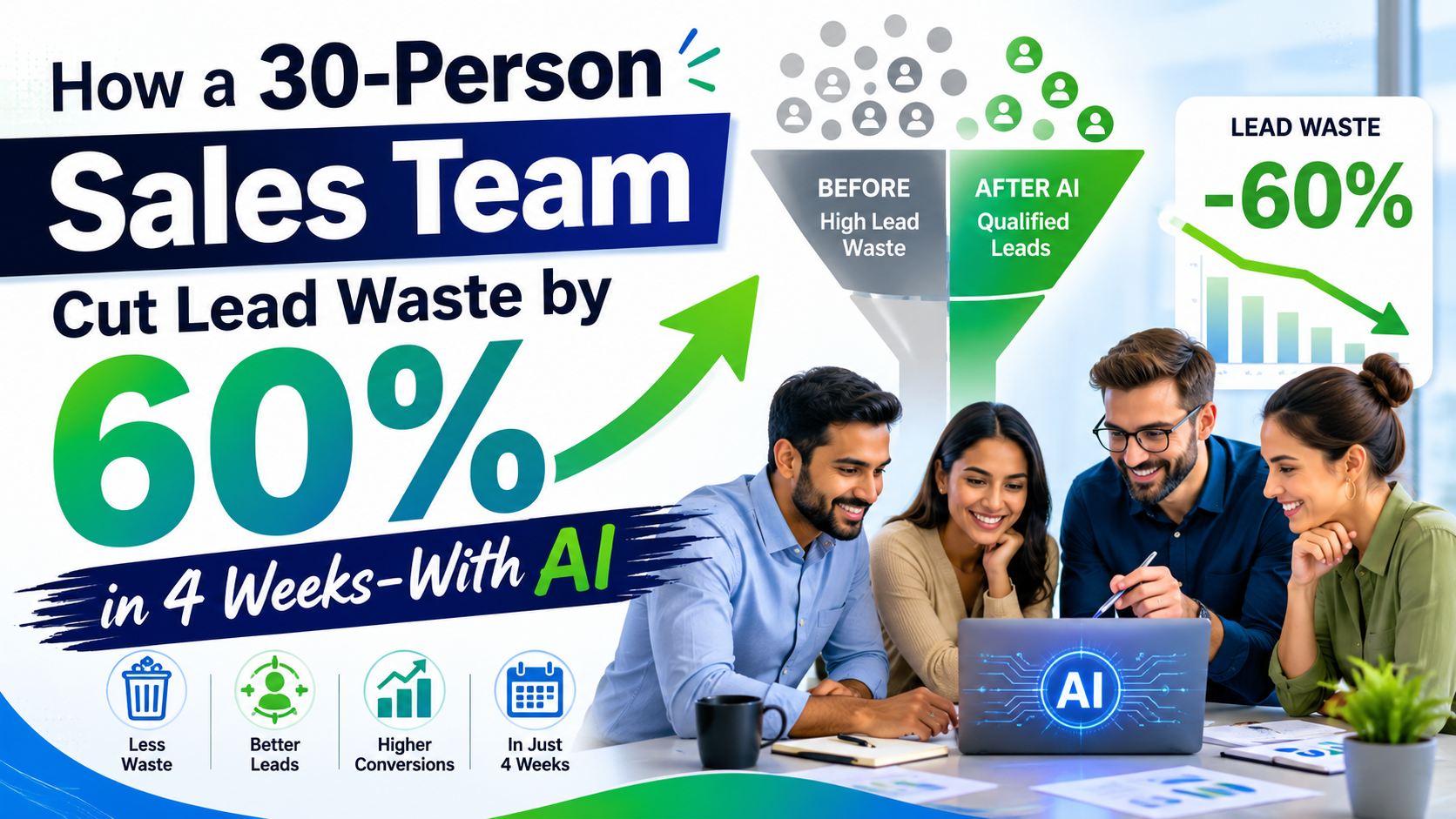
I'm going to be blunt: most companies don't have a lead problem. They have a lead management problem.
Let me show you what I mean.
The Situation: A Problem You Probably Recognize
A mid-market B2B SaaS company, let's call them DataRise, was caught in a frustrating position. Their marketing team was performing exceptionally well. 200 qualified leads were landing every month. The revenue target was 12 million dollars. Growth was the stated objective. Everything should have been straightforward. But it wasn't.
The Reality:
- 200 leads came in monthly
- Only 36 became real opportunities, representing an 18 percent conversion rate
- Lead response time averaged 4.2 hours, while industry averages show response to close happening within 5 minutes
- Sales reps spent 15 or more hours per week on data entry rather than selling
- Leadership had zero visibility into pipeline health and opportunity status
- Sales cycles dragged on for 90 days or longer
- Sales team turnover reached 35 percent annually, with everyone experiencing severe burnout
The Financial Damage:
The CFO conducted a thorough analysis and the numbers were sobering. Lost revenue from unqualified leads represented approximately 400,000 dollars annually. The operational cost of manual processes added another 184,000 dollars per year. Turnover costs, including hiring and training replacement staff, totaled around 160,000 dollars yearly. The total opportunity cost came to 744,000 dollars annually. Her question was direct and difficult to ignore: Are we investing in marketing, or a data entry service? The company had what appeared to be a lead quantity problem but was actually facing a lead quality problem.
The Problem Nobody Talks About: Timing is Everything
Here's the central truth about sales that nobody emphasizes enough: whoever responds first wins approximately 30 percent of the deals. DataRise was responding in 4 or more hours. Their competitors? Often within 5 to 15 minutes. That 4-hour gap cost them an estimated 127,000 dollars in lost deals annually. But here's what surprised them most: the problem wasn't the sales team. It was the system itself. Reps were spending their days doing the wrong things. They were manually entering lead data into 3 different systems. They were spending 30 minutes per day manually scoring leads. They were routing leads to the right person by hand. They were manually scheduling follow-ups. They were manually pulling reports that were always outdated before they could even be reviewed. By the time a rep could finally see a lead, the competitive moment had already passed.
The Turning Point: Why More Leads Weren't the Answer
The VP of Sales pushed back when the marketing team asked for budget increases to generate more leads. His statement was direct: We don't need more leads. We need to stop losing the ones we have. That simple observation changed the entire conversation. They realized the core issue. The problem wasn't quantity. The problem was speed, consistency, and visibility. Three things their current system, a mix of Salesforce, spreadsheets, and manual processes, couldn't reliably deliver. That realization became the turning point for the entire organization.
The Solution: AI-Powered Lead Management
DataRise evaluated 5 CRM platforms carefully. Here's what they discovered:
- Salesforce: 150,000 dollars or more in implementation costs, overly complex, exceeded their actual needs
- HubSpot: 10,000 dollars or more monthly, but with limited AI capabilities
- Pipedrive: Good user experience, but no predictive features available
- Zoho: Scattered implementation experience, inconsistent support quality
- Odoo CRM: Affordable pricing, integrated ecosystem, AI features built in, minimal implementation needs
They chose Odoo and implemented the system in 4 weeks with zero disruption to ongoing sales operations.
Here's what they activated:
1. AI Lead Scoring (The Game Changer)
The AI algorithm was trained on 18 months of historical company data. The system automatically scores every new lead based on 12 or more different signals, including company size and industry fit, engagement metrics from email opens and page visits, budget indicators, decision-maker seniority, and timeline signals that predict buying readiness. The result was immediate and significant. Instant, consistent, and predictive scoring replaced the previous 30-minute daily manual effort. Sales reps saved 12 hours per week team-wide that could be redirected toward actual selling activities.
2. Intelligent Lead Routing
High-scoring leads now automatically route to the rep most likely to successfully close them. The system bases this routing on historical win rates, industry expertise, and current workload distribution. This eliminated the constant confusion about lead ownership. More importantly, it enabled immediate outreach. Leads were now reaching the right person in 8 minutes instead of 4 or more hours.
3. Workflow Automation (12 Automated Triggers)
The system was configured with 12 automated workflow triggers that handle the repetitive work that kills sales productivity. New high-score leads trigger SMS alerts and instant email assignments. No response in 4 hours triggers automatic escalation to the team lead. 5 days of inactivity triggers an automated follow-up email with supporting proof points. A booked meeting automatically sends a pre-call research brief. Deals over 60 days old trigger alerts for at-risk opportunities. The result eliminated all administrative overhead that previously wasted rep time.
4. Predictive Analytics Dashboard
The leadership team gained real-time pipeline forecasting with accuracy within 12 percent. The system provided early warning signals for at-risk deals before they started slipping. Individual rep performance became visible and transparent. The CFO received a customized executive summary highlighting 5 metrics that actually matter for business decisions.
5. Mobile-First Approach
Reps could access everything they needed from a mobile device. One-tap lead qualification (high, medium, or low) simplified the interface. Field updates synced instantly across all systems. Faster response times directly translated into more deals closed.
The Results: The Numbers Tell the Story
4 weeks after implementation, the metrics shifted dramatically across every category.
Conversion Metrics
- Lead-to-opportunity rate increased from 18 percent to 34 percent, representing an 89 percent improvement
- Deal close rate improved from 28 percent to 41 percent, a 46 percent increase
- Average deal size grew from 45,000 dollars to 52,000 dollars, a 15 percent increase
- Sales cycle length decreased from 90 days to 62 days, a 31 percent reduction
Speed and Efficiency Gains
- Lead response time dropped from 4.2 hours to 8 minutes, a 95 percent improvement
- Time per rep on administrative work fell from 12 hours per week to 3 hours per week
- Total team administrative time saved was 540 hours per month reduced to 135 hours monthly
- Pipeline forecast accuracy increased from 45 percent to 87 percent
Financial Impact
- Additional ARR generated in Year 1: 1.8 million dollars
- Cost savings from eliminated manual work: 184,000 dollars
- Implementation investment: 8,000 dollars
- Return on Investment: 340 percent in the first year
- Payback period: 2.8 months
Team Satisfaction
- Sales team retention improved from 35 percent annual churn to 12 percent churn, exceeding industry averages
- Team Net Promoter Score increased from 32 to 67, a positive shift of 35 points
- Reps recommending the tool increased from 40 percent to 89 percent
The Unexpected Insight: It Changed Their Strategy
Here's what surprised them most about the implementation and results. Their channel partners, not their direct sales team, were the source of the highest-quality leads. However, the old system ranked direct leads higher in its logic. This meant those channel-sourced leads were sitting in the queue, waiting for attention. The AI algorithm revealed this pattern clearly in the data. DataRise made a bold decision and completely restructured their compensation model to prioritize channel partnerships. The result was tangible: close rates on channel-sourced deals improved by 23 percent. Their entire business strategy shifted because the data finally told them the truth about where their best customers actually came from.
Key Learnings (If You're Considering This)
What Worked Brilliantly
First, involve the people doing the actual work from day one. The reps who complained most loudly about manual processes became our strongest advocates for change. They saw immediate time savings and adopted the system naturally. Second, start with data quality rather than features. We spent the entire first week cleaning historical data. Better data produces smarter AI, which delivers better results. Third, celebrate the early wins publicly and loudly. During the first week, one rep went from closing 2 deals per month to 5 deals monthly. We shared that success across the entire team. Adoption accelerated dramatically. Fourth, measure everything from day one. Establish your baseline metrics before launch. Otherwise, you cannot prove the comparison afterwards.
What We'd Do Differently
VP of Sales, DataRise: "Honestly, we should have implemented this 18 months earlier. The cost of delay exceeded 744,000 dollars. The implementation cost was only 8,000 dollars. That's a 93 to 1 ratio in favor of moving forward. If you're on the fence about making this change, move quickly."
The Bottom Line
Your sales team isn't struggling because they lack enough leads. They're struggling because they spend more time typing than selling. Qualified leads sit in queues for hours while the opportunity window closes. Leadership cannot see what is actually happening in the pipeline. The best opportunities remain hidden in the noise of unqualified leads. AI-powered CRM fixes all of this. Not by generating more leads. But by ensuring that the leads you already have are actually closed. For DataRise, the 1.8 million dollars in additional revenue came from the exact same 200 leads they were already receiving every month. They finally had a system smart enough to not waste them.
One Question for You
If you could capture just 25 percent of DataRise's improvements, which is a conservative estimate, what would that mean for your revenue? Would a 10-point increase in close rate move the needle? Would a 4-week shorter sales cycle improve cash flow? Would 200,000 dollars in operational cost savings justify an investigation? That level of improvement is possible. And it's closer than you might think. If you want to explore whether AI-enabled CRM could work for your specific situation, I'm available to discuss it. We can show you exactly where AI could create value for your sales organization. Download the AI CRM Decision-Maker's Checklist to get 12 specific questions you should answer before evaluating any CRM solution. In the comments below, tell me which challenge hits hardest for your sales team: Speed (slow response time losing deals), Visibility (inability to forecast pipeline accurately), or Team burnout (reps leaving due to administrative work). I'm curious to see what patterns emerge across different organizations.
---
This case study is based on actual implementation patterns observed across multiple organizations. Results vary depending on team size, data quality, and industry factors.



In a competitive business landscape, efficient logistics management is essential for success. Companies must handle inventory, warehousing, and transportation with precision to meet customer demand