

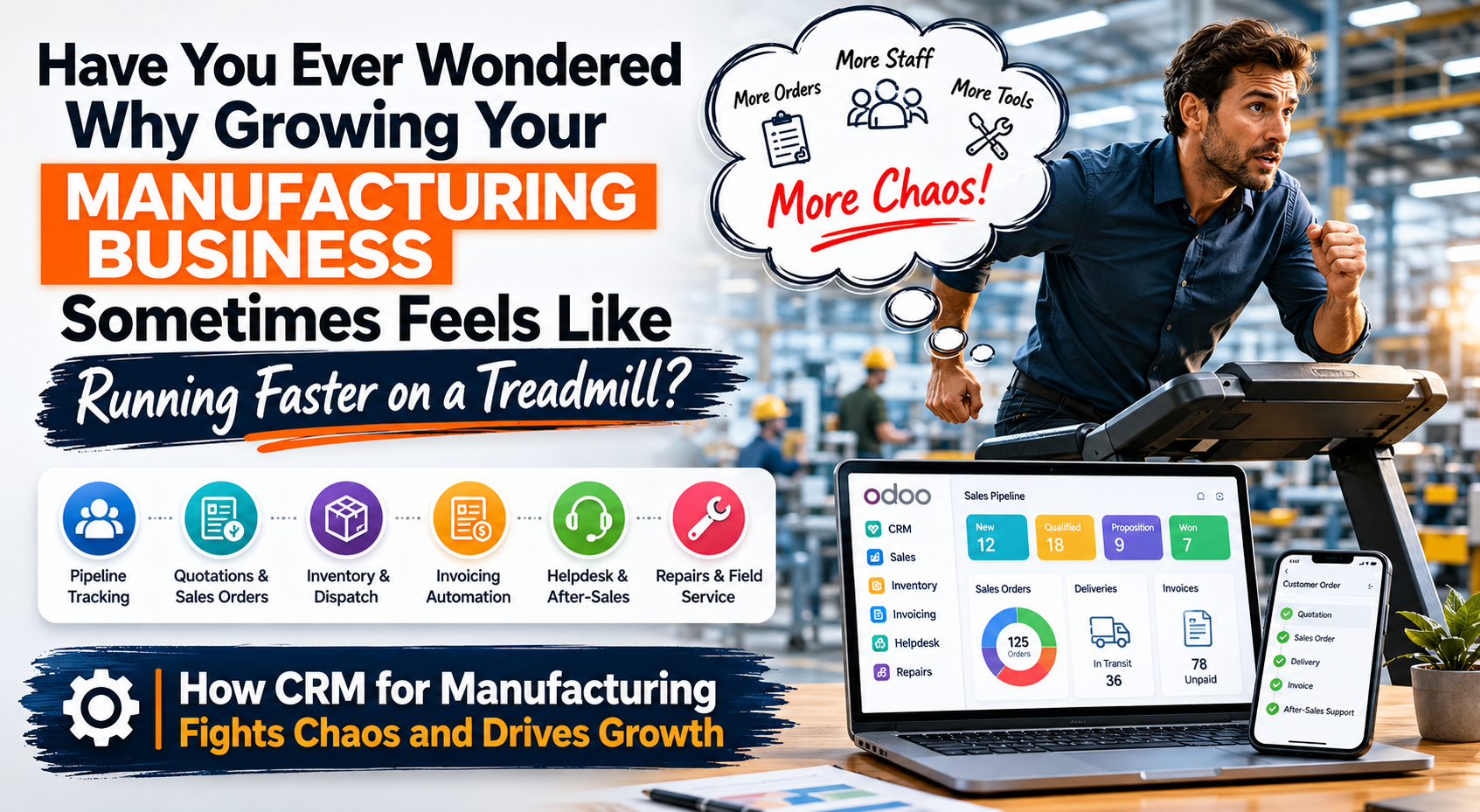
More orders. More staff. More tools. And somehow, more chaos.
If that sounds familiar, you are not doing something wrong. You are experiencing what most manufacturing businesses go through when they scale without updating the systems underneath. The informal ways of working that were fine at a smaller size, a shared WhatsApp group here, an Excel tracker there, a verbal handoff between dispatch and accounts, start to buckle under the weight of more volume, more customers, and more moving parts.
The curious thing is that most factory owners know something is off. They feel it every time they spend 20 minutes hunting for a quotation that was sent on someone else's phone. Or every time a customer calls to ask why their order has not arrived and nobody in the room has an immediate answer.
What they do not always know is that this problem has a name and a well-tested solution. It is called CRM for manufacturing, and this article is going to explain exactly what it means, how it works, and whether it is right for your business.
First, What Does CRM for Manufacturing Actually Mean?
CRM stands for Customer Relationship Management. In most contexts, it refers to software that tracks contacts, manages sales pipelines, and logs customer communications. That is what you get with tools like Salesforce or HubSpot.
But here is the thing: those tools were built for service businesses. They are brilliant at tracking a sales conversation. They are not built for what happens after a customer says yes in a manufacturing context, which is where the real complexity begins.
CRM for manufacturing is a broader, more integrated concept. It connects the sales relationship with the actual operational chain: the quotation, the stock pick, the dispatch, the invoice, the after-sales support, and, where relevant, the repair order. When all of these live in one connected system, your business stops running on individual memory and starts running on shared, real-time data.
Think of it this way. A standard CRM manages the conversation. A manufacturing CRM manages the conversation and everything that happens because of it.
What Does This Look Like in a Real Factory?
Let us walk through a realistic scenario.
A distributor contacts your sales team and requests a quote for 400 units of an industrial component. In a disconnected setup, your rep sends the quote over email or WhatsApp, gets verbal confirmation, and the information starts its informal journey through your business. Someone tells dispatch. Dispatch tells the stores team. Someone remembers to tell accounts when the goods go out, usually.
Now picture the same scenario in a connected CRM for manufacturing. The rep raises the quotation in the system. The customer confirms. A sales order is created automatically. Dispatch sees it in their queue immediately, no phone call required. When the delivery is validated, the invoice is generated for the exact quantity shipped. The customer gets a notification. If they raise a query afterwards, your support team can see the full order, delivery, and invoice history in about ten seconds.
Nobody is chasing anybody. Nobody is sending 'just checking in' messages. The system is holding the thread.
Watch This Before Reading Any Further
Before going deeper into the technical side, I would genuinely recommend watching this short video. It shows a live walkthrough of exactly what we are talking about, Odoo ERP handling the full manufacturing CRM cycle from pipeline to repair management. It is about five minutes and it will make the rest of this article land much more concretely:
Watch now: https://youtu.be/bOjawUfHPSA
The Seven Things a Manufacturing CRM Should Handle
Not every platform that calls itself a CRM for manufacturing companies actually covers the full picture. Here is what you should expect from a genuinely integrated system:
• Pipeline tracking: Every inquiry and opportunity visible in stages, with activity reminders and forecast reporting
• Quotation management: Raise, track, and convert quotes without leaving the system or forwarding messages
• Sales order visibility: One screen showing what was ordered, delivered, and invoiced per customer
• Dispatch and inventory: Real-time delivery tracking with partial shipment handling built in
• Invoicing: Triggered automatically from delivery records, not manually created days later
• Helpdesk and after-sales: Customer tickets logged, assigned, and tracked with a self-service portal option
• Field service and repairs: Engineer scheduling, on-site job tracking, and repair order management with stock integration
If your current setup handles some of these but not all, and they are living in separate tools, you are paying a coordination tax every single day that shows up as management time, billing errors, and customer frustration.
Why Odoo Keeps Coming Up in This Conversation
Odoo is not the only ERP option for manufacturers, and it would be misleading to suggest it is the right fit for everyone. But it comes up repeatedly for one straightforward reason: it covers all seven functions above natively, in a single connected system, with modular pricing that lets small and mid-sized manufacturers start small and grow.
You do not need to buy the full platform on day one. You can start with CRM and sales, stabilise your team's usage, then add inventory, helpdesk, and repair management as you are ready.
There is also an honest caveat worth mentioning. Odoo's power comes from its configurability, which means the quality of your implementation depends heavily on your implementation partner. A good partner who understands manufacturing will get you live on a solid foundation in three to four months. A poor one will leave you with a complex system that confuses more than it clarifies.
Choosing your implementation partner deserves as much attention as choosing the software itself. Ask for manufacturing-specific references before you sign anything.
Is Your Business Ready for a Connected CRM System?
Here is a question worth sitting with before you book any demos or request any proposals.
Is your team operationally ready to work in a connected system? Meaning: will your sales reps actually log opportunities consistently? Will dispatch validate deliveries in the system rather than informally? Will your support team close tickets in the platform rather than over the phone and move on?
The businesses that see the fastest and clearest ROI from manufacturing CRM software are the ones that invest as much in process and team adoption as they do in the technology itself. The ones that struggle typically moved too fast, on too many modules at once, without enough internal buy-in.
If you are at a stage where your current tools are creating visible operational friction, CRM for manufacturing is worth exploring seriously. Most businesses that implement systematically report measurable improvements in delivery accuracy, invoicing speed, and customer satisfaction within six to nine months.
For the full deep-dive, including a detailed look at each Odoo module, what to get right before go-live, and common implementation mistakes to avoid, the complete guide is here:
Read the full guide: https://www.apagen.com/crm-for-manufacturing-how-odoo-erp-fixes-the-chaos-most-factory-owners-live-with/