





Executive Summary
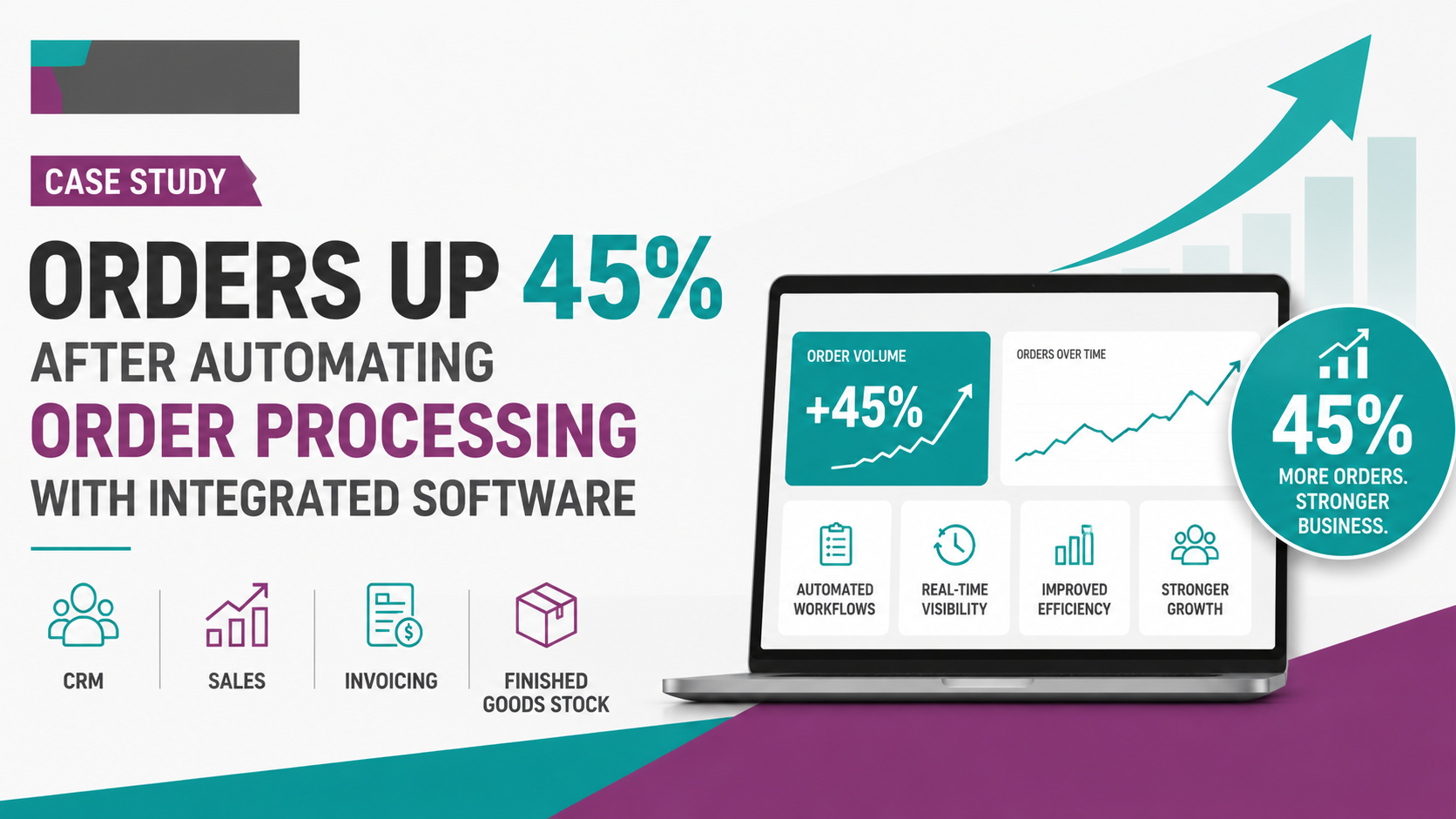
This case study examines how a mid-sized organization achieved a 45% increase in order volume by implementing integrated order processing software. The company unified its CRM, Sales, Invoicing, and Finished Goods Stock management into a single platform. This integration eliminated data silos, reduced manual processing, and improved visibility across all departments. Within six months of deployment, the organization experienced measurable improvements in operational efficiency and revenue growth.
Company Background
The organization is a B2B solutions provider operating in the manufacturing and distribution sector. The company processes hundreds of orders monthly across multiple customer segments. With a team of 45 employees distributed across Sales, Finance, Operations, and Warehouse departments, the organization was managing order processing through fragmented systems. Prior to this initiative, the company operated with separate tools for each business function. This distributed approach created operational challenges and limited visibility into the entire order lifecycle. Despite strong market demand, the company could not scale operations efficiently.
The Challenge
Fragmented Systems
The organization relied on multiple disconnected software platforms. Customer information lived in the CRM. Sales records were maintained separately. Invoicing was handled through accounting software. Inventory management used a basic spreadsheet system. This fragmentation created several critical problems.
Key Problems Identified
- Sales teams could not access real-time inventory data while talking to customers, leading to inaccurate quotes and delayed responses
- Finance spent hours manually entering order information from sales records into the invoicing system, creating errors and payment delays
- Warehouse could not see customer commitments in real-time, resulting in overcommitments and fulfillment failures
- Customers experienced inconsistent communication and long turnaround times for order confirmations
- Management lacked visibility into the full order lifecycle, making it difficult to identify bottlenecks or optimize processes
- Data inconsistencies between systems caused disputes, chargebacks, and customer satisfaction issues
These challenges resulted in missed sales opportunities, operational inefficiencies, and poor customer experiences. The organization recognized that implementing comprehensive order processing software was essential for growth.
The Solution
Integrated Order Processing Software
The organization selected an integrated order processing software platform that unified four critical business functions into one system. This solution provided a single source of truth for all customer and order information.
Platform Components
The order processing software bundle included four integrated modules:
- CRM Module: Centralized customer relationship management with complete contact history, interaction records, and relationship tracking
- Sales Module: Order creation, quoting, and deal management with real-time visibility into pipeline and customer preferences
- Invoicing Module: Automated invoice generation, payment tracking, and financial reconciliation integrated with sales orders
- Finished Goods Stock: Real-time inventory management showing available stock, reserved quantities, and automated stock-level alerts
Key features of the selected order processing software included automated workflow, real-time data synchronization across all modules, customizable reporting dashboards, user-friendly interface requiring minimal training, and seamless integration with existing accounting systems.
Implementation Process
- Phase 1: Planning (Weeks 1-2): System assessment, stakeholder interviews, data audit, and customization requirements definition
- Phase 2: Data Migration (Weeks 3-4): Historical customer data transferred to CRM module, sales records imported, inventory counts validated
- Phase 3: Configuration (Weeks 5-6): Customization of order processing workflows, automation rules configured, report templates created
- Phase 4: Training (Weeks 7-8): Staff training for each department, hands-on practice sessions, documentation provided
- Phase 5: Pilot Testing (Weeks 9-10): Limited rollout with select customers, process validation, feedback collection
- Phase 6: Full Deployment (Weeks 11-12+): Organization-wide launch, ongoing support, optimization based on user feedback
The implementation team worked closely with department heads to minimize disruption. The phased approach allowed the organization to validate processes and adjust before full rollout. Staff received comprehensive training covering order processing software functionality, best practices, and troubleshooting. Change management support helped teams transition from legacy systems to the new integrated platform.
Results and Impact
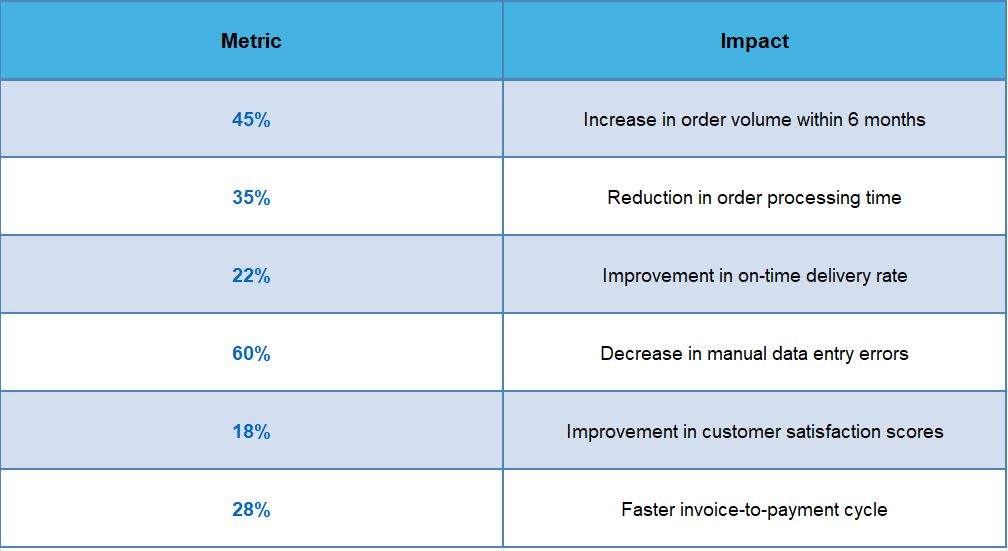
Quantifiable Business Results
Operational Improvements
- Real-time inventory visibility eliminated overbooking and fulfillment delays
- Sales team productivity increased with instant access to customer data and stock levels
- Finance department processing time reduced by automating invoice generation and payment reconciliation
- Warehouse operations became more efficient with accurate, real-time order information
- Customer communication improved with faster order confirmations and accurate delivery dates
- Management gained visibility into KPIs through customizable dashboards and real-time reporting
Financial Impact
The 45% increase in order volume translated directly to revenue growth. Simultaneously, operational efficiencies reduced per-order processing costs. The return on investment was achieved within the first six months of deployment. Beyond financial gains, the organization established a foundation for sustainable scaling without proportional increases in staff or infrastructure.
Key Learnings and Takeaways
- Integration Creates Value: Systems that share data eliminate manual processes. Order processing software that unifies CRM, Sales, Invoicing, and Inventory creates exponentially more value than separate tools.
- Data Quality Matters: Clean data in the old system is critical for successful migration. Invest time in data validation before moving to new order processing software.
- Change Management is Essential: Technology alone does not drive results. Staff adoption and training are critical success factors. Comprehensive change management makes the transition smoother.
- Real-time Visibility Changes Behavior: When sales teams see inventory in real-time, they change how they sell. When warehouse sees orders immediately, they plan differently. Order processing software that provides transparency drives better decisions.
- Scalability Without Complexity: Integrated order processing software allows organizations to handle more volume without adding equivalent complexity or staff.
- Customer Experience is Competitive: Speed and accuracy in order processing are now customer expectations. Order processing software that delivers both becomes a competitive advantage.
Conclusion
This case study demonstrates the transformative power of integrated order processing software. By unifying CRM, Sales, Invoicing, and Finished Goods Stock into a single platform, the organization achieved a 45% increase in order volume while simultaneously improving operational efficiency and customer satisfaction. The success of this initiative was driven by several factors: clear understanding of business challenges, selection of the right order processing software, comprehensive implementation planning, strong change management, and commitment from leadership and staff. Organizations facing similar challenges with fragmented systems should recognize that order processing software solutions exist that can deliver rapid, measurable results. The investment in modern order processing software typically pays for itself within months while establishing the foundation for sustainable growth. For organizations considering whether to implement order processing software: the data is clear. Unified systems work. Integrated order processing software eliminates friction, improves visibility, and drives business results.





Get more liquor orders by kickstarting on-demand alcohol delivery app development.
Entrepreneurs can hire a skilled app development company for offering customers the best brands of beer, spirits, tequila, wine, whiskey, and vodka.
Likewise, customers do everything digitally (order processing and tracking, payment execution, and posting ratings and reviews).
Pocket hefty revenue in quick time by beginning on-demand alcohol delivery app development now.