The modern retail landscape is defined by speed, transparency, and seamless technology. Customers today expect instant, accurate, and verifiable transactions, especially when purchasing goods sold by weight, such as fresh produce, deli meats, or artisanal bulk items. For businesses operating in this dynamic environment—from bustling supermarkets to local farmer’s markets—the traditional analog scale is rapidly becoming a relic of the past.
Consequently, the shift to smart technology is no longer an option but a competitive necessity. At the heart of this transformation lies the Digital Price Computing Scale. This powerful device is more than just a weighing instrument; it is an integrated point-of-sale tool that is fundamentally changing how goods are priced, tracked, and sold, thereby injecting a new level of efficiency into day-to-day retail operations.
For a specialized manufacturer like Ningbo Develo Precision Mac Co., Ltd., understanding this market evolution has been key. We have witnessed firsthand the incredible demand for precision and integration, and we recognize that our customers require tools that reduce human error while simultaneously boosting transaction speed.
The Three Pillars of Revolution – Accuracy, Transparency, and Speed
The revolution driven by Digital Price Computing Scales is built upon three fundamental improvements over older, mechanical models. These improvements directly address the pain points of both retailers and consumers.
1. Unmatched Precision and Accuracy
The cornerstone of any successful retail operation is trust, and nothing erodes trust faster than pricing inconsistencies. Mechanical scales rely on springs and levers, making them susceptible to environmental factors like temperature change, surface vibration, and general wear and tear, often resulting in minor—but costly—errors.
In stark contrast, a modern Digital Price Computing Scale utilizes advanced load cell technology. These electronic sensors are protected within the scale’s housing and are capable of measuring weight with extreme precision, often down to 1 or 2 grams, regardless of the overall capacity. This granular precision ensures that the retailer always charges the correct price, eliminating product loss from under-charging and preventing customer disputes from over-charging.
Furthermore, these digital systems are equipped with internal memory and sophisticated software. This means that once a scale is legally calibrated and certified (such as with OIML approval), that high standard of accuracy is consistently maintained. For businesses like those served by Ningbo Develo Precision Mac Co., Ltd., this compliance and precision are non-negotiable foundations for sustainable profit.
2. Boosting Customer Trust Through Transparency
A common frustration for customers in stores where items are weighed is the lack of clarity at the point of sale. Traditional scales often have small, single-sided displays only visible to the clerk. This lack of visibility forces the customer to blindly trust the final calculation.
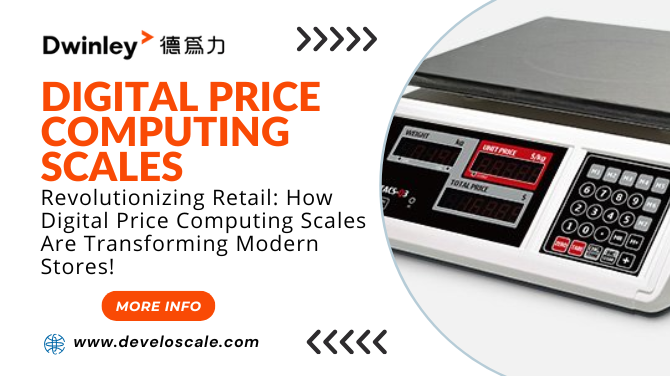
However, modern Digital Price Computing Scales are designed with mandated transparency in mind. They feature dual-sided, large, bright LED or LCD displays—one facing the operator and one facing the customer. These screens simultaneously show three crucial pieces of information:
- Weight: The precise weight of the product
- Unit Price: The price per kilogram or pound.
- Total Price: The automatically calculated final cost.
Consequently, the customer is a fully informed participant in the transaction. This real-time visual confirmation builds immediate confidence and trust. The clarity provided by this dual-display system is a powerful tool for customer satisfaction, turning the weighing process from a point of potential suspicion into an affirmation of fair trade.
3. Accelerated Workflow and Throughput
Time is money in retail, particularly in high-volume environments like supermarkets, butcher shops, and delicatessens. Manually calculating the price of a weighed item involves several slow, error-prone steps: reading the weight, recalling the unit price (or looking it up), manually calculating the total, and then entering that total into the Point-of-Sale (POS) system.
On the other hand, a Digital Price Computing Scale automates this entire sequence. The operator simply places the item on the pan, selects the item’s code (often via a quick hotkey), and the scale instantly computes and displays the final price.
Moreover, many advanced models, including the professional scales manufactured by Ningbo Develo Precision Mac Co., Ltd., come equipped with Add-Up functionality (Accumulation Mode). This allows the clerk to weigh and price multiple items for the same customer sequentially, with the scale keeping a running total until the final checkout. This dramatically reduces transaction time, speeds up customer flow, and enables staff to handle more customers efficiently, especially during peak hours.
Beyond Weighing – Advanced Features for a Smart Retail Ecosystem
The truly revolutionary aspect of modern Digital Price Computing Scales is their evolution from simple measurement tools into fully integrated, intelligent terminals that communicate with the rest of the store’s ecosystem.
1. Seamless POS and Inventory Integration
Perhaps the most significant leap in functionality is connectivity. Older scales were isolated islands of data. Modern digital scales feature multiple connectivity ports (RS232, Ethernet, and sometimes Wi-Fi or USB) that allow them to communicate directly with the store's central POS system and inventory software.
This integration offers multifaceted benefits:
- Eliminating Double Entry: The calculated price is instantly transmitted to the cash register, eliminating the need for the cashier to manually key in the price, thus removing a major source of human error.
- Real-Time Inventory Management: When an item is weighed and sold, the scale can immediately deduct that precise weight or quantity from the inventory system. For instance, knowing exactly how many pounds of a specific cheese were sold today aids in more accurate ordering and reduces spoilage.
- Dynamic Pricing: In some advanced setups, price updates can be pushed directly from the central office system to every scale simultaneously, ensuring that flash sales or sudden price adjustments are consistent across all locations instantly.
2. PLU Memory and Direct Price Recall
For stores selling dozens or even hundreds of different items by weight, product identification needs to be instantaneous. Digital Price Computing Scales are built with vast memory capabilities, housing hundreds (or even thousands) of Product Look-Up (PLU) codes.
Significantly, the most frequently sold items are often assigned to Direct Access Keys (Hotkeys). These are physical or digital buttons on the scale's keypad. Instead of typing a four-digit code, the operator simply presses a single key labeled "Organic Apples" or "Premium Beef Cut," and the pre-programmed unit price is instantly applied to the weighed item. This feature is crucial for maintaining high speed during busy periods.
3. Integrated Label Printing Scales
For pre-packaged goods, bakeries, or meat departments, label printing is indispensable. High-end Digital Price Computing Scales, often referred to as Label Printing Scales, include a built-in thermal printer.
Crucially, these scales perform the weighing, calculate the price, and then instantly print a professional-looking label that includes:
- The item name (e.g., "Deli Sliced Ham")
- The precise weight
- The price per unit
- The final total price
- A scannable barcode or QR cod
- Date information (Pack Date, Best-By Date)
- Store logo and brand information
The presence of a barcode means the item can be quickly scanned at any POS terminal, further accelerating checkout. Therefore, this single device consolidates three separate operations—weighing, pricing, and labeling—into one efficient step.
4. Durability, Hygiene, and Portability
Retail environments are demanding. Deli counters are wet, produce departments are messy, and farmer's market setups require mobility. Manufacturers like Ningbo Develo Precision Mac Co., Ltd. design their Digital Price Computing Scales with these harsh conditions in mind.
- Hygienic Design: Features like easy-to-clean, rust-resistant stainless steel weighing pans and robust, sealed keypads prevent the ingress of liquids and food particles, promoting superior hygiene critical in food service
- Robust Construction: The internal components are housed in durable casings built to withstand continuous commercial use.
- Battery Backup: For operations that require flexibility (like mobile vendors or those susceptible to power outages), many models include a powerful rechargeable battery that provides days of continuous service.
A Manufacturer’s Insight – Quality from Ningbo Develo Precision Mac Co., Ltd.
At Ningbo Develo Precision Mac Co., Ltd., our commitment is to provide the critical instruments that drive modern retail efficiency. Our design and manufacturing philosophy centers on integrating maximum functionality with uncompromising quality assurance.
The Assurance of Certification: OIML and Legal Metrology
The retail world is governed by strict laws regarding fair measurement. For a scale to be legally used for trade (meaning the price charged to a customer is determined by the scale’s reading), it must be verified and certified by official regulatory bodies.
Our scales, consequently, meet and often exceed these global benchmarks, notably including OIML (International Organization of Legal Metrology) certification. This certification guarantees that the scale adheres to the most stringent international standards for accuracy, performance, and legal compliance. By choosing a certified scale from Ningbo Develo Precision Mac Co., Ltd., our clients gain immediate compliance and peace of mind, knowing their transactions are legally sound and trustworthy.
Designed for the Customer Experience
The success of a scale is measured not just by its accuracy, but by its usability. Our design process focuses heavily on the operator's workflow and the customer's visual experience. The clear separation of the weight, unit price, and total price displays, combined with large, tactile keypads, minimizes operator fatigue and reduces the chance of input errors. Furthermore, the quick response time of our advanced load cells ensures near-instantaneous readings, contributing directly to the speed and efficiency targets of our clients.
Weighing in on the Future of Retail
The introduction of the Digital Price Computing Scale represents a definitive moment in retail history, marking the transition from slow, error-prone manual operations to an era of digital precision and streamlined service. For retailers operating in today’s fiercely competitive market, these scales are not just an upgrade; they are a critical component of a modern, efficient, and customer-centric business model.
In summary, the advantages are clear: enhanced accuracy minimizes costly errors, dual displays foster unparalleled customer trust, and seamless integration with POS systems turbocharges operational efficiency.

Frequently Asked Questions (FAQ)
Q1: What is the main difference between a Digital Price Computing Scale and a standard digital weighing scale?
A: A standard digital scale only provides the weight of an item. A Digital Price Computing Scale is designed specifically for retail trade, performing three functions simultaneously:
- It weighs the product
- It stores the unit price for that product (per kg or per lb)
- It automatically calculates and displays the final price (Weight×Unit Price=Total Price).
In essence, it acts as a mini-POS terminal right at the weighing station.
Q2: Do these scales require specific government calibration or approval to be used in my store?
A: Yes, absolutely. Any scale used in trade—meaning a scale whose reading directly determines the price paid by the customer—must be legally verified and certified by the local or national weights and measures authority (often called Legal Metrology). Look for certifications such as OIML or NTEP (in North America). Scales from a reputable manufacturer like Ningbo Develo Precision Mac Co., Ltd. will have the necessary type-approval to ensure they can pass this legal verification process.
Q3: What is a PLU and how does it speed up transactions?
A: PLU stands for Product Look-Up. It is a unique code assigned to each specific item sold by weight. For example, "Deli Ham" might be PLU 101, and "Fuji Apples" might be PLU 205.
Instead of manually typing the unit price for Fuji Apples ($1.99/lb), the operator simply presses the PLU key for 205. The scale instantly recalls the $1.99/lb price from its memory and performs the calculation. Therefore, the use of PLU codes, especially when assigned to direct hotkeys, makes pricing nearly instantaneous and eliminates errors from manual price entry.
Q4: Can I connect a Digital Price Computing Scale to my existing Point-of-Sale (POS) system?
A: In most cases, yes. Modern commercial scales, especially those from professional manufacturers, are built with industry-standard communication ports (like RS232, USB, or Ethernet) specifically to interface with POS systems. This allows the scale to send the final weight and price data directly to the cash register software. However, it is essential to verify compatibility with both your scale provider (like Ningbo Develo Precision Mac Co., Ltd.) and your POS software vendor during the purchasing process.
Q5: Is the durability and hygiene better than older scales?
A: Significantly. Modern scales designed for retail food environments prioritize durability and hygiene. They feature:
- Stainless Steel Pans: Easy to remove, sanitize, and resistant to corrosion from food acids or cleaning agents.
- Sealed Keypads: Protect the sensitive electronics from liquid spills, dust, and food debris.
- Robust Housing: Built to handle the heavy use and occasional bumps of a busy commercial setting, ensuring a much longer service life compared to older, less protected models.
Q6: What does the 'Tare' function do, and why is it important?
A: The 'Tare' function is essential for accuracy. It allows the operator to subtract the weight of any container, wrapper, or bag placed on the scale before the product is added. Consequently, the scale registers the net weight of the product only, ensuring the customer is not charged for the packaging. This is a critical feature for fair pricing and is typically done with a single press of the 'Tare' button.