
Risk management is one of the most critical pillars of medical device development, yet it is also one of the most misunderstood. Many manufacturers treat the Risk Management File (RMF) as a documentation exercise created just before regulatory submission. In reality, regulators worldwide expect risk management to be an ongoing, living process that begins at concept stage and continues throughout the entire product lifecycle. A well-structured Risk Management File not only supports compliance with ISO 14971 but also plays a decisive role in regulatory approvals, audits, and post-market performance.
As regulatory scrutiny increases across global markets, structuring a Risk Management File correctly has become essential for medical device manufacturers, startups, and quality professionals alike.
Understanding the Purpose of a Risk Management File
A Risk Management File is a controlled set of records that demonstrates how a manufacturer has identified hazards, estimated and evaluated risks, implemented risk controls, and assessed residual risks associated with a medical device. According to ISO 14971, the file must provide objective evidence that risk management activities have been planned, executed, reviewed, and maintained systematically.
Regulators do not view the RMF as a standalone document. Instead, it acts as a central repository linking design decisions, usability engineering, clinical evaluation, verification and validation, and post-market surveillance. Whether the device is a Class I product or a high-risk implantable system, the expectation remains the same: risks must be known, justified, and continuously monitored.
Regulatory Expectations Across Global Markets
ISO 14971 is the globally recognized standard governing medical device risk management, and it forms the backbone of regulatory expectations in most jurisdictions. However, each regulatory authority applies additional interpretations that manufacturers must consider while structuring their Risk Management File.
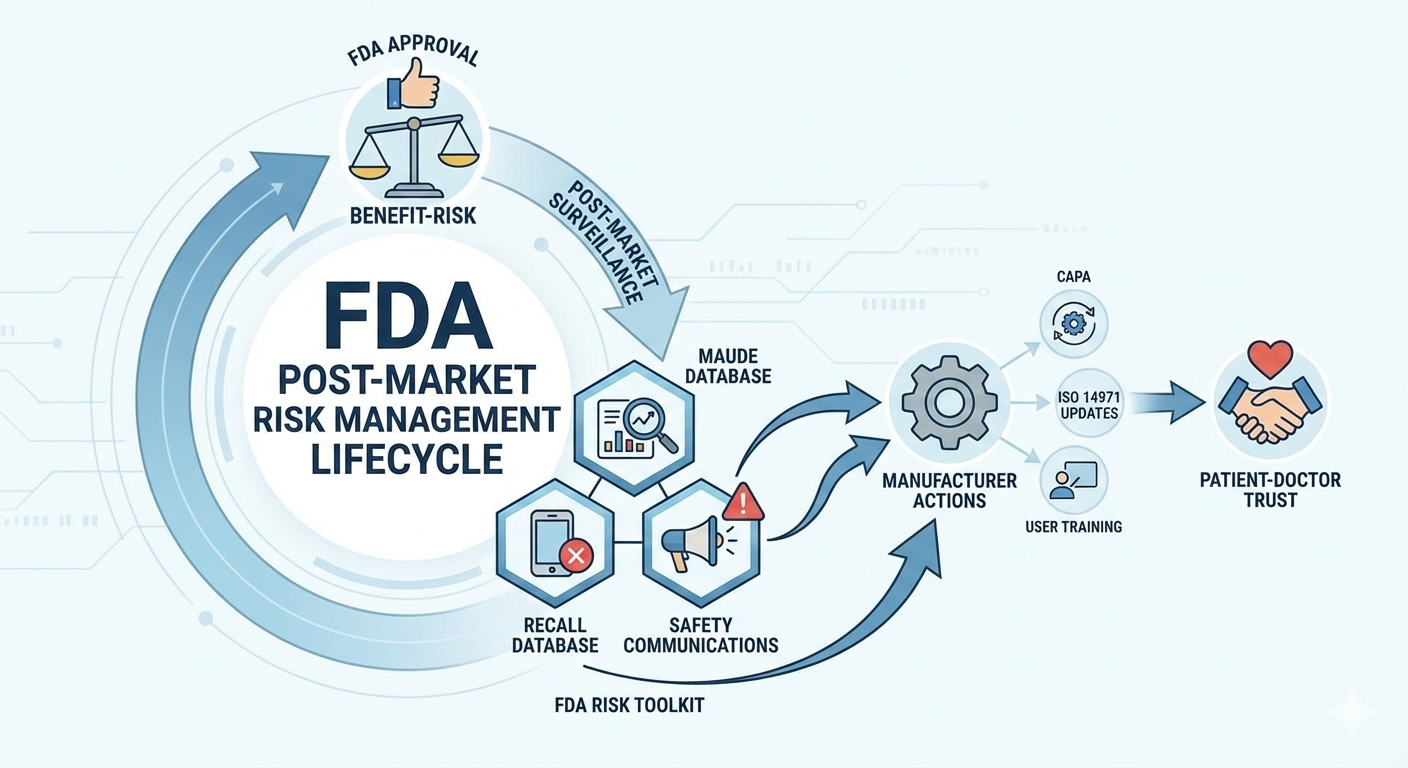
From a US FDA perspective, risk management is deeply integrated into design controls under 21 CFR 820. The FDA expects manufacturers to demonstrate that hazards have been identified comprehensively and that risk controls are verified and validated. During inspections, reviewers frequently examine how risk analysis aligns with complaints, CAPA, and post-market data.
In the European Union, the Medical Device Regulation (EU MDR) significantly strengthened risk management requirements. Manufacturers must demonstrate continuous risk-benefit evaluation, alignment between the RMF and clinical evaluation reports, and integration with post-market surveillance and post-market clinical follow-up activities. A static or outdated RMF is often cited as a major non-conformity during Notified Body audits.
India’s CDSCO, while aligning increasingly with global practices, expects manufacturers to submit risk-related documentation that supports safety and performance claims. As regulatory maturity increases, expectations around structured risk documentation continue to rise, especially for higher-risk and software-driven devices.
Core Elements That Form a Robust Risk Management File
A well-structured Risk Management File follows a logical flow that mirrors the lifecycle of the device rather than appearing as a collection of disconnected reports. The foundation of the file is the Risk Management Plan, which defines the scope of activities, responsibilities, criteria for risk acceptability, and methods to be used throughout the process. This plan sets the tone for consistency and traceability across the entire file.
Risk analysis is the next critical component. It involves identifying hazards associated with the device, including those related to intended use, reasonably foreseeable misuse, materials, software, cybersecurity, usability, and environmental factors. Each hazard must be linked to potential hazardous situations and resulting harms. Estimating risk typically involves evaluating both the severity of harm and the probability of occurrence, using clearly defined criteria.
Once risks are analyzed, risk evaluation determines whether identified risks are acceptable based on predefined criteria. Unacceptable risks must be addressed through risk control measures. These controls may include design modifications, protective measures within the device or manufacturing process, and information for safety such as warnings or instructions for use.
Residual risk assessment is often overlooked but is critically important. Even after applying controls, some level of risk usually remains. Manufacturers must assess whether residual risks are acceptable individually and collectively, and whether they are outweighed by the medical benefits of the device. This evaluation becomes particularly important under EU MDR requirements.
The Risk Management Report serves as formal confirmation that all planned activities have been completed and that the overall residual risk is acceptable. It provides closure while still acknowledging that risk management continues post-market.
Structuring the Risk Management File Step by Step
The most effective Risk Management Files are built progressively rather than compiled retrospectively. Structuring begins with clear planning, ensuring that the RMF aligns with the device’s intended use, classification, and regulatory markets. Early involvement of cross-functional teams, including design, clinical, quality, manufacturing, and regulatory experts, ensures that risks are identified from multiple perspectives.
Hazard identification should be systematic and exhaustive. This includes reviewing applicable standards, similar devices, historical complaint data, and usability studies. For software and SaMD products, cybersecurity threats and data integrity risks must also be considered. Missing hazards at this stage often leads to regulatory findings later.
Risk estimation and evaluation should remain consistent throughout the file. Using different scoring systems or undocumented assumptions weakens credibility during audits. Clear rationale and traceability are essential, especially when determining why certain risks are considered acceptable.
Risk control implementation must be documented alongside evidence of effectiveness. Regulators increasingly expect manufacturers to show verification and validation results that confirm risk controls actually reduce risk as intended. Merely listing controls without supporting evidence is insufficient.
Benefit-risk analysis becomes particularly relevant when residual risks remain high. This analysis should be objective, clinically justified, and aligned with the device’s intended medical purpose. Unsupported benefit claims often trigger regulatory questions.
Finally, post-market risk review closes the loop. Complaints, adverse events, vigilance reports, and post-market surveillance data must feed back into the Risk Management File. An RMF that does not reflect real-world performance is considered incomplete.
Common Pitfalls That Undermine Risk Management Files
Many Risk Management Files fail not because of missing documents, but because of poor integration. One common mistake is treating risk management as a one-time activity rather than a continuous process. Another frequent issue is inadequate traceability between hazards, controls, verification activities, and post-market data.
Ignoring reasonably foreseeable misuse is another area where manufacturers struggle. Regulators increasingly expect realistic misuse scenarios to be evaluated, especially for consumer-facing and home-use devices. In addition, failing to update the RMF after design changes or field actions can quickly render the file obsolete.
Best Practices for Long-Term ISO 14971 Compliance
Sustainable compliance requires discipline and structure. Maintaining clear traceability between the Risk Management File and other technical documentation is essential. Regular reviews, especially after complaints, CAPAs, or regulatory changes, help keep the RMF current and defensible.
Cross-functional collaboration strengthens risk identification and ensures that controls are practical and effective. Documentation should be written clearly, avoiding vague language, so that third-party reviewers can easily follow the manufacturer’s logic.
Using a lifecycle-based approach rather than a submission-driven mindset significantly improves audit outcomes and reduces regulatory friction.
How a Well-Structured Risk Management File Supports Faster Approvals
Regulators and Notified Bodies rely heavily on risk documentation to assess whether a device is safe and performs as intended. A clear, well-organized Risk Management File reduces review cycles, minimizes clarification requests, and demonstrates regulatory maturity. It also simplifies responses during inspections and audits, as evidence is readily available and logically connected.
Manufacturers with strong risk documentation often experience smoother regulatory pathways, particularly when expanding into new markets or updating existing approvals.
Conclusion
Structuring a Risk Management File correctly is not just about meeting ISO 14971 requirements; it is about embedding risk-based thinking into the DNA of medical device development. A comprehensive, well-maintained RMF strengthens regulatory submissions, supports safer products, and builds long-term compliance resilience.
Manufacturers seeking deeper insight into structuring and maintaining effective risk management documentation often refer to specialized regulatory resources such as the detailed guidance available on risk management file best practices, which can support alignment with evolving global expectations.
When approached strategically, risk management becomes not a regulatory burden, but a powerful tool for quality, safety, and sustainable growth in the medical device industry.
For organizations seeking structured support in building compliant risk management documentation, expert regulatory guidance can add significant value. Firms like Operon Strategist work closely with medical device manufacturers to align Risk Management Files with ISO 14971 expectations and global regulatory requirements. Such support helps ensure consistency, traceability, and readiness for audits while reducing gaps that often delay regulatory approvals.
Read more at- Best Way to Structure a Risk Management File




Software has become an important aspect of medical devices and is proving to benefit both patient and provider.
QSS can help licence your medical device!Read more:https://qualitysmartsolutions.com/blog/what-you-need-to-know-software-as-a-medical-device-samd/