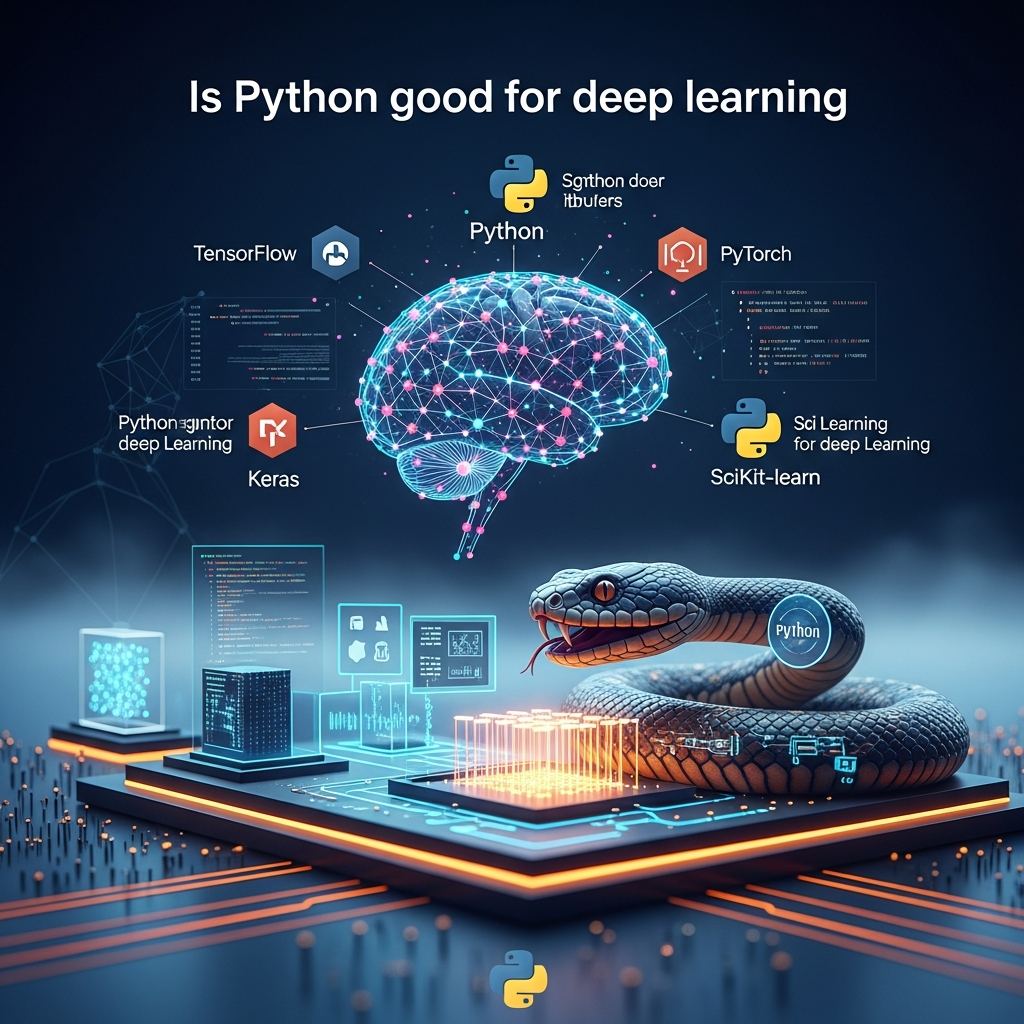
In 2026, the answer is a resounding yes. Python is not just "good" for deep learning; it is the industry standard. While the language itself is technically slower than compiled languages like C++ or Rust, its ecosystem has been designed to bypass these limitations, making it the primary choice for researchers and engineers alike.
Why Python Dominates Deep Learning
Python’s success in deep learning is built on three main pillars: its role as a "glue" language, its massive library ecosystem, and its unparalleled community support.
1. The "Glue" Language Advantage
Python acts as a user-friendly interface for high-performance code written in C and C++. When you run a deep learning model in Python, the heavy mathematical lifting (tensor operations, backpropagation) happens in highly optimized low-level libraries.
GPU/TPU Acceleration: Frameworks like PyTorch and TensorFlow interface directly with CUDA (NVIDIA) and other hardware accelerators, ensuring that the "slowness" of Python never actually touches the heavy computation.
Ease of Use: It allows you to focus on the architecture of the neural network rather than managing memory or low-level pointers.
2. The Powerhouse Ecosystem
Virtually every breakthrough in AI and deep learning is released with a Python implementation first.
Tool Category
Key Libraries
Purpose
Deep Learning Frameworks
PyTorch, TensorFlow, JAX
Building and training neural networks.
High-Level APIs
Keras, FastAI
Rapid prototyping with less code.
Data Manipulation
NumPy, Pandas, Polars
Cleaning and preparing datasets.
Generative AI
Hugging Face (Transformers)
Accessing state-of-the-art LLMs and diffusion models.
Visualization
Matplotlib, Seaborn
Understanding model performance and data patterns.
3. Rapid Prototyping
Deep learning is an iterative process of trial and error. Python’s simple syntax and tools like Jupyter Notebooks or Google Colab allow you to test small snippets of code, visualize data instantly, and tweak hyperparameters without recompiling your entire project.
Are there any drawbacks?
While Python is the king of development, it faces some competition in specific areas:
Raw Execution Speed: For ultra-low latency production environments (like high-frequency trading or real-time embedded systems), engineers might export a Python-trained model to C++ or Rust for deployment.
Mobile Development: Python is rarely used for the actual on-device deep learning logic in mobile apps; specialized frameworks like TensorFlow Lite or CoreML (Swift) are preferred here.
Verdict for 2026: If you are looking to enter deep learning, Python is the only logical starting point. It has the most jobs, the best documentation, and the most powerful tools available today.