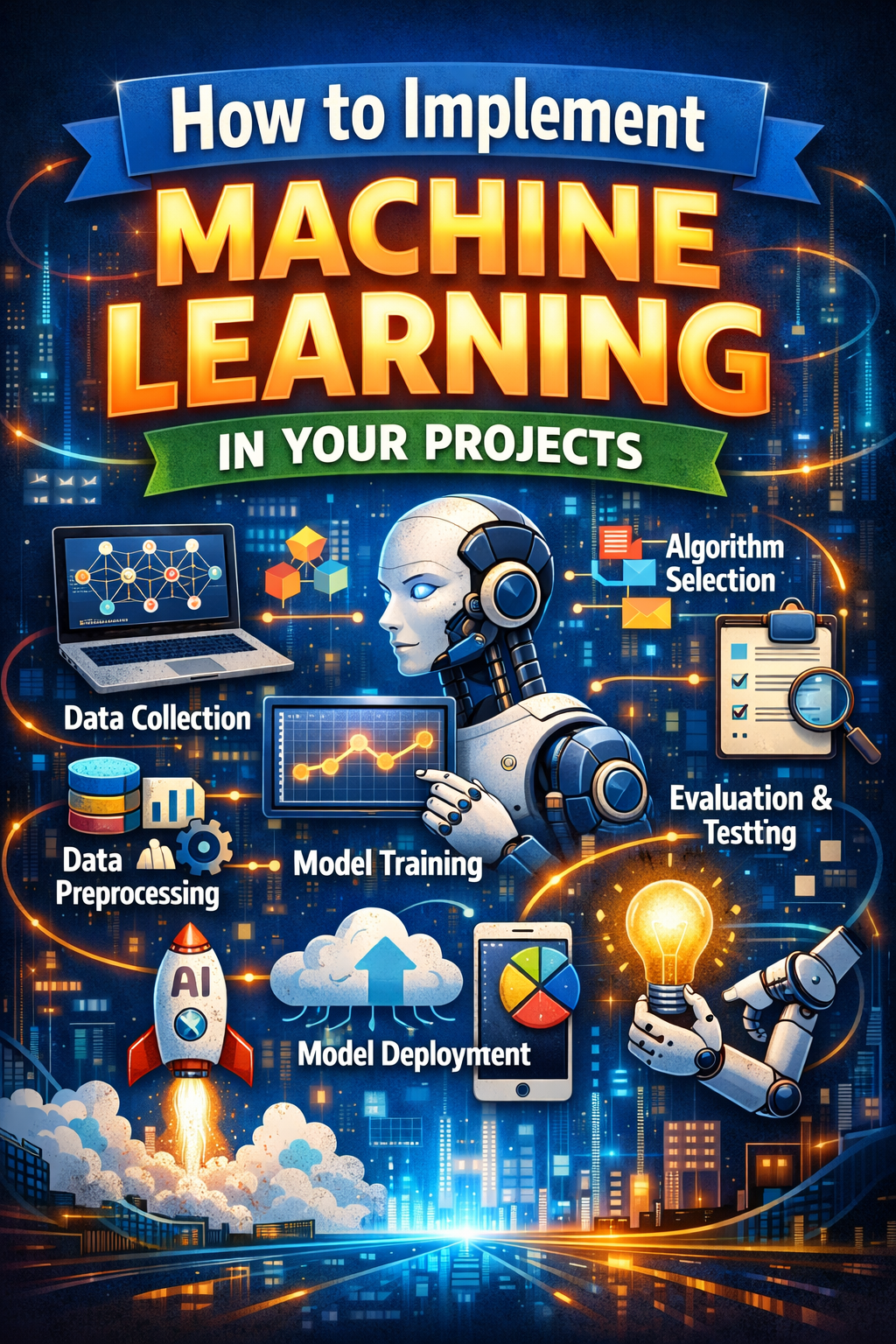
Implementing Deep learning (DL) can feel like trying to build a plane while flying it, but the process is actually quite structured. Whether you're building a recommendation engine or a predictive tool, the workflow generally follows a standard lifecycle.
Here is a roadmap to get your project from an idea to a working model.
1. Define the Problem
Before touching any code, identify what you are trying to solve. ML isn't always the answer—sometimes a simple "if-else" statement is better.
Supervised Learning: Predicting a specific value (e.g., house prices or spam vs. not spam).
Unsupervised Learning: Finding hidden patterns (e.g., grouping customers by behavior).
Reinforcement Learning: Learning through trial and error (e.g., teaching an AI to play a game).
2. The Machine Learning Workflow
The process is iterative. You will likely go back and forth between these stages several times.
Phase 1: Data Acquisition & Cleaning
Your model is only as good as the data you feed it ("Garbage In, Garbage Out").
Collection: Gather data from APIs, SQL databases, or CSV files.
Cleaning: Handle missing values, remove duplicates, and fix outliers.
Feature Engineering: This is the "secret sauce." It involves selecting the most relevant variables or creating new ones (e.g., converting a "Timestamp" into "Day of the Week").
Phase 2: Modeling
This is where the "learning" happens.
Split the Data: Divide your dataset into a Training Set (usually 80%) to teach the model and a Test Set (20%) to see how it performs on data it hasn't seen before.
Select an Algorithm:
Linear Regression: For predicting continuous numbers.
Random Forest: Great for classification and handling complex data.
Neural Networks: Best for images, audio, or very large datasets.
Training: Run your data through the algorithm. Mathematically, the goal is to minimize a Loss Function, often represented as:
$$J(\theta) = \frac{1}{2m} \sum_{i=1}^{m} (h_\theta(x^{(i)}) - y^{(i)})^2$$
Phase 3: Evaluation
How do you know if it works? You use metrics based on your goal:
Accuracy: Percentage of correct guesses.
Precision/Recall: Crucial for things like medical diagnoses where a "false negative" is dangerous.
Mean Squared Error (MSE): Used for regression to see how far off your predictions are.
3. Implementation Tools
You don't need to write algorithms from scratch. The ecosystem is very mature:
Category
Tools
Languages
Python (Standard), R (Statistical focus), Julia
Libraries
Scikit-learn (General ML), Pandas (Data manipulation), NumPy
Deep Learning
TensorFlow, PyTorch
Cloud Services
AWS SageMaker, Google Vertex AI, Azure ML
4. Deployment and Monitoring
A model on your laptop is a hobby; a model in an API is a product.
Export: Save your model (using formats like Pickle or ONNX).
API: Wrap the model in a framework like Flask or FastAPI so other apps can send it data and get predictions.
Monitoring: Models "drift" over time as real-world data changes. You’ll need to retrain periodically.