


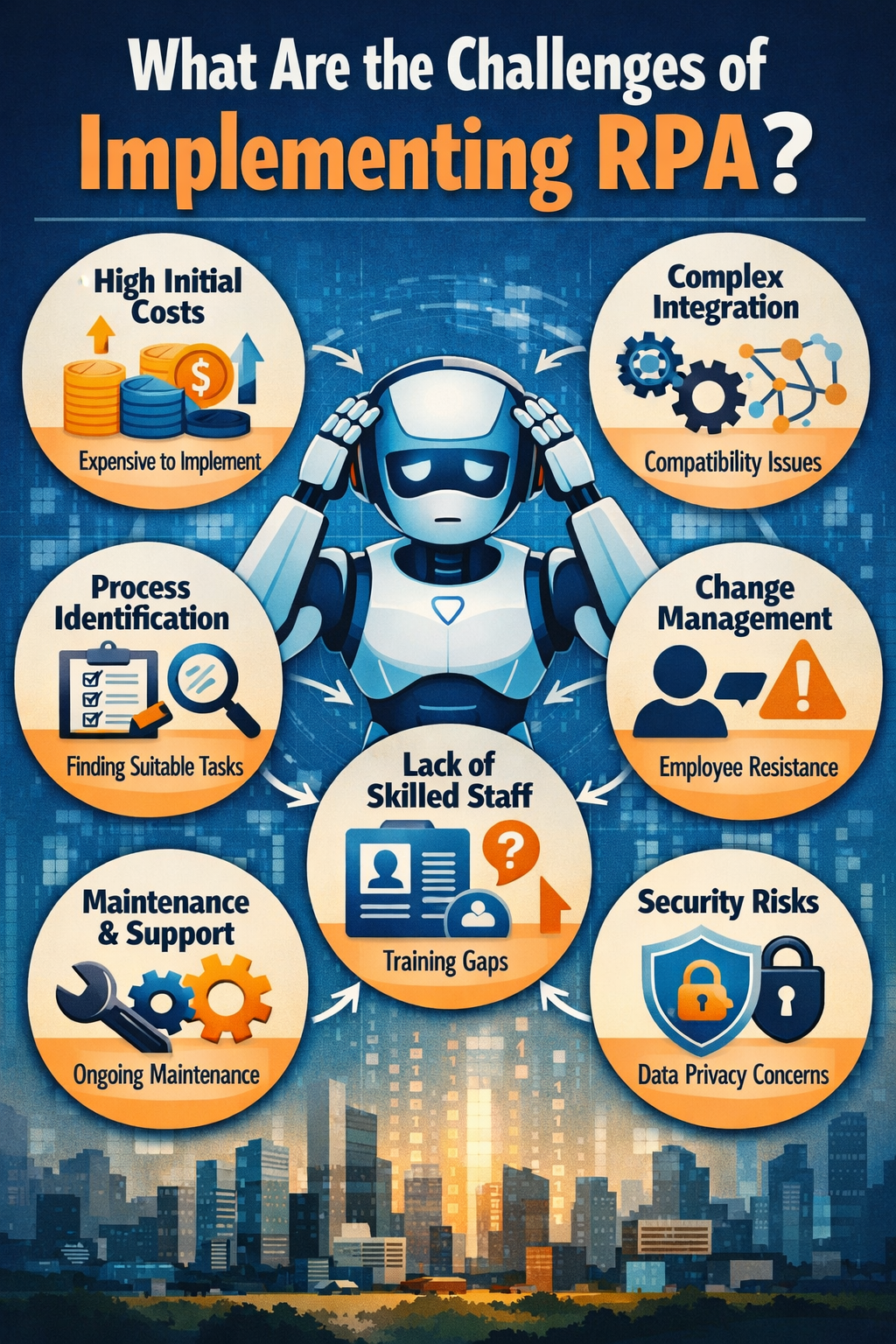
Implementing Robotic Process Automation (RPA) is often pitched as a "quick fix" for efficiency, but it carries significant hurdles. According to recent industry data, nearly 30–50% of initial RPA projects fail to scale beyond the pilot phase due to unforeseen complexities.
The challenges generally fall into four categories: Strategic, Technical, Organizational, and Operational.
1. Strategic & Process Challenges
Poor Process Selection: This is the #1 cause of failure. Automating a "broken" or non-standardized process only speeds up the errors. RPA is best for high-volume, rules-based tasks; if a process requires frequent human judgment or has high variability, a standard bot will fail.
Unrealistic Expectations: Many leaders expect immediate $100\%$ ROI. In reality, initial licensing fees, infrastructure setup, and consulting costs can make the first year expensive.
Lack of a Roadmap: Treating RPA as a series of isolated experiments rather than a centralized strategy leads to "bot silos" that are impossible to manage long-term.
2. Technical & Infrastructure Hurdles
Bot Fragility: RPA bots interact with the User Interface (UI). If an application updates its layout, changes a button name, or moves a text box, the bot "breaks." This leads to high maintenance costs.
Infrastructure Limitations: Bots require stable environments. Issues with virtual machine (VM) resources, slow network speeds, or incompatible legacy systems can cause bots to time out or crash.
Security & Data Privacy: Bots often need administrative-level access to multiple systems to move data. If not managed with strict role-based access control (RBAC) and encryption, they become a massive security vulnerability.
3. Organizational & People Issues
Employee Resistance: The "Robots are coming for my job" fear is real. Without clear communication that RPA is meant to augment (not replace) staff, employees may be reluctant to share process details or provide the necessary support.
IT and Business Misalignment: RPA is often driven by business units (Finance, HR) without involving IT early. This leads to friction regarding security protocols, server maintenance, and software updates.
Skill Gaps: There is a persistent shortage of skilled RPA architects and developers. Relying solely on low-code tools without understanding the underlying logic can lead to poorly built, unstable automations.
4. Operational Maintenance
The "Shadow IT" Problem: If bots are built by business users without governance, they may perform tasks that violate compliance or create "technical debt" that the IT team eventually has to fix.
Scalability Issues: What works for two bots rarely works for 200. Without a Center of Excellence (CoE) to standardize development and orchestration, scaling becomes an operational nightmare.
Comparison: Successful vs. Struggling Implementations
Feature
Struggling Projects
Successful Projects
Focus
Automating complex, rare tasks
Automating high-volume, rule-based tasks
Governance
Managed by individual departments
Centralized Center of Excellence (CoE)
IT Involvement
IT is notified after deployment
IT is a core partner from day one
Maintenance
Reactive ("Fix it when it breaks")
Proactive monitoring & version control



Mattress protectors are trendy these days.
It serves as a barrier against spills, germs, and allergies.
These covers fit over the mattress like a bed sheet and fully encases it.
If you put this cover on your mattress, it will protect it from dust, dirt, and insects.
It can be a safeguard for your mattress if you have children or pets at home.The most significant advantage of mattress protectors is that they are usually liquid-proof.
We spend 8 to 10 hours every day in bed.
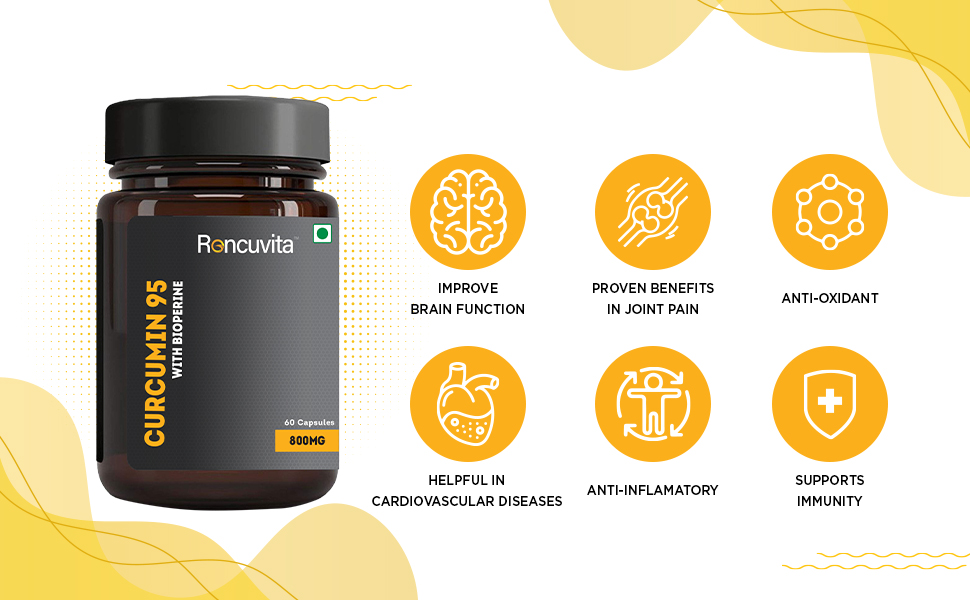
This product by Roncuvita contains turmeric and curcumin and these have a lot of different health benefits.
Tumeric is an ingredient that can be easily found in Indian households as it serves as a key ingredient in a lot of foods that we eat.
This spice is not just accidentally chosen as the main ingredient of so much of our food, there is a specific reason behind it.