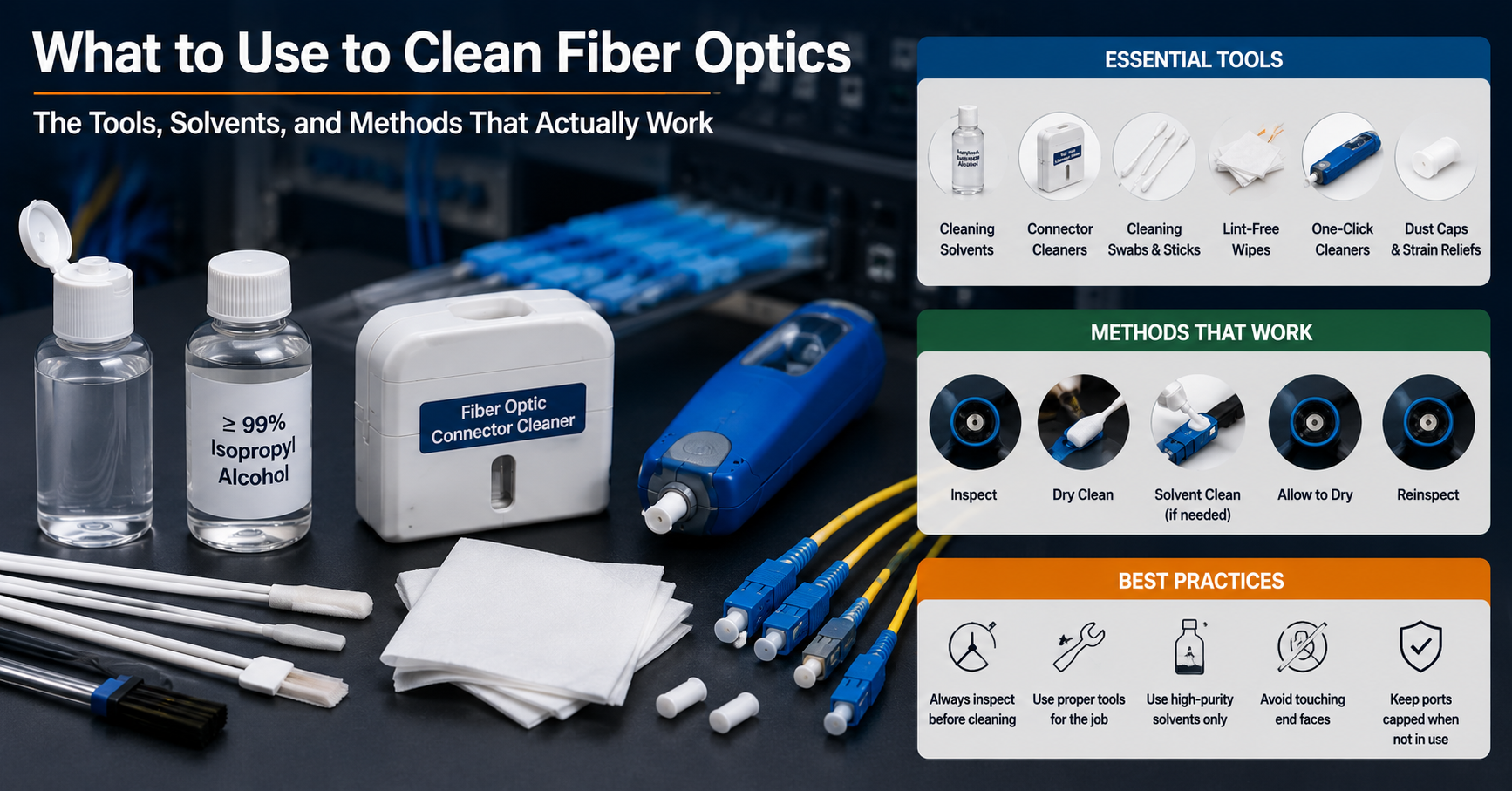
To clean fiber optics you need three things: a dry mechanical cleaner such as a one-click pen or cassette, an optical-grade cleaning fluid paired with lint-free wipes for oils and fingerprints, and an inspection scope to confirm the end face is actually clean. Everything else is a variation on those three. The tool you reach for depends entirely on what is sitting on the ferrule, and no single device handles every contaminant.
That distinction matters more than most technicians expect. A dust particle a few microns across can sit directly over a 9 µm single-mode core and scatter enough light to push a link out of the loss budget. Mating a contaminated connector under optical power can also bake that particle into the glass permanently.
What to Use to Clean Fiber Optics: Matching the Tool to the Contaminant
Contamination on an end face falls into two broad categories, and each has its own removal method. Dry particulates like dust, cladding fragments, and airborne debris lifts away mechanically, which is why a dry cleaner fiber optic tool is the correct first choice in the field. Oils, skin residue, and index-matching gel behave differently: they smear under a dry pass instead of lifting.
Deciding between the two is not guesswork. Inspect first, identify what you are looking at, then choose the method. The practical rule most crews follow is dry first, wet-then-dry only if dry fails.
- Dust and loose particulate: dry mechanical cleaning (pen, cassette, swab)
- Fingerprints, oils, gel residue: optical-grade solvent applied wet, followed immediately by a dry pass
- Recessed bulkhead ports and transceivers: a cleaner optical fiber connector tool sized to the ferrule, since a wipe cannot physically reach the end face
- Bare fiber before splicing: 99%+ isopropyl alcohol on a lint-free wipe, single stroke, discard
Dry Cleaning Tools: Pens, Cassettes, and Cleaning Boxes
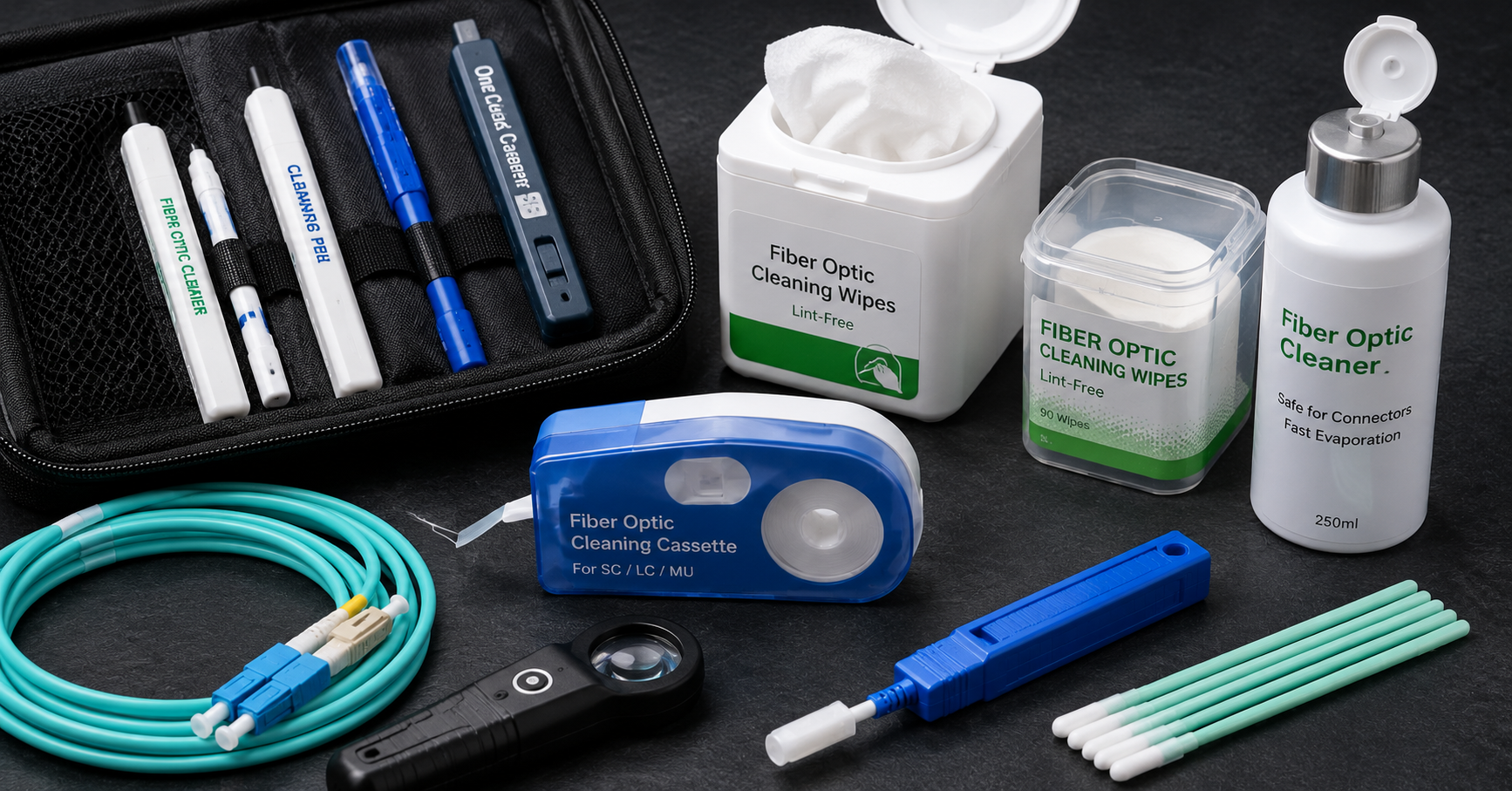
A one-click cleaner pen is the most common tool for a clean fiber optic connector job because it works in place. The pen inserts into an adapter or bulkhead, advances fresh cleaning fabric with a single push, and rotates that fabric across the ferrule in one controlled motion. Cleaning heads come sized to the ferrule rather than the connector body, which is why coverage is described in millimetres.
Ferrule sizing is the part people get wrong when ordering. A 1.25 mm head serves LC and MU connectors, a 2.5 mm head serves SC, FC, ST, and E2000, and MPO or MTP interfaces need a dedicated multi-fiber head because the ferrule face is flat and holds twelve or more fibers in a row. Buying a single pen and assuming it covers the plant is a costly mistake. Most crews carry all three formats, which is why fiber optic cleaner pens are usually specified as a set rather than a single unit.
Cassette-style tools solve a different problem. A clean fiber optics box or reel-fed cassette presents a fresh strip of lint-free cloth for every wipe, so the same contaminated surface is never dragged back across a second connector. That matters enormously in high-volume bench work, patch panel builds, and QC lines where hundreds of exposed connectors pass through in a shift. A fiber cleaning cassette also drives cost-per-clean down considerably compared with single-use wipes.
Wet Cleaning: Solvents, Wipes, and Why Alcohol Alone Falls Short
Wet cleaning exists because dry methods cannot dissolve a film. When you have a fingerprint, the oil needs a solvent to break its surface tension before anything can carry it away. The technique is specific: apply fluid to the wipe or use a solvent pen, pass the ferrule across the damp area, then move immediately to a dry section of the same wipe.
The timing is the whole technique. If solvent air-dries on the end face it leaves a visible ring of dissolved residue, which is usually worse than the original contamination. Engineered fiber optic cleaning solutions are formulated to flash off faster and leave no film, which is the main reason they outperform bottle-shelf isopropyl alcohol.
- Use 99%+ IPA if that is all you have. Standard 70% rubbing alcohol contains water and additives that leave deposits.
- Never soak a connector or flood an adapter. A damp pass is enough.
- Discard the wipe after one use. Reusing it redistributes the residue you just removed.
- Skip household tissue, cotton buds, and shop cloth entirely. They shed lint directly onto the glass.
Cleaning Bare Fiber, Splice Prep, and Field Realities
The question "can you clean fiber optic cable" usually means one of two different jobs. Cleaning a connector end face is one task. Cleaning bare fiber after stripping the coating, ahead of cleaving and splicing, is another, and it uses a different method.
For bare fiber, the accepted practice is a lint-free wipe moistened with high-purity isopropyl alcohol, drawn along the fiber in a single stroke away from the stripped section. You will often hear a faint squeak, which indicates the acrylate residue has released. Do not re-wipe with the same surface, and cleave immediately, because exposed glass picks up airborne particulate within seconds.
Field conditions add constraints. A splice van, a manhole, or a rooftop cabinet all mean dust, humidity, and poor light. Cleaning fiber optics by hand with improvised materials is where most contamination failures start, and it is the habit worth breaking first.
Inspection Is What Tells You the Cleaning Worked
You cannot judge a clean end face by eye. Contamination sits at a scale far below what unaided vision resolves, so verification requires a fiber inspection scope or video probe with 200x to 400x magnification. This is why cleaning and inspection are always described as a loop rather than two separate tasks.
The reference standard is IEC 61300-3-35, which sets pass and fail criteria for scratches and defects by zone across the end face. The current third edition, published in 2022, removed the outer C and D zones from the grading scheme and places the outer edge of zone B at 110 µm for single-mode connectors. Importantly, the standard positions visual inspection as a supplement to optical measurement, not a replacement for it, so insertion loss and return loss testing still matter.
- Inspect the end face before mating anything
- Clean only if a zone fails, using the method matched to the contaminant
- Re-inspect to confirm the pass
- Repeat the wet-then-dry cycle if residue persists, then verify with an optical power meter or OTDR
The Fiber Optic Association, a nonprofit professional society that publishes free technical reference material and certification standards, documents this inspect-clean-inspect sequence in its installer training. Any clean fiber optics association guidance you encounter will describe the same loop, because the sequence itself is method-agnostic.
Building a Practical Cleaning Kit
Assembling the right kit is less about brand and more about coverage. A functional set holds dry pens in all three ferrule sizes, a cassette or box for bench work, a solvent pen or fluid bottle, lint-free wipes, and cleaning swabs for recessed adapters that no other tool reaches. That combination handles roughly every contamination scenario a technician meets.
Sourcing is where clean fiber optics availability becomes a real planning question. Consumables run out mid-project, pens are rated for a finite click count, and cassettes have a fixed sheet count, so procurement teams generally stock ahead rather than searching for clean fiber optics available in my area during a deployment window. A consolidated fiber optic cleaning kit simplifies that logistics problem considerably.
Before you order, confirm:
- Ferrule coverage (1.25 mm, 2.5 mm, MPO)
- Rated cleans per pen and sheets per cassette
- Solvent type and drying time
- Whether the media is genuinely low-shed lint-free
- Compatibility with your existing inspection scope workflow
Before You Mate That Connector
Cleaning fiber is not a step you complete once and forget. Every mate and de-mate cycle is a fresh opportunity for contamination, which is why the inspect-clean-inspect loop belongs in the standard workflow rather than in troubleshooting.
If you are specifying tools for a crew, start with ferrule coverage and consumable duty cycle rather than price per unit. Review a full range of cleaning pens, cassettes, wipes, and kits, match the format to how your team actually works, and request samples so you can validate performance on your own connectors before committing to volume.
Frequently Asked Questions
What to use to clean fiber optics in the field?
A dry one-click cleaner pen sized to the ferrule is the correct field default. It requires no consumable fluid, works on connectors already seated in an adapter, and handles the dust and particulates that cause most field contamination. Carry a solvent pen and lint-free wipes as backup for oils.
Can you clean fiber optic cable yourself without specialist tools?
Not reliably. Contamination sits at a scale that requires lint-free media and controlled contact pressure to remove without scratching the ferrule. Improvised materials shed fibers onto the glass and usually worsen the problem.
Is it safe to clean fiber optics by hand with a cloth?
No. Standard cloth, tissue, and cotton swabs deposit lint directly onto the polished surface. Purpose-built lint-free media exists precisely because ordinary materials fail this requirement.
How many times can you clean a fiber optic connector?
There is no fixed limit, but each pass carries risk. Excessive dry wiping can generate static that attracts fresh particulate, and heavy pressure can scratch the ferrule. Inspect between passes rather than cleaning on assumption.
What is the difference between a cleaner fiber optic pen and a cassette?
A pen cleans connectors in place inside adapters and bulkheads. A cassette cleans exposed connector end faces on the bench and advances fresh cloth per wipe. Most technicians need both.
Does isopropyl alcohol damage fiber connectors?
Not the glass or ceramic, but concentration matters. Alcohol below 99% purity contains water and additives that leave visible residue as it evaporates. Engineered optical fluids dry faster and leave less behind.
How do you clean an MPO connector?
With a dedicated MPO cleaning tool. The multi-fiber ferrule presents a flat face holding twelve or more fibers, and single-ferrule pens cannot make even contact across it. Inspection afterwards should check every fiber position.
Do you need to clean a brand new connector?
Yes. Factory dust caps protect against physical damage but are not clean-room sealed, and the cap itself can shed particulate onto the ferrule. Inspect every connector before first mate, regardless of packaging.