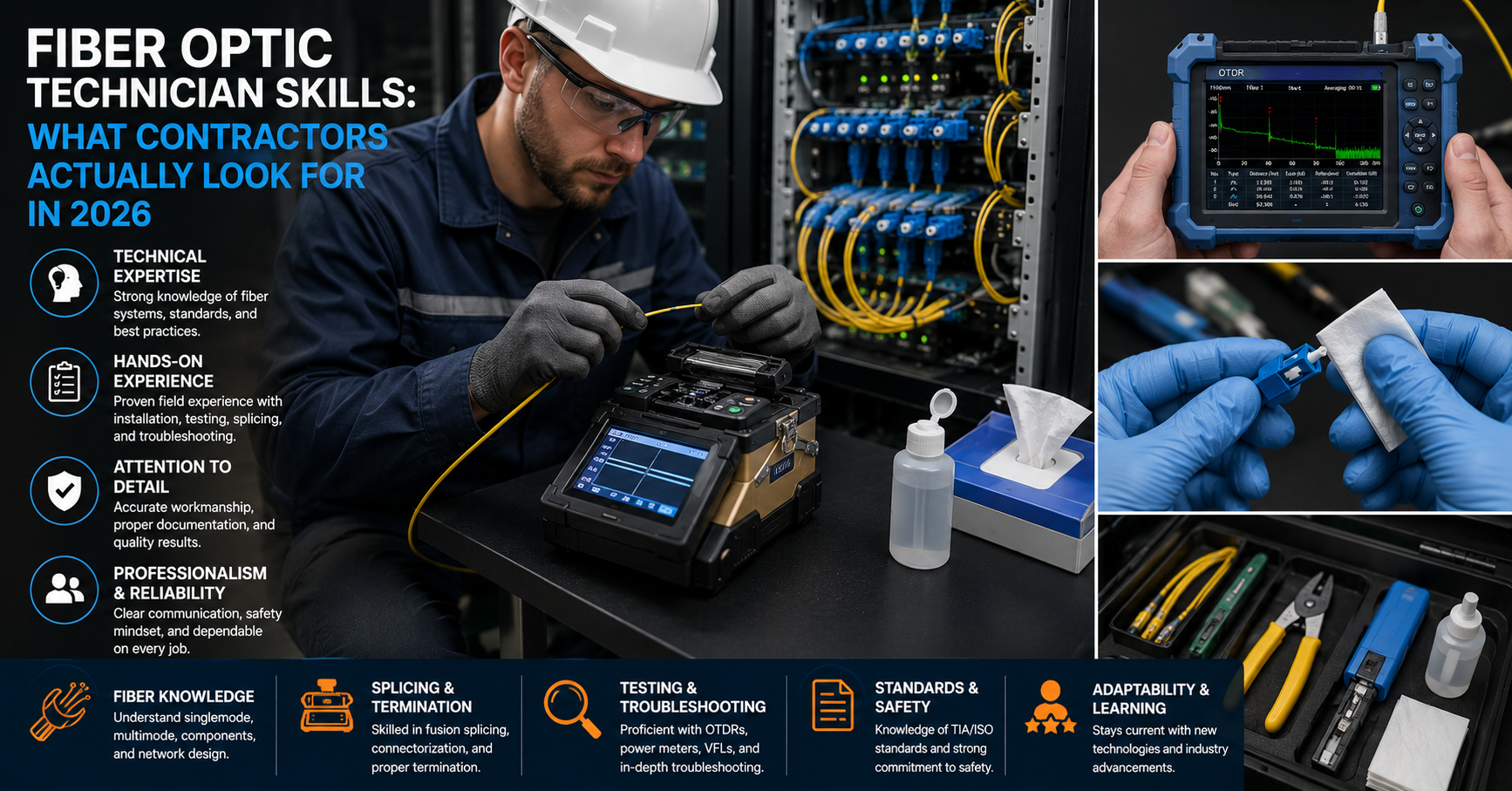
Fiber Optic Technician Skills are the measurable hands-on abilities a contractor verifies before putting someone on a live network build: splicing, termination, end face inspection, optical loss testing, OTDR interpretation, and clean documentation. Everything else on a resume is secondary to those six. Hiring managers in 2026 are not screening for enthusiasm. They are screening for whether a new hire can close out a span without a rework ticket.
The gap between "trained" and "billable" is where most crews lose money, because a technician who splices well but cannot read an OTDR trace still needs a second pair of hands on every acceptance test.
What Is a Fiber Optic Technician?
A fiber optic technician installs, splices, terminates, tests, and repairs optical fiber cable and the connectivity that terminates it. The role sits between the cable placement crew and the network engineering team, and it covers both outside plant work such as aerial and underground routes, and inside plant work such as data center patch fields and building risers. Answering what is a fiber optic technician in practical terms: this is the person who makes light travel from one end of a link to the other within budget.
Scope varies by employer. A technician at an FTTH provider spends most days on drops, splice enclosures, and subscriber turn-ups, while one in a data center may spend a shift on MPO trunks and patch field verification. The underlying fiber optic skills overlap heavily, but the daily rhythm does not.
- Outside plant: aerial lashing, duct and bore support, splice closures, slack storage, fiber optic cable installation across long spans
- Inside plant: riser routing, rack dressing, patch panel termination, MPO trunk management
- FTTH and access: drop placement, ONT installation, PON testing, subscriber troubleshooting
- Restoration: emergency splicing, fault location, span re-certification after damage
The Fiber Optic Technician Job Description in 2026
A current fiber optic technician job description reads less like a cabling posting and more like a test-and-verify role. Contractors have shifted the weight of the job toward proof, because operators now demand documented acceptance data before they will pay an invoice. That single change reshaped what fiber optic technician responsibilities look like on paper.
The scale of the labor market matters here. According to the U.S. Bureau of Labor Statistics, telecommunications technicians held about 268,500 jobs in 2024, with 99,900 of those in telecommunications line installers and repairers, and the median annual wage for telecommunications technicians was $64,310 in May 2024. Employment is projected to move slowly, but turnover keeps openings coming: about 23,200 openings for telecommunications technicians are projected each year, on average, over the decade. Competition for fiber optic technician jobs is therefore less about volume of postings and more about who clears the bench test.
Typical duties listed by contractors now include:
- Prepare, cleave, and fusion splice single-mode and multimode fiber to a stated loss target
- Terminate connectors and verify end faces against a published grading standard
- Perform bidirectional OTDR and insertion loss testing, then export results
- Locate faults using an OTDR, a visual fault locator, and an optical power meter
- Maintain as-built records, splice logs, and port assignments
- Follow confined space, aerial lift, and traffic control procedures on site
Core Fiber Optics Technical Skills Contractors Test First
The fiber optics technical skills that decide a hire are the ones that produce a number. A contractor can argue about attitude, but not about a 0.02 dB splice or a 0.35 dB connector pair. Bench tests exist because talk is cheap and rework is not.
Most screening follows the same order: splice, terminate, inspect, test, document. Each stage is scored, and failing an early stage usually ends the assessment. The sequence mirrors the field workflow closely enough that a strong candidate barely notices the difference.
Fusion Splicing and Termination
Fusion splicing is the first filter because it exposes preparation habits within minutes. A clean strip, a square cleave, and a correctly seated fiber in the V-groove produce consistent results; sloppy prep produces a spread of loss values that no splicer setting will fix. Contractors watch the cleaver angle readout as closely as the loss estimate, because a cleave above roughly one degree tends to predict trouble later.
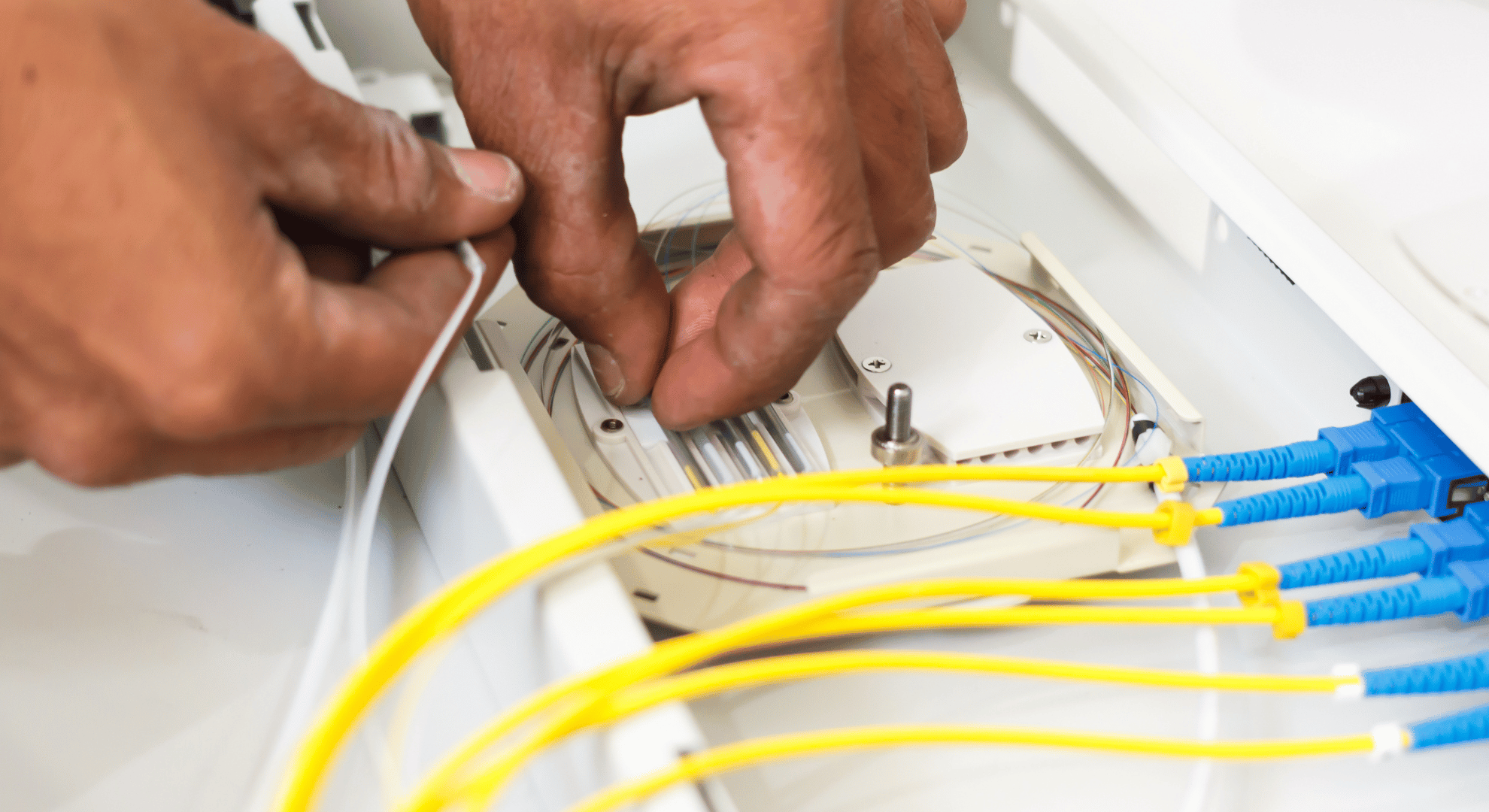
Fiber optic splicing technician skills also cover the parts that do not involve the machine. Sleeve placement, tray routing with correct bend radius, closure sealing, and slack management all determine whether a splice survives a winter. Splice loss estimates from the fusion splicer are useful for workflow, but they are estimates, and OTDR verification remains the accepted evidence.
- Electrode cleaning and arc calibration on schedule, not when losses drift
- Cleaver blade rotation and replacement tracking
- Correct handling of ribbon versus loose tube, and of 200 µm versus 250 µm coated fiber
End Face Inspection and Cleaning
Contamination remains the most common preventable cause of link failure, and it is invisible without magnification. A connector that looks spotless can carry a film of oil that scatters light the moment it mates under power, driving insertion loss up and return loss down. The industry reference for grading is IEC 61300-3-35, which defines pass and fail criteria by zone and defect type.
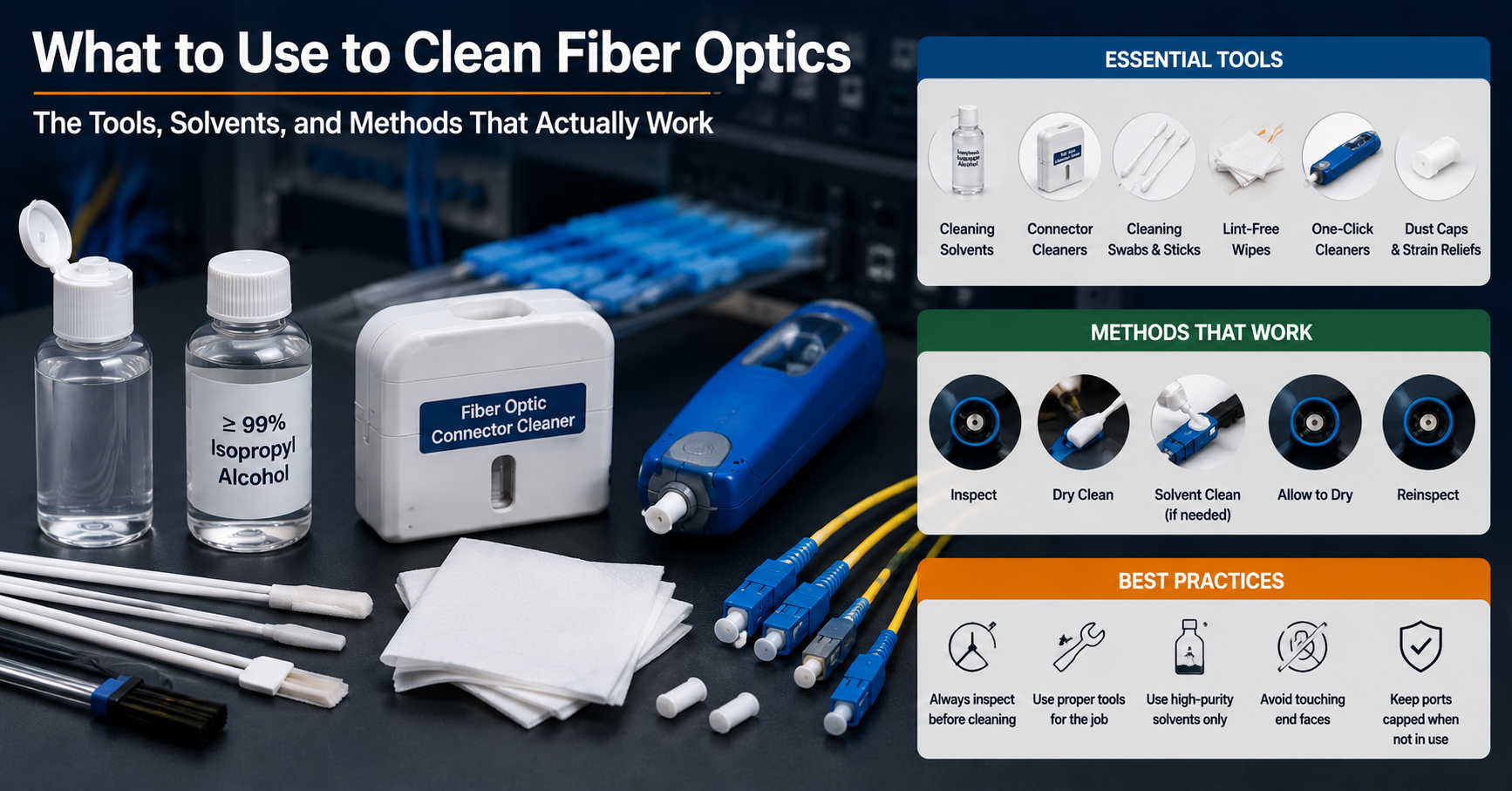
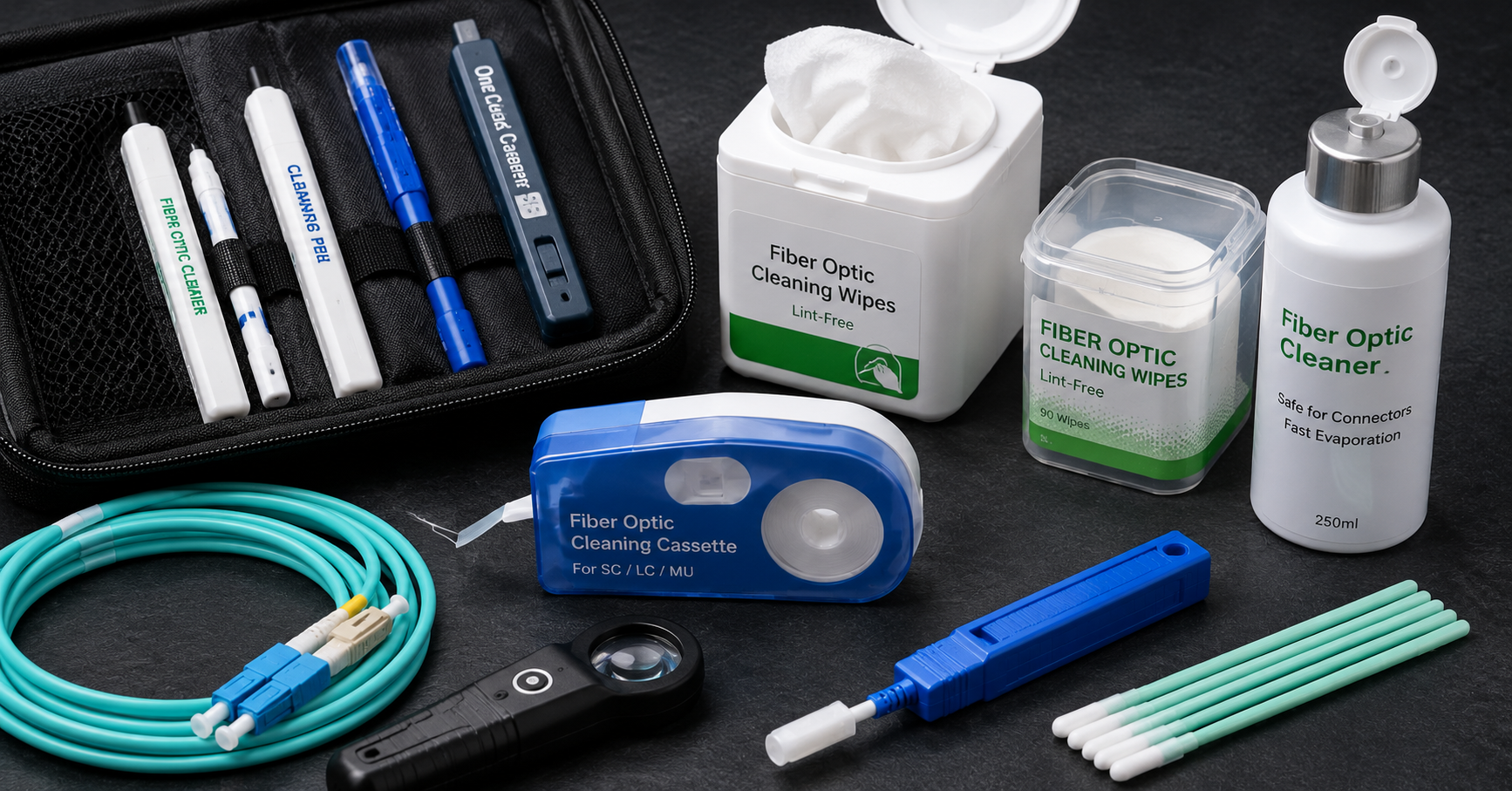
The professional habit is a loop rather than a single step: inspect, clean if it fails, re-inspect, then connect. That loop needs two things in the kit, a probe or microscope for grading and the right fiber optic cleaning tools for the contaminant in front of you. Dry mechanical cleaners lift particulates; oils and fingerprints need a wet-then-dry pass, because dry media alone tends to smear them.
- Dry cleaning first for dust and loose debris
- Wet-then-dry with optical-grade fluid for films and fingerprints
- Never inspect a live fiber without confirming the link is dark
- Re-inspect after every clean, without exception
OTDR and Optical Loss Testing
Optical loss testing with a light source and power meter answers the question the customer actually asked: how much light survives end to end. OTDR testing answers a different question, which is where the loss lives along the span. Confusing the two is one of the fastest ways for a technician to fail a skills check.
Reading a trace well is a learned skill that takes months of repetition. Pulse width, range, and averaging time all change what the instrument can resolve, and a dead zone can hide an event entirely if the settings are wrong. Bidirectional averaging exists because a splice between fibers of slightly different mode field diameter can show apparent gain in one direction, which is an artifact rather than a fault.
- Set a reference correctly, then verify the test cords before testing the link
- Match pulse width to span length and event spacing
- Test bidirectionally where acceptance criteria are tight, and export traces in the format the customer specified
Documentation and Standards Literacy
Documentation has quietly become one of the most valuable fiber optic technician skills and responsibilities on a modern crew. Acceptance packages now travel to the operator as structured files with per-fiber results, and a technician who mislabels ports creates a problem that surfaces months later during a restoration. Contractors have started scoring documentation during bench tests for exactly this reason.
Standards literacy sits alongside it. Knowing which specification governs a task, and where the numbers come from, separates a technician who follows instructions from one who can defend a result to an inspector. The commonly referenced documents include IEC 61300-3-35 for end face grading, the ANSI/TIA-568 series for structured cabling performance, and IEC 61280-4 series methods for attenuation measurement.
- Consistent naming for cables, ports, trays, and splice points
- Photographs of closures and enclosures before sealing
- Loss budget calculated before testing, and test results tied to a specific fiber, wavelength, and direction
Safety and Site Discipline
Safety credentials are a hard gate on most contracts, not a preference. Aerial lift operation, confined space entry, traffic control, and fall protection each carry their own training requirements, and a missing card can keep an otherwise capable technician off site entirely. Optical safety adds a layer that other trades do not deal with, because infrared light at telecom wavelengths is invisible and can be present at damaging power levels.
Housekeeping matters more than new technicians expect. Fiber scraps are a genuine hazard, they are nearly invisible on light surfaces and they embed in skin easily, so disciplined scrap disposal is a habit contractors watch for during a trial shift. Employers frequently reference OSHA construction training as a baseline for field crews.
- Never look into a fiber end or connector port without confirming it is dark
- Use a scrap container, work over a dark mat, and dispose of cleave offcuts immediately
- Verify lift, ladder, and trenching qualifications before the job, not on the morning of
Certifications That Move a Resume
Certification does not replace field time, but it shortens the trust gap for a contractor who has never seen you work. The most widely recognized fiber credential is issued by the Fiber Optic Association, whose CFOT designation covers the fundamentals, with specialist tracks such as CFOS/S for splicing, CFOS/T for testing, and CFOS/O for outside plant. Employers also recognize BICSI and ETA International credentials, and many operators run their own internal qualification on top.
Manufacturer training carries weight in specific situations. A crew standardized on one splicer platform values documented training on that platform, and an operator with a PON footprint values PON-specific testing experience. Fiber optic training programs delivered through community colleges, union apprenticeships, and state workforce boards remain a practical entry route, and several are funded rather than self-paid.
- Entry: FOA CFOT, BICSI Installer 1 and 2, ETA Fiber Optics Installer
- Specialist: splicing, testing, outside plant, and FTTH tracks
- Adjacent: OSHA 10 or 30, aerial lift, confined space, first aid and CPR
- Vendor: splicer and OTDR platform training tied to the fleet you will use
How a Fiber Optic Technician Skills Assessment Usually Works
A fiber optic technician skills assessment is typically a timed practical exercise rather than a written exam. Candidates are given a prepared cable, a splicer, a cleaver, an inspection probe, and a test set, then asked to produce a working, documented link within a set window. Scoring covers loss values, end face grades, tidiness, and whether the paperwork matches what is physically in the tray.
Where candidates lose points is predictable. Rushing the strip and cleave, skipping inspection because the connector "looks fine," and leaving the documentation until last are the three most common failures assessors report informally. Fiber optic technician skills and abilities are judged on repeatability here, so three consistent splices beat one excellent splice and two poor ones.
Common assessment tasks include:
- Strip, clean, cleave, and fusion splice a set number of fibers to a stated loss ceiling
- Terminate connectors and present them for end face grading
- Inspect and clean a deliberately contaminated connector until it passes
- Reference a test set, then measure insertion loss in both directions
- Shoot an OTDR trace and identify each event on it
- Produce a labeled results file and an as-built sketch, matching what is in the tray
Practicing the inspection step is cheap, and it is the step candidates most often neglect. Access to fiber end face inspection equipment during training is what turns "it looks clean" into a graded call a technician can defend.
Building Fiber Optic Technician Skills From Scratch
Entry into the trade rarely starts with splicing. Most technicians begin on placement crews, pulling and lashing cable, learning route conditions and closure locations before they ever touch a fusion splicer. That grounding is useful, because a technician who understands how a span was built diagnoses it faster when it breaks.
Progression follows the equipment. Cleaning and inspection come first because they are low-risk and high-value, then termination, then splicing, then testing and fault location with an OTDR tester once someone can already interpret a clean baseline. The order matters, since testing without inspection discipline produces numbers nobody trusts.
- Months 0 to 3: cable handling, safety cards, cleaning and inspection, basic termination
- Months 3 to 9: fusion splicing volume, closure work, tray routing, splice logs
- Months 9 to 18: loss testing, OTDR interpretation, fault location, acceptance packages
- Year 2 and beyond: specialist tracks such as PON, MPO and data center, or restoration lead
The Soft Skills Contractors Quietly Weigh
Reliability outranks raw technical talent on most crews. A technician who arrives on time with a charged splicer, a stocked consumables bag, and calibrated test gear costs the contractor nothing in lost hours, and that predictability is worth more than a slightly better average splice loss. Foremen tend to describe this as being "easy to schedule."
Communication carries the rest. Fiber work is inherently two-ended, so a technician who reports clearly over radio or phone during loss testing halves the time a test takes, and one who writes a legible closure note saves the next crew an hour of guessing. Customer-facing work in FTTH adds another layer, because a subscriber turn-up is often the only time a network operator's brand meets a human being.
- Show up with consumables, spare electrodes, blades, and charged batteries
- Flag a marginal result immediately rather than hoping it passes acceptance
- Leave the site cleaner than the previous crew did
Where the Trade Is Heading
Density is the main change. MPO and multi-fiber connectivity have pushed inspection and cleaning from a good habit to a hard requirement, because a single contaminated fiber in a twelve-fiber array fails the whole trunk. Technicians comfortable with multi-fiber work sit in a smaller pool than the job postings suggest.
Automation is changing the paperwork rather than the craft. Test sets now grade end faces automatically against IEC zones and export acceptance data directly, which raises the floor on consistency and removes the excuse of a subjective judgment call. The fiber optic skills that stay valuable are the ones a machine cannot do: preparation, diagnosis, and deciding what a strange trace actually means.
Ready to Build a Sharper Bench?
If you are training technicians or upgrading a crew's kit, start with the two habits that fail assessments most often: inspection and cleaning. Standardize the loop, put a graded probe and a matched cleaning kit in every bag, and the rest of the workflow gets easier to teach.
If you are the one being assessed, practice the same loop before your next interview. Rehearse a contaminated connector until you can bring it to a pass consistently, then shoot and explain your own OTDR trace out loud. Contractors hire the technician who can show the work, not the one who says it usually goes fine.
Frequently Asked Questions
What is a fiber optic technician responsible for day to day?
A fiber optic technician installs, splices, terminates, tests, and repairs optical fiber links and their connectivity. Daily work usually mixes physical tasks such as cable placement and closure work with instrument-based tasks such as insertion loss testing and OTDR verification. Documentation is part of the same shift rather than an afterthought, since acceptance data is what closes out a job.
What are the most important Fiber Optic Technician Skills for getting hired?
The highest-weighted skills are fusion splicing, connector termination, end face inspection and cleaning, optical loss testing, and OTDR interpretation. Contractors verify these through a practical bench test rather than a written quiz. Consistency across several attempts matters more than one exceptional result.
Do you need a degree to work in fiber optic technician jobs?
No. Telecommunications technicians typically need at least a high school diploma or equivalent to enter the occupation, though employers may prefer candidates who have a certificate or associate's degree, and these workers also receive on-the-job training. Certification plus documented field hours usually carries more weight than academic credentials.
What certifications should a new technician get first?
Start with a recognized fundamentals certification such as the FOA CFOT, then add safety cards that the local contract requires, commonly OSHA construction training and aerial lift qualification. Specialist tracks in splicing, testing, or outside plant come later, once field hours support them. Vendor training on the specific splicer and OTDR platform your employer runs is worth arranging early.
Why is cleaning treated as a core skill rather than a chore?
Because contamination is the most frequent preventable cause of link loss and reflection, and it is invisible at the scale that matters. A few microns of debris on an end face can spike insertion loss and, under optical power, can pit the glass permanently. Cleaning is judged as a skill because the method has to match the contaminant, dry for particulates and wet-then-dry for films.
What separates fiber optic technician skills and responsibilities at a senior level?
Senior technicians own the outcome of a span rather than a task within it. That means calculating loss budgets before testing, deciding test parameters, interpreting ambiguous OTDR events, and signing off acceptance documentation. They also train newer technicians, which is where documentation and standards literacy become non-negotiable.
How do employers verify fiber optics technical skills before hiring?
Most use a timed practical assessment on their own equipment, scored on splice loss, end face grades, test accuracy, and documentation quality. Some add a trial period on a live crew, since site behavior and reliability are difficult to observe on a bench. References from a previous foreman are weighted heavily, because they speak to repeatability rather than a single good day.