


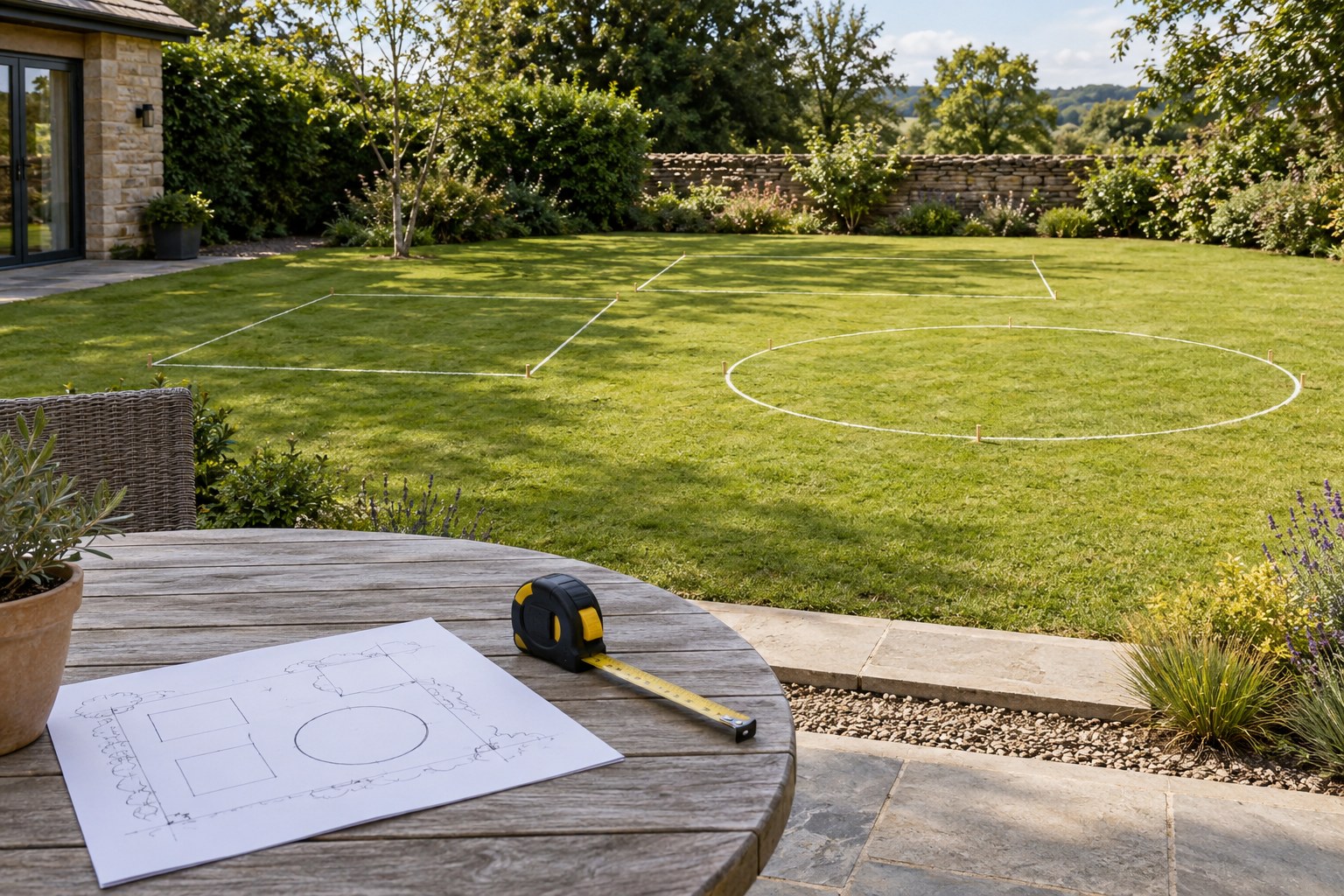
The shape that looks convenient in a catalogue may be unsuitable once a trampoline's full footprint and required clearances are drawn onto a garden plan. A useful round vs rectangular trampoline comparison begins with the available site, the intended users and the exact model instructions. Shape alone cannot establish safe use or suitable bounce behaviour.
Before comparing products, recognise the underlying risk. Health Canada's backyard trampoline guidance reports that Canadian paediatricians advise against recreational home use. For households that nevertheless choose a trampoline, neither an enclosure nor a particular frame shape removes the possibility of serious injury.
Measure the Usable Site Before the Jumping Bed
Draw the available ground area and mark fences, trees, buildings, paths and overhead obstructions. Consider where people need to walk while the equipment is in use. A trampoline that occupies the only route through the garden creates a different problem from one placed in an otherwise clear area.
Use the manufacturer's complete assembled dimensions, including relevant frame, enclosure and support projections. A product's advertised size may refer to a nominal category rather than every external dimension you need. For example, the QX-118G round trampoline listing identifies a round model, but a site decision still needs the exact supplied configuration and its installation instructions.
Confirm ground and anchoring requirements from that model's documentation. Do not assume that a visibly flat patch is suitable or that the enclosure poles represent the outer limit of the required space. If the instructions are unavailable, leave the site decision open.
Compare the Complete Clearance Envelope
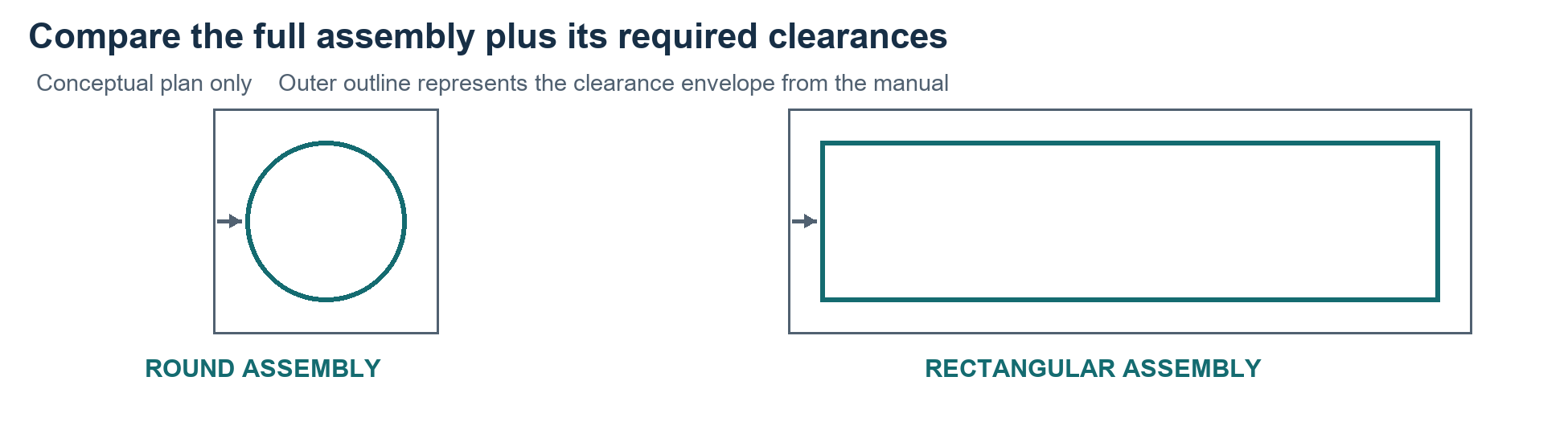
A rectangle can align with a long space, while a round frame may suit a more evenly proportioned area. That geometric difference is useful only after adding the required clearance on every side and checking overhead space. A frame that fits tightly between two obstacles has not passed that check.
For a simplified plan using equal clearance C on each side, a round assembly of diameter D needs a bounding area D plus 2C wide and deep. A rectangular assembly of width W and length L needs W plus 2C by L plus 2C. These are planning relationships, not recommended clearance values. Use the actual manual and applicable local guidance for the required distances.
Mark the resulting envelope on the ground before ordering. Include access for inspection and the route to the entrance. Look upwards from the planned location as well as across the ground; a clear lawn beneath overhanging branches is not a clear installation area.
Keep Bounce Claims Separate From Shape
Retail descriptions often associate round trampolines with family recreation and rectangular models with training. Those descriptions do not establish what a particular bed feels like or which activity the manufacturer permits. Spring design, mat construction, dimensions and user characteristics all influence the experience.
If the purpose is coached sport, use equipment and facilities appropriate to that activity with qualified instruction. Do not treat a recreational rectangular model as authorisation to practise flips at home. The US Consumer Product Safety Commission's trampoline safety guidance advises against somersaults because of the risk of serious head and neck injury.
For home recreation, assess the exact model's instructions and limitations rather than buying additional apparent performance. A weight limit is not permission for several jumpers at once. An enclosure may help address falls from the equipment, but it does not prevent collisions or every injury on the mat.
Check the Enclosure and Maintenance Requirements
Review how the enclosure attaches, how its entrance closes and how exposed springs and frame areas are protected. Ask for the supplied manual and replacement-part information. A photograph of a completed enclosure cannot demonstrate that every supplied component meets a particular safety standard.
The CPSC advises one jumper at a time and says children younger than six should not use a full-size trampoline. Keep supervision and the manufacturer's restrictions part of the decision. Do not assume a round mat provides reliable separation between users or that a net makes simultaneous jumping acceptable.
Inspect the mat, padding, enclosure, frame and connections as the instructions require. Stop use when damage or missing components create an unsafe condition. Consider how the equipment will be secured or taken out of service during unsuitable weather. A convenient shape does not reduce the need to maintain it.
Ask for Evidence Before Choosing a Model
Prepare a short request containing the measured site, intended use and information still missing. Ask for exact assembled dimensions, clearances, permitted users, installation requirements and relevant test documentation for the specific model. A generic certificate image or a broad catalogue claim needs a clear connection to the supplied equipment before it can support a decision.
When reviewing options from Qixin Amusement or another equipment supplier, compare the answers against the same site plan. Do not accept a larger model simply because its nominal size sounds close to the space available. The complete envelope has to work.
Include ongoing inspection and replacement parts in the comparison. If neither a round nor a rectangular model meets the location and supervision requirements, choosing a different activity or a suitable supervised facility is a valid outcome. The comparison does not have to end with a purchase.
Conclusion
Choose between round and rectangular trampolines only after the site, instructions and intended use have been checked. Draw the complete assembly and clearance envelope, then compare exact models within it. If a safe, maintainable arrangement cannot be established, the available space is unsuitable regardless of frame shape.
FAQ
Is a round trampoline automatically safer?
No. Frame shape alone does not establish safety. Equipment condition, installation, permitted activity and user behaviour remain important, and serious injuries can occur on either shape.
Can a rectangular model fit better in a narrow garden?
Possibly, but compare the assembled width plus required clearances with the usable space. A narrow mat is insufficient evidence that the whole installation fits.
Does an enclosure allow several children to jump together?
No. CPSC guidance recommends one jumper at a time. An enclosure does not prevent collisions between users or eliminate injuries occurring on the mat.
Should the largest available model be the default choice?
No. Select only a model that meets the site, user and maintenance requirements. Extra jumping area does not compensate for inadequate clearance or an unsuitable location.