





Acoustic wall panels are easier to specify when you know which sound path you want to change. In a small stereo listening room or home studio, first reflection points help identify surfaces that send early reflected sound from the speakers towards the listening position. Marking them before ordering panels turns a decorative layout into a more useful acoustic plan.
The marks are a starting point rather than a complete room diagnosis. They describe a relationship between speakers, surfaces and listeners. They do not, by themselves, identify every bass problem or establish how much absorption a particular panel provides.
Fix the Listening Arrangement Before Marking the Walls
Record where the speakers and main listening position will normally sit. Check left and right geometry, speaker orientation and ear height before tracing reflections. If the desk moves substantially after installation, the useful treatment locations may also change.
Genelec's monitor-placement guidance explains how nearby surfaces influence reproduction and why left-right symmetry matters. It also distinguishes reflection behaviour from room resonances. Use that distinction to set a practical objective: improving a stable listening area is a different task from trying to solve every low-frequency peak with wall decoration.
Draw a simple top view and note the surfaces that differ on the two sides, such as a window, open doorway or large cabinet. Perfect symmetry may be impossible, but documenting the differences helps explain why equal-looking panel arrangements may not produce equivalent acoustic conditions.
Map Both Speakers on Both Side Walls
Sit in the normal listening position and ask a helper to hold a small mirror against a side wall at a suitable height. As the helper moves it along the surface, mark the positions where each speaker becomes visible in the mirror. Repeat on the other wall. The reflected sightline is a practical approximation for locating the corresponding sound path at middle and high frequencies.
Check both speakers on each wall rather than finding one convenient mark and assuming the job is complete. Identify which speaker produced each mark. A quick note such as left speaker to right wall is more useful later than several pieces of tape with no explanation.
Repeat the check across the small range of positions your head normally occupies. If more than one seat matters, assess those listening positions too. The resulting area is a treatment zone, not a promise that a tiny patch at one geometrical point will control the relevant reflections for everyone.
Add the Surfaces a Side Wall Test Misses
Look for other short reflection paths, including a desk, ceiling or nearby hard surface. A wall-only sketch can overlook a large reflective desktop between the speakers and listener. Note whether changing an object or adjusting the listening arrangement could reduce a problem before adding material.
The mirror principle can inform a ceiling plan, but marking it should not require balancing on furniture or improvising overhead installation. Use a safe measurement method or competent help. Any suspended treatment needs appropriate fixings and a mounting arrangement suited to the building and product.
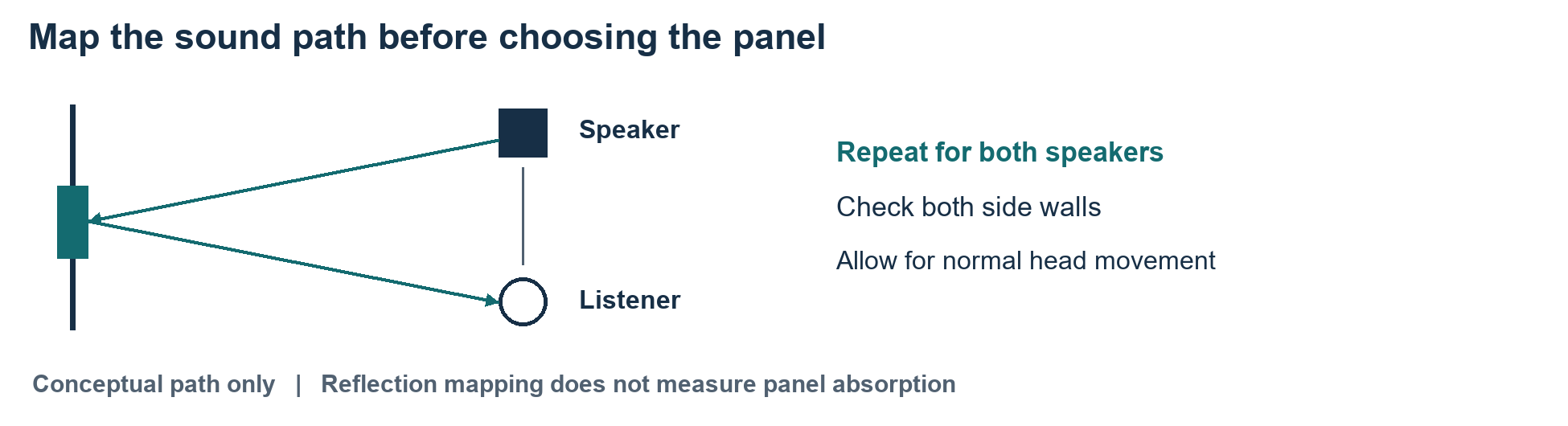
Keep the plan readable by recording one surface at a time. For each zone, note the speaker, listening area, physical obstruction and feasible coverage. This creates a useful brief even when a professional later performs a more detailed acoustic assessment.
Choose Panels From Frequency Data and Mounting Details
A wood slat surface, felt backing and deeper absorber can behave differently from a bare decorative panel. The acoustic wood veneer slat panel construction shows why material layers and thickness belong in a specification. The listed construction alone does not establish broadband performance at a reflection zone.
Request absorption data for the exact assembly and installation arrangement. Check whether reported results used direct wall mounting, an air space or added material behind the panel. Compare frequency-dependent results rather than assuming that one headline rating describes the whole audible range. Obtain clarification if the proposed installation differs from the tested one.
When considering products from Akupaneldecor or another supplier, include the reflection-zone dimensions and mounting constraints in the enquiry. Ask what evidence supports the intended application. Absorbing sound within a room should also be distinguished from isolating sound between rooms; a decorative acoustic panel is not proof of sound isolation.
Evaluate One Change With a Repeatable Comparison
Keep speakers, listening position, playback level and programme material consistent. Listen for changes in clarity and centre-image stability. Change one relevant variable at a time so the result is easier to interpret.
Use consistent microphone positions and procedures where measurement is available. Timing information can help investigate early arrivals. A mirror mark alone cannot quantify reflection strength or predict a panel's benefit.
Record the layout, coverage and observations. If uneven bass remains the main concern, revisit speaker and listener positions and seek suitable low-frequency treatment or professional advice. Expanding a thin wall covering may leave that problem unresolved.
Conclusion
Map reflection zones after settling the listening arrangement, then request evidence for the proposed panel assembly. A labelled sketch of speakers, surfaces and the normal listening area gives material and mounting discussions a clear purpose.
FAQ
Is there only one first reflection point on each wall?
Not necessarily. Both speakers can create relevant paths to a listener through the same wall, and different listening positions produce different marks. Plan for the listening area you actually use.
Does the mirror test locate bass traps?
It is mainly a geometric aid for reflection paths, particularly at middle and high frequencies. Low-frequency room behaviour needs a broader assessment; the mirror marks do not map every bass problem.
Can any wood slat panel treat these zones?
Do not assume so. Review absorption data for the exact construction, coverage and mounting arrangement. Appearance and material names alone are insufficient evidence of suitable performance.
Will acoustic panels stop sound reaching another room?
Absorption and sound isolation are different tasks. Reducing reflections inside a room does not establish isolation through walls, doors or other paths. Assess the actual sound-transmission problem separately.



Buy best acoustic panels from SSJ Wallpaper at best price.
A wide variety of Acoustic Panels options are available - Decorative acoustic wall panels,acoustic wood panels ,soundproof acoustic panels, white acoustic panels etc at cheap price.
Visit our website for more details
