





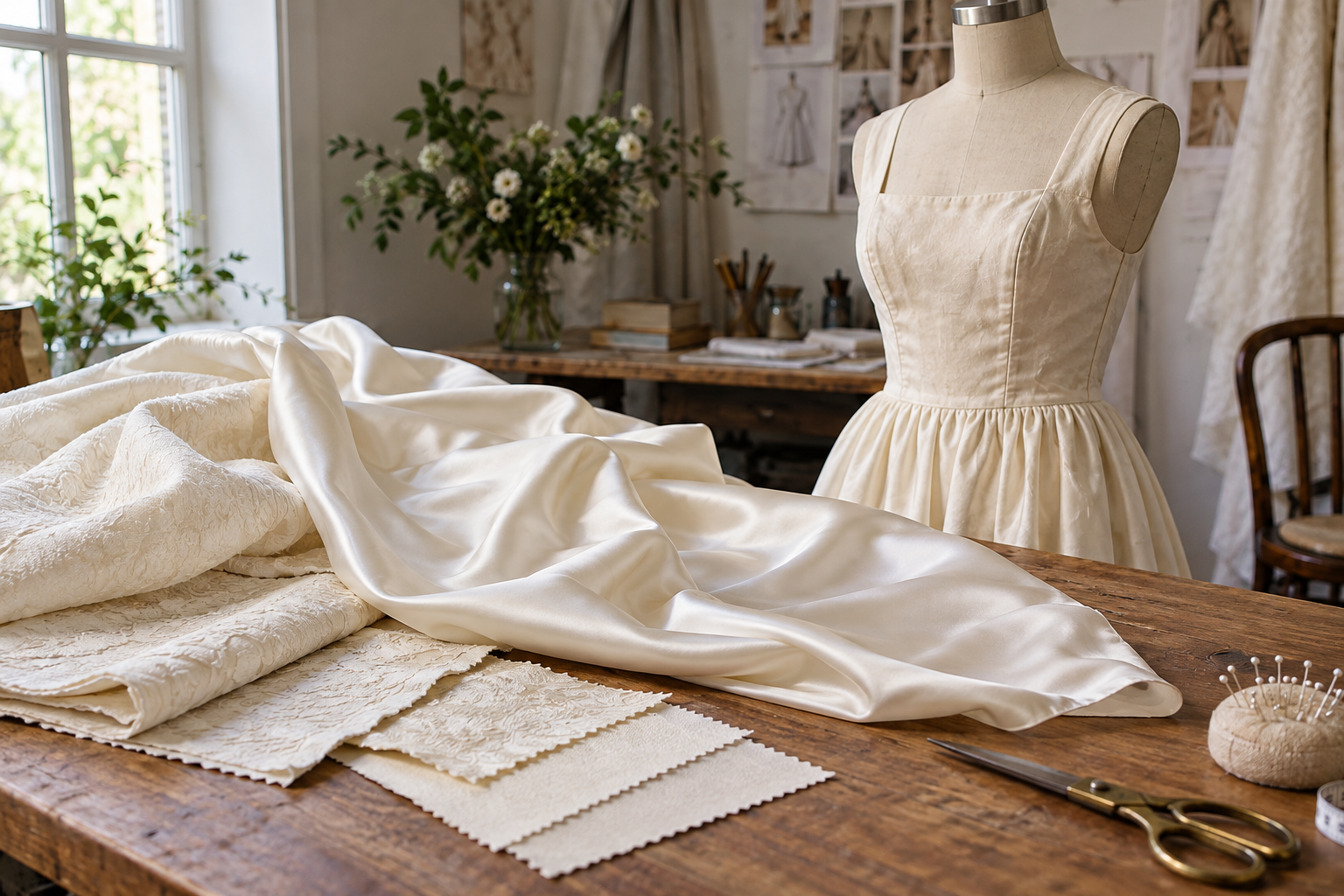
A lining can look ideal on a supplier's card and still change how a dress moves. It may pull against a stretchy shell, show through a pale fabric or shrink differently after cleaning. Choosing dress lining fabric therefore works best as a small sampling exercise that examines the finished garment's behaviour.
The first decision is what the lining must do. A formal dress may need a smooth interior and discreet coverage; a fitted everyday dress may also need stretch and straightforward care. Define those requirements before choosing a fibre or ordering bulk fabric.
Separate Lining From Structural Support
A lining generally forms an interior layer assembled separately from the outer dress. Underlining is handled with the shell as a combined layer and can change its body or opacity. Interfacing reinforces selected areas. These distinctions appear in New Mexico State University's guidance on garment support materials and help prevent the wrong solution being specified.
If a skirt needs more structure, a slippery lining alone may not produce the intended silhouette. If a sheer shell needs extra coverage, compare an independently hung lining with a suitable underlining sample. The position and attachment of the added layer affect the result, even when the fabric itself is unchanged.
Write the construction intention into the sample request. Specify whether the interior should hang freely at the hem, be attached at selected seams or follow another documented method. A fabric choice cannot be assessed fully while the person sewing the sample is left to guess its role.
Compare Fabric Properties Rather Than Names Alone
Fibre content is useful, but it does not describe the complete fabric. Weight, weave or knit construction, finish and stretch all affect handling. Satin describes a structure, not one particular fibre, so asking only for a satin lining leaves important choices unresolved.
Handle the shell and candidate lining together. Let them hang over a curved support, gather them gently and inspect how the layers fall. Compare whether the lining dominates a light shell, clings to it or creates visible ridges. The goal is a compatible combination rather than a lining that feels luxurious in isolation.
For a stretch dress, assess the lining in the directions the garment needs to move. A lining with insufficient extension can restrict a shell that otherwise fits comfortably. An elastic waistband does not establish that the rest of the lining can accommodate sitting, walking or reaching.
Make a Sample That Answers the Difficult Questions
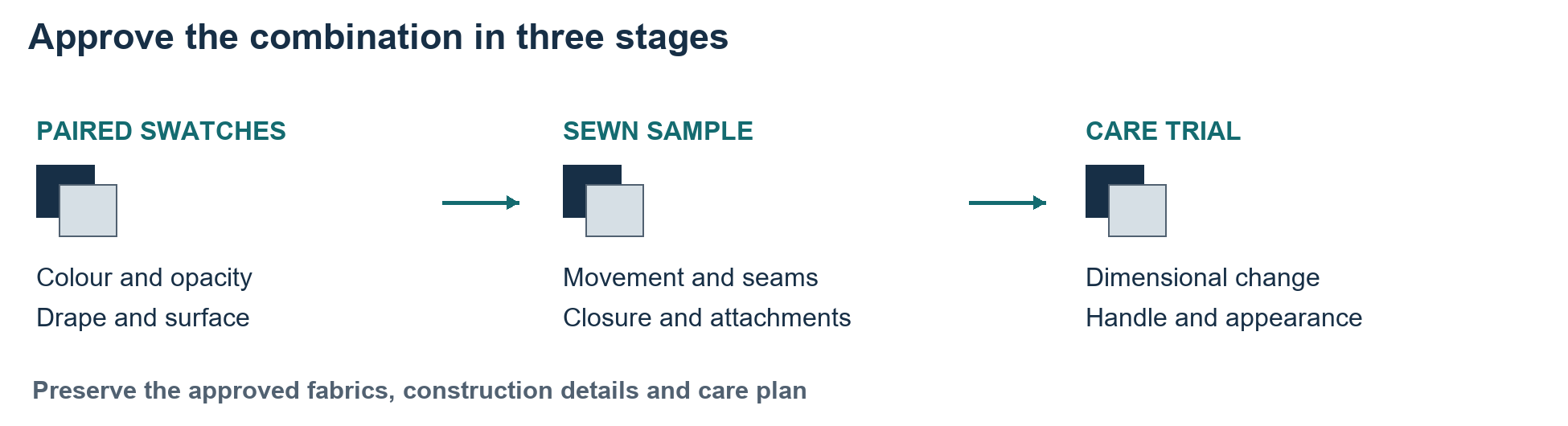
Begin with layered swatches for colour, opacity and surface compatibility. Check the combination in daylight and under the lighting relevant to the dress. A lining close to the shell colour is a candidate, not an automatic answer: contrast, seam allowances and the wearer's intended undergarments can alter what shows through.
Then make a wearable sample of the most demanding area. For a fitted style, this might include the bodice, hip and closure rather than an unshaped square of fabric. Include representative seams and attachments so the trial tests the planned construction as well as the materials.
Ask the wearer to sit, walk and raise their arms within normal use. Look for the lining holding the hem up, pulling at a closure or making the outer layer bunch. Record the movement and location of each problem. That makes the next sample request more useful than simply calling the lining uncomfortable.
Check Care Before Confirming the Pairing
Follow the proposed care method on representative materials before bulk approval. Measure and photograph samples consistently before and after the trial, allowing them to dry and settle as appropriate. Look for differential shrinkage, puckering, colour transfer and changes in handle. A home trial can identify concerns without becoming a formal laboratory performance claim.
The lining and shell need a compatible finished-garment care plan. Do not assume that a washable lining makes the entire dress washable, or that the shell's cleaning instructions cover every trim and interior component. Where performance claims or market requirements require formal testing, agree the method with an appropriate testing provider.
Check comfort in the context of intended wear. A brief fitting in an air-conditioned room does not answer every question about a summer dress or a garment worn for several hours. If the sample cannot reproduce those conditions, record the limitation instead of describing comfort as proven.
Turn the Approved Sample Into a Clear Production Brief
Record the approved lining's composition, construction, colour reference and supplier identification. Include the shell it was assessed with, the garment areas covered, attachment details and the agreed care plan. Keep an identifiable approved sample so a later substitution can be compared with the actual decision.
When discussing women's dress production and processing with a manufacturer, include these details alongside the outer fabric specification. A general request to add a lining leaves room for different interpretations of coverage, movement and finishing. A useful brief explains how the finished dress should behave.
For a discussion with Spruce Clothes or another apparel supplier, ask for substitutions to be flagged before production. A replacement fabric with the same fibre name may have a different weight or stretch. Review changes against the approved combination rather than accepting a matching label as sufficient evidence.
Conclusion
The best lining choice is the one that supports the particular dress through movement, wear and care. Start with paired swatches, test a representative sewn area and preserve the approved construction details. That process makes lining selection a repeatable decision rather than a guess based on fabric names.
FAQ
Should lining always match the shell colour?
No. Compare the layers in the intended garment and lighting. A close match may work well, but contrast and show-through can make another shade more suitable for the design.
Can a woven lining work in a stretch dress?
Possibly, depending on the pattern, ease and areas lined. Test the movement required. A lining that restricts the wearer needs a different material or construction, even if the shell stretches comfortably.
Will lining solve every transparency problem?
No. Coverage depends on both materials, their colours and the garment construction. Underlining or another design change may be appropriate; assess the alternatives in a representative sample.
Is a swatch test enough to approve production?
It is useful for initial screening. A wearable sample tests seams, attachments and movement that a flat swatch cannot show. The approval process should reflect the dress's actual risks and requirements.




They are generally considered acceptable by the music industry, but as a music teacher I have found it difficult for most adults and Oxford Polyester almost impossible for young students to play these guitars (this is also true for other entry and intermediate level instruments as well).
Above all else, make sure your guitar is properly adjusted, as this will greatly insure your interest and success on the guitar.With Either Type of String, Fingers Will Initially Become A Little Tender And Sore Initially, playing on either nylon or steel strings will make the fingertips a little tender and sore, but with a little time and practice will go away.Nylon strings are made of a softer, less dense material and are under less tension than steel strings.
As a result, they are slightly easier to push down, provided the instrument is properly adjusted.
Steel string guitars are under a higher amount of tension and therefore the strings are somewhat harder to push down than nylon strings, but the difference is not great as long as the guitars are correctly adjusted for easy playability.Strings Are Not Interchangeable Between Nylon and Steel String Guitars Whatever decision you make, remember that the two types of strings are not interchangeable on one guitar.
Steel string guitars are designed and manufactured for steel strings and will provide the most playability, intonation and sound when used with steel strings.
Steel strings on a nylon string guitar will damage the instrument because it is not designed or braced for higher tension strings.Nylon Strings May Need To Be Tuned More Frequently Nylon strings tend to go out of tune more easily due to temperature and humidity changes because they are made of a softer material.
